Product
Scaling Revenue Without Scaling Headcount: The Partner Model Explained

When growth slows, the default response is predictable. Hire more SDRs. Add more AEs. Increase outbound. Spend more on acquisition.
For a while, it works. Then costs climb faster than revenue, pipeline quality drops, and every new hire needs more support, more management, and more marketing just to hit quota.
"The companies pulling away from the pack aren't hiring more; they're growing through partners. Not because it's trendy. Because it creates leverage."
A great sales rep can only work so many opportunities. A strong partner ecosystem can create hundreds of opportunities your team would never have reached alone. That's the difference between adding capacity and creating scale.
A great sales rep can only work so many opportunities. A strong partner ecosystem can create hundreds of opportunities your team would never have reached alone. That's the difference between adding capacity and creating scale.
Why Headcount Stops Being the Answer
Every sales hire comes with hidden costs: ramp time, management, enablement, additional pipeline requirements, and more operational complexity. The maths eventually breaks.
The trust advantage
Your buyers already rely on agencies, consultants, systems integrators, accountants, and specialist service providers. Those relationships already exist. Those conversations are already happening. The question is simple: would you rather spend six months trying to get into an account, or work with someone already in the room?
That is the foundation of partner-led growth, and it's why more mature SaaS companies are rebuilding their go-to-market around it.
The Real Advantage of the Partner Model
Partnerships are often described as "just another channel." That undersells them considerably.
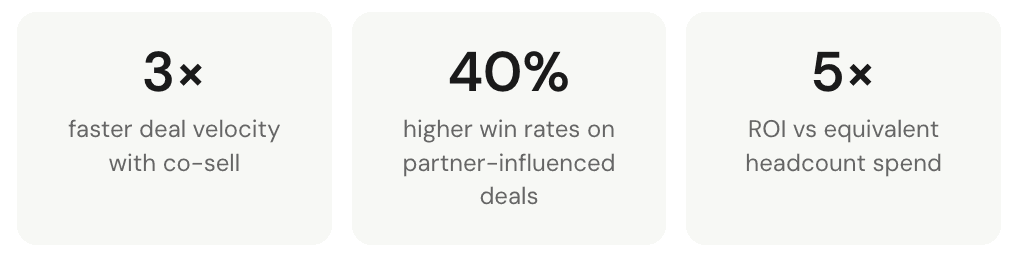
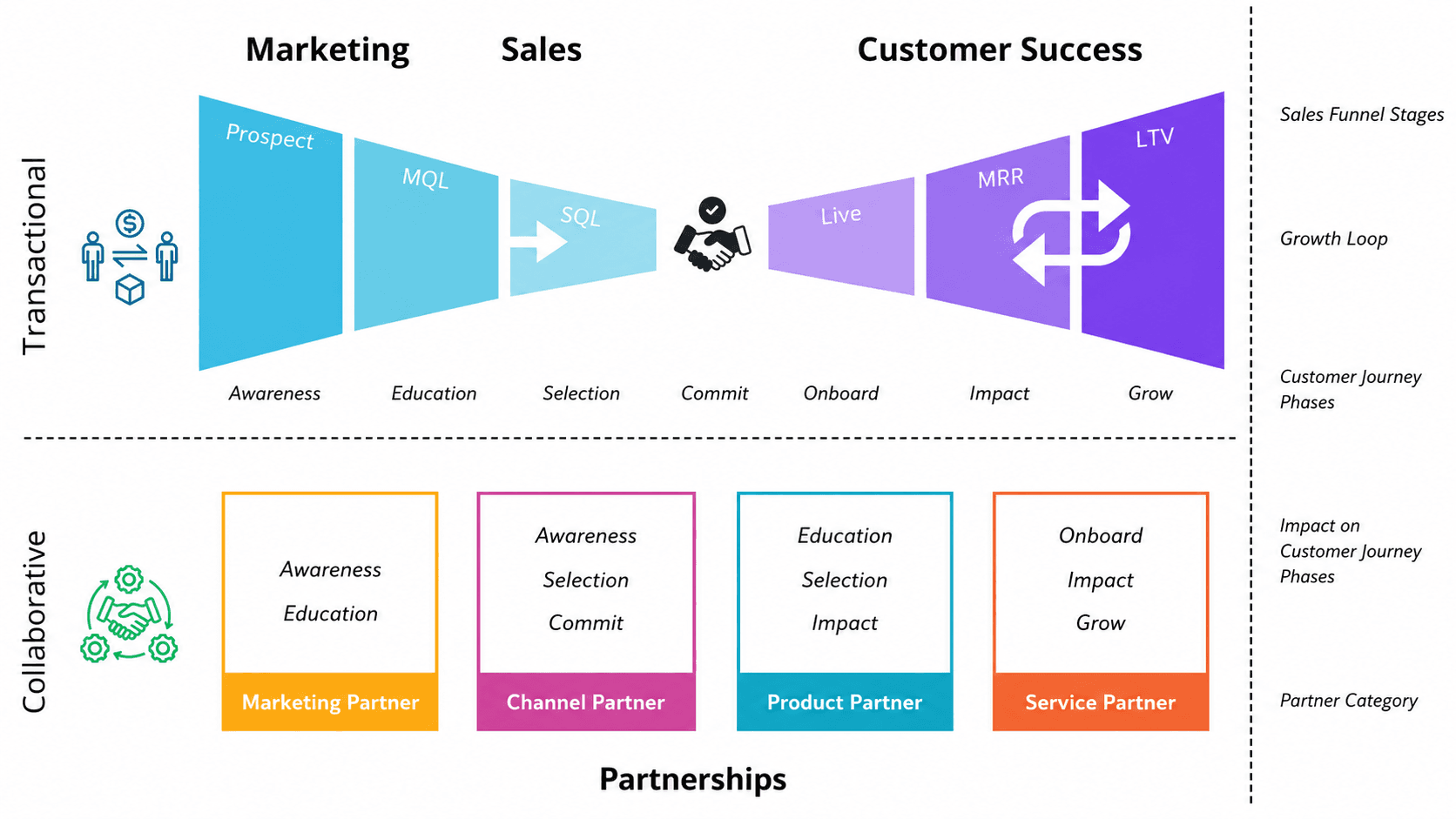
A good partner programme becomes a force multiplier across the entire revenue engine, helping create, accelerate, and close opportunities, and helping retain customers and expand accounts long after the contract is signed.
"The strongest partner ecosystems influence revenue long before a deal appears in CRM and long after the contract is signed."
That's why mature companies increasingly measure partner influence, not just partner sourcing. See our page on capturing, tracking and converting more partner referrals
The Five Partner Motions That Actually Scale
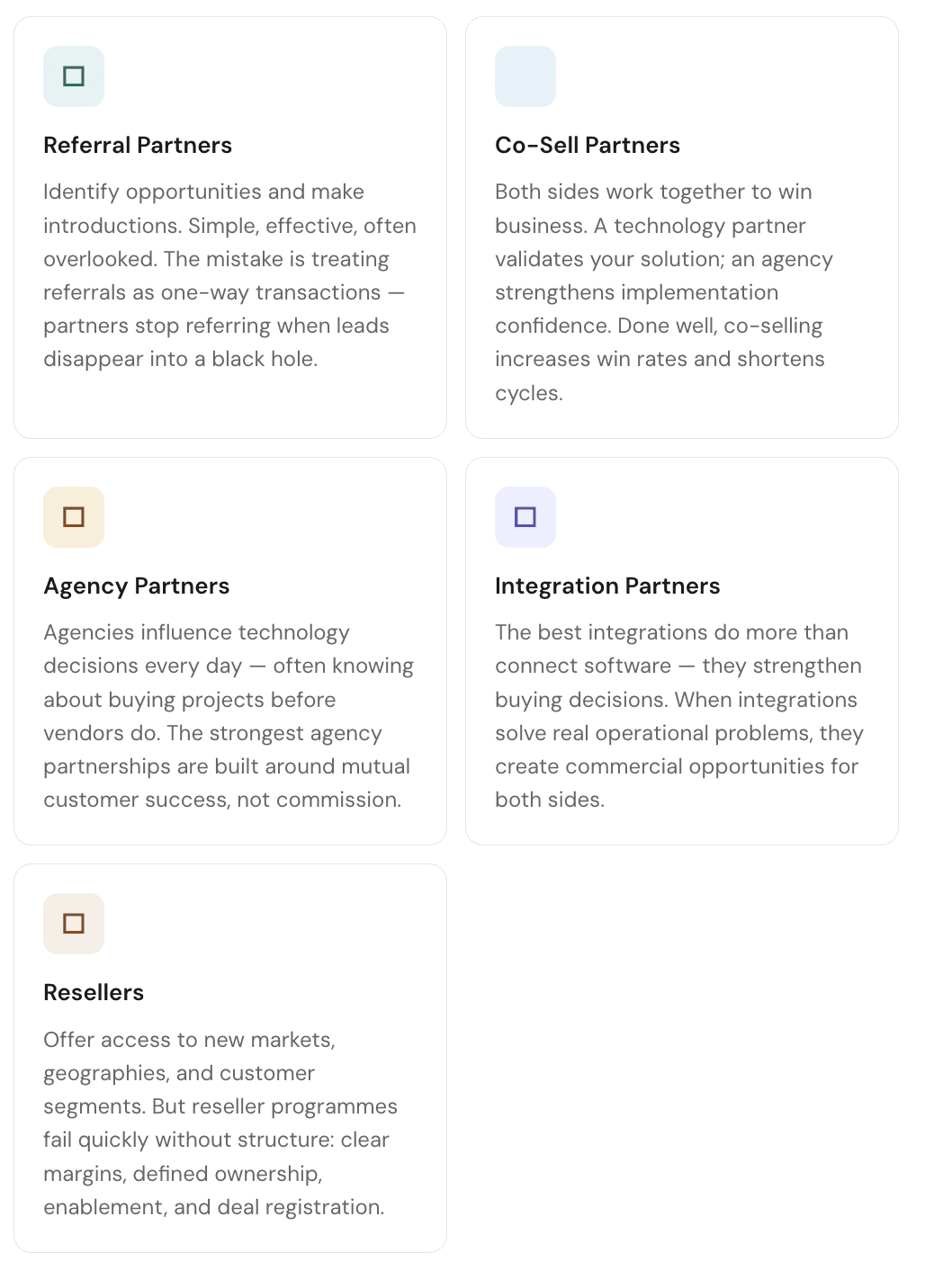
Not all partnerships create revenue equally. The best partner programmes focus on specific motions and build operational infrastructure around each one.
→ Related: Choose the right partner with Deal Surround
See how Partner.io tracks all five partner motions
Referral workflows, co-sell rooms, deal registration and attribution: all in one place.
Why Most Partner Programmes Stall
Most companies make the same mistake. They hire someone to run partnerships, then expect that person to build the entire ecosystem manually: recruiting, training, supporting sales, managing referrals, tracking attribution, handling commissions, and maintaining spreadsheets.
Nothing scales. Eventually, leadership concludes partnerships are underperforming. Usually the problem isn't the partnerships.
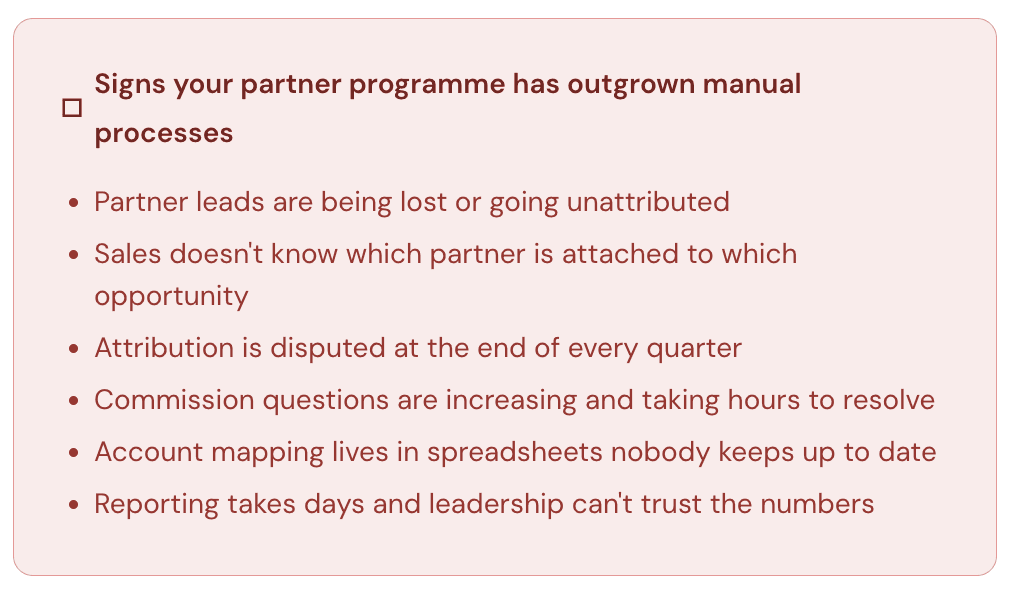
"Usually the problem isn't the partnerships. The problem is the operating model. Partnerships cannot become a revenue channel without systems."
Sales has CRM. Marketing has automation. Finance has ERP. Partnerships need operational infrastructure too, and that's exactly what Partner.io provides. See: How to Build Partnerships That Drive Consistent Growth in SaaS →
The Partner Revenue Engine: Five Stages
Find - Identify the right partners
Ignore logo collecting. Focus on influence. Who advises buyers? Who manages implementation? Who owns trusted relationships in your target accounts? Those are the partners that matter.
Align - Create a compelling reason to act
Commission is rarely enough. Agencies care about client outcomes. Consultants care about solving recurring problems. Technology partners care about adoption and retention. You must answer: what's in it for them?
Activate - Give partners a motion, not a welcome email
This is where most programmes fail. Partners join, everyone celebrates, and nothing happens. Strong activation includes target accounts, referral criteria, sales assets, demo environments, and clear deal registration.
Attach - Connect partners to revenue moments
Partners create value at sourcing, influencing, closing, implementing, expanding, and retaining. Attach partners to revenue moments - not just treat them as lead generators. That's where the biggest returns appear.
Measure - Make partner impact visible to leadership
Track partner-sourced pipeline, partner-influenced pipeline, win rates, deal velocity, and revenue by partner type. Measurement creates credibility. Credibility creates investment. Investment creates scale.
What This Looks Like In Practice
Case example: Finance SaaS
A SaaS company selling into finance teams noticed several deals involved the same finance transformation consultants; people already helping companies select and implement technology. Rather than recruiting generic partners, they built a focused consultant programme with shared account mapping, dedicated enablement, and deal collaboration visible inside CRM. Within months, consultant-attached opportunities were outperforming standard outbound. Not because the product changed. Because distribution changed.
Patterns Shared by High-Performing Partner Teams
They prioritise influence over volume
Five active partners outperform fifty inactive ones, every time. Large partner directories look impressive. Revenue does not come from directories; it comes from engagement. See: how to measure partner engagement scores →
They make sales teams better
The fastest way to kill a partner programme is creating friction for sales. Strong partner teams help sales close more business, providing introductions, context, relationships, credibility, and support. Sales should view partners as an advantage, not an obligation.
They separate sourced from influenced revenue
A partner who creates a deal is valuable. A partner who helps close a six-figure opportunity is equally valuable. The best teams track both.
They build around account mapping
Random referral requests produce random results. Account mapping creates focus when both sides know exactly where opportunities exist; partner activity becomes predictable rather than hopeful.
They automate the admin
No serious partner programme scales through spreadsheets. Not onboarding, attribution, deal registration, commissions, or co-sell motions. The more manual the process becomes, the less reliable the data and eventually nobody trusts the reporting.
Why Partner.io Fits Naturally Into This Model
Once partnerships start generating meaningful revenue, they need a system of record. That's exactly where Partner.io fits.
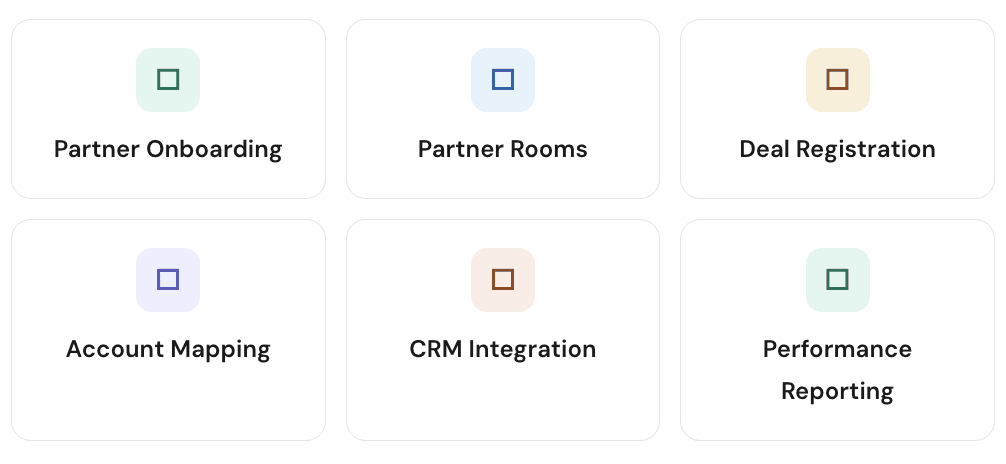
Everything sits in one place. Partners gain visibility. Sales gains clarity. Leadership gains reliable reporting. Most importantly, partner activity becomes operational rather than anecdotal because partnerships stop scaling when information lives in spreadsheets, Slack messages, and individual memories.
The companies still managing partner revenue through spreadsheets eventually hit a ceiling. The companies building operational partner ecosystems don't.
Ready To Scale Revenue Without Scaling Headcount?
The highest-performing partner programs are not built on more meetings, more spreadsheets, or more partner logos.
They are built on visibility, accountability, and repeatable partner motions.
If you're serious about growing partner revenue, improving partner attribution, and operationalising partner-led growth, Partner.io gives your team the infrastructure to do it.
Try Partner.io Free For 14 Days
See how modern partner teams manage onboarding, account mapping, co-selling, deal registration, partner rooms, and reporting from a single platform.