Product
Mantle Is Gone. Your Partner Revenue Still Needs a System.

Shopify absorbed Mantle's core reason to exist. But the problem Mantle never solved, partner revenue that starts outside your product, still needs infrastructure. Here is what comes next.
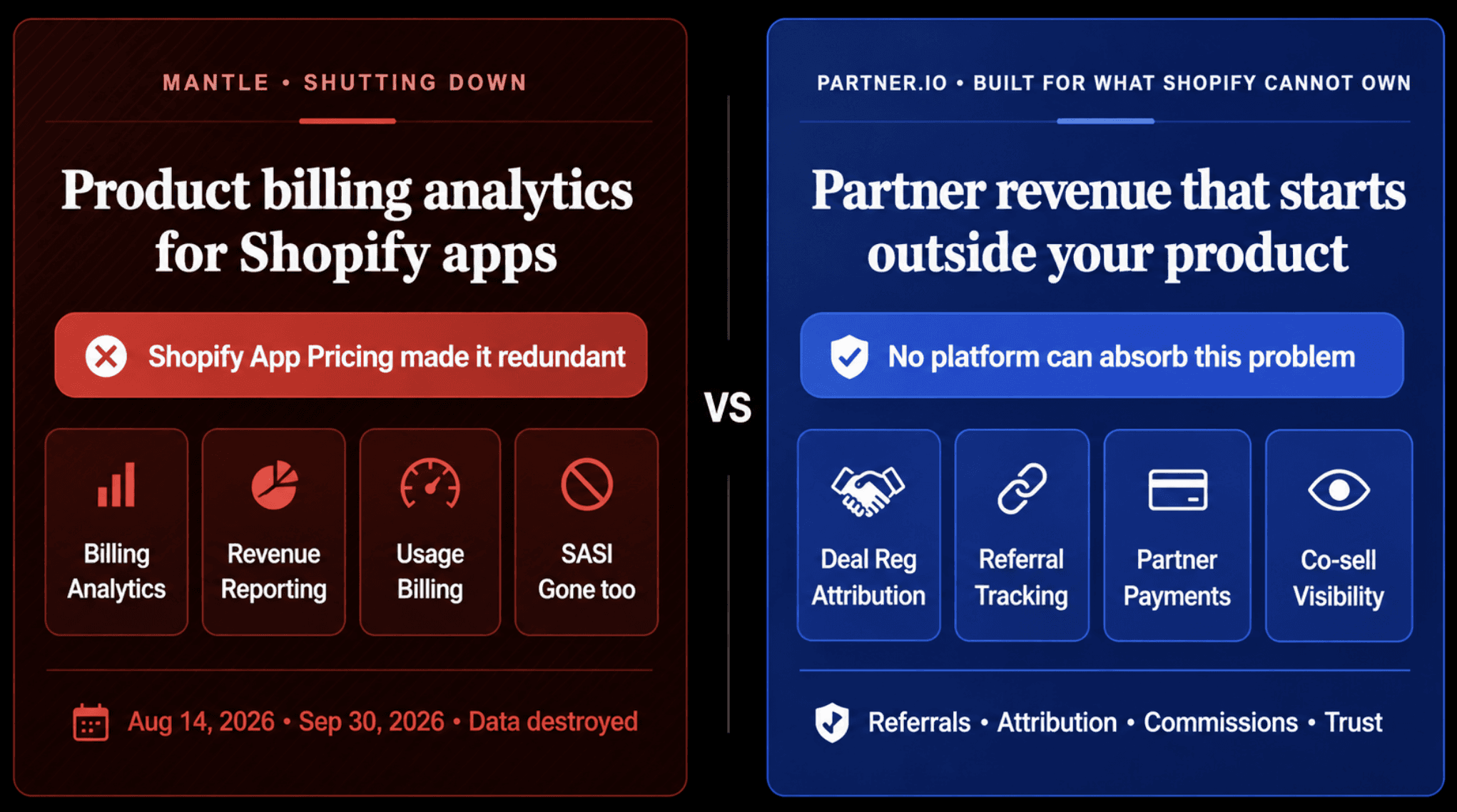
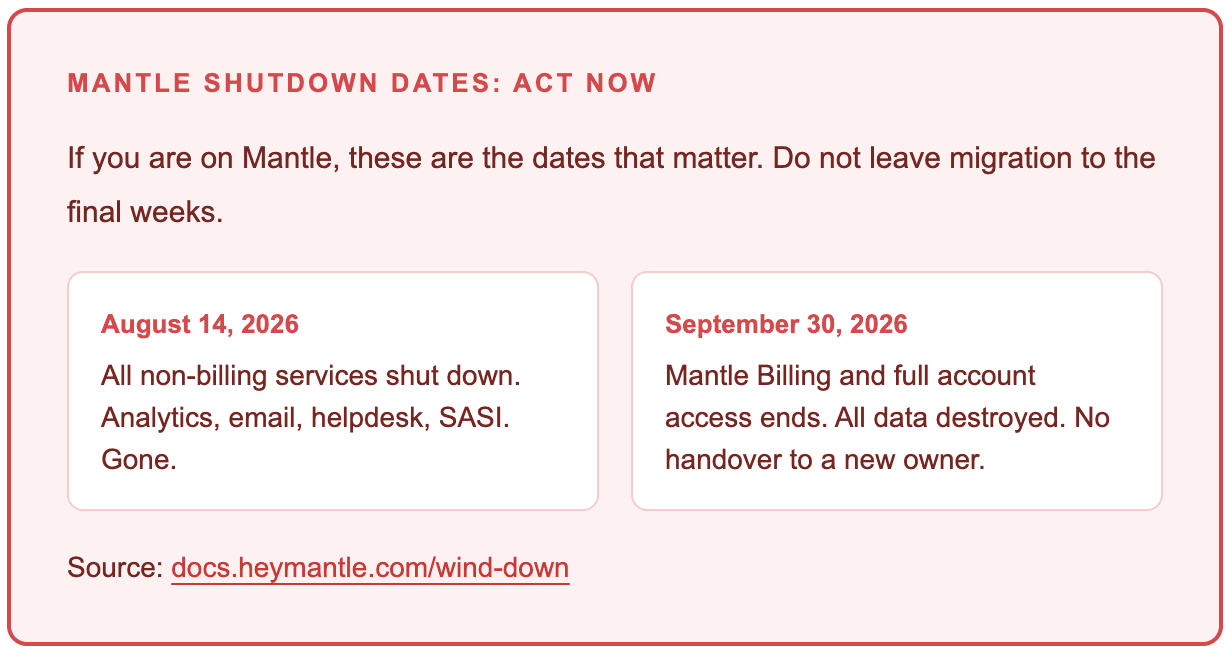
On June 16, 2026, Mantle told its customers it was winding down. No acquirer. No pivot. A complete shutdown, all data destroyed, all services off by September 30.
For Shopify app developers who relied on Mantle for billing, analytics, email, and support, this is an operational emergency. But there is a second story inside the shutdown that matters more for where you put your infrastructure bets next.
Mantle did not fail because it built bad software. It failed because Shopify absorbed the layer it was built on. When Shopify launched App Pricing in May 2026, native usage-based billing and clean revenue reporting became a configuration step in the Partner Dashboard. The engineering problem Mantle spent three years solving disappeared overnight.
That is platform risk in its sharpest form. And it carries a lesson that goes well beyond billing.

Why Shopify Ate Mantle's Business
Mantle was excellent at one specific thing: making Shopify billing data legible. Metered usage billing and turning raw charge data into clean revenue analytics were genuinely hard problems. Mantle solved them years before Shopify did. That was the moat.
Then Shopify made both things native. On May 12, 2026, Shopify App Pricing launched with built-in usage-based billing, the App Events API for per-action charging, and structured billing data directly in the Partner Dashboard. What once required a third-party platform became a configuration option.
When a platform absorbs the layer a company is built on, the company's product can be perfectly good and still lose its reason to exist. Mantle was not a bad product. It was a product whose core problem got solved by the platform it served. There is no defense against that unless you own something the platform genuinely cannot absorb.
This is the question every operator should be asking about every tool in their stack right now: does our core value sit on a layer that the platform underneath could make native? If yes, the clock is already running.
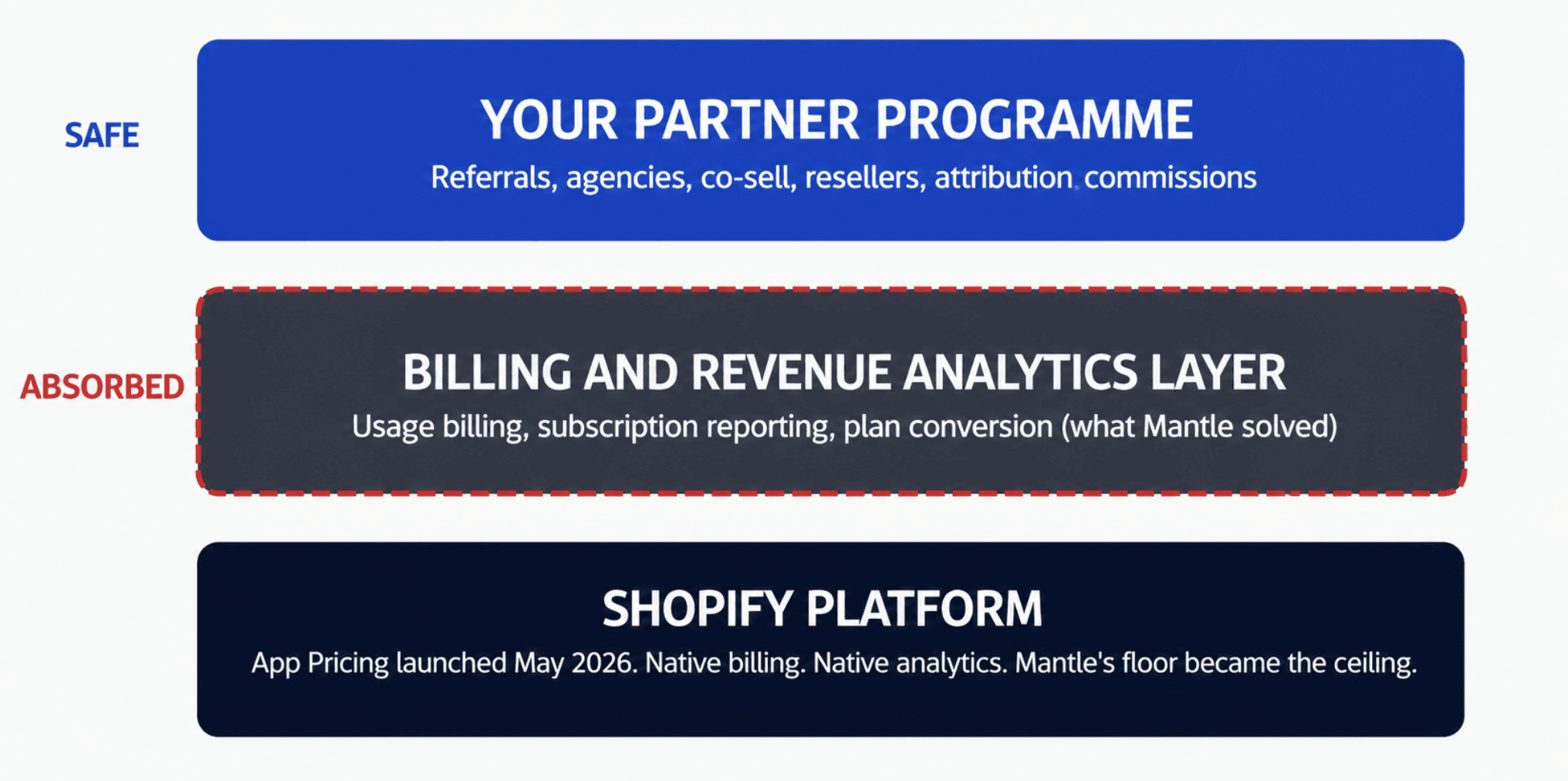
The layer Mantle owned is now a Shopify native feature. Partner revenue sits above the platform, which is exactly where it belongs.
What Mantle Never Solved, and Never Would Have
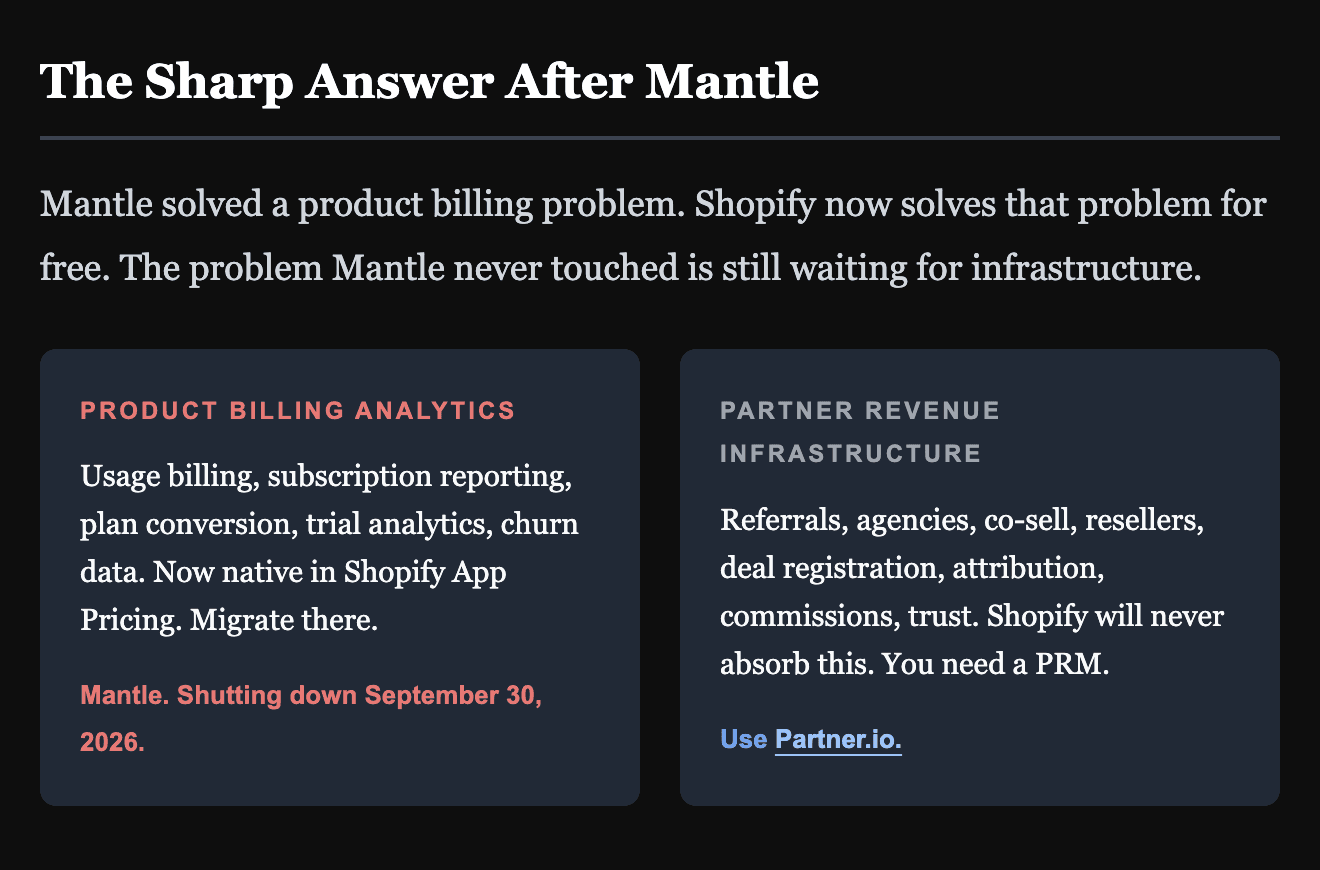
Even if Shopify had never launched App Pricing, Mantle was not built for partner revenue. It was built for product revenue. Those are not the same problem.
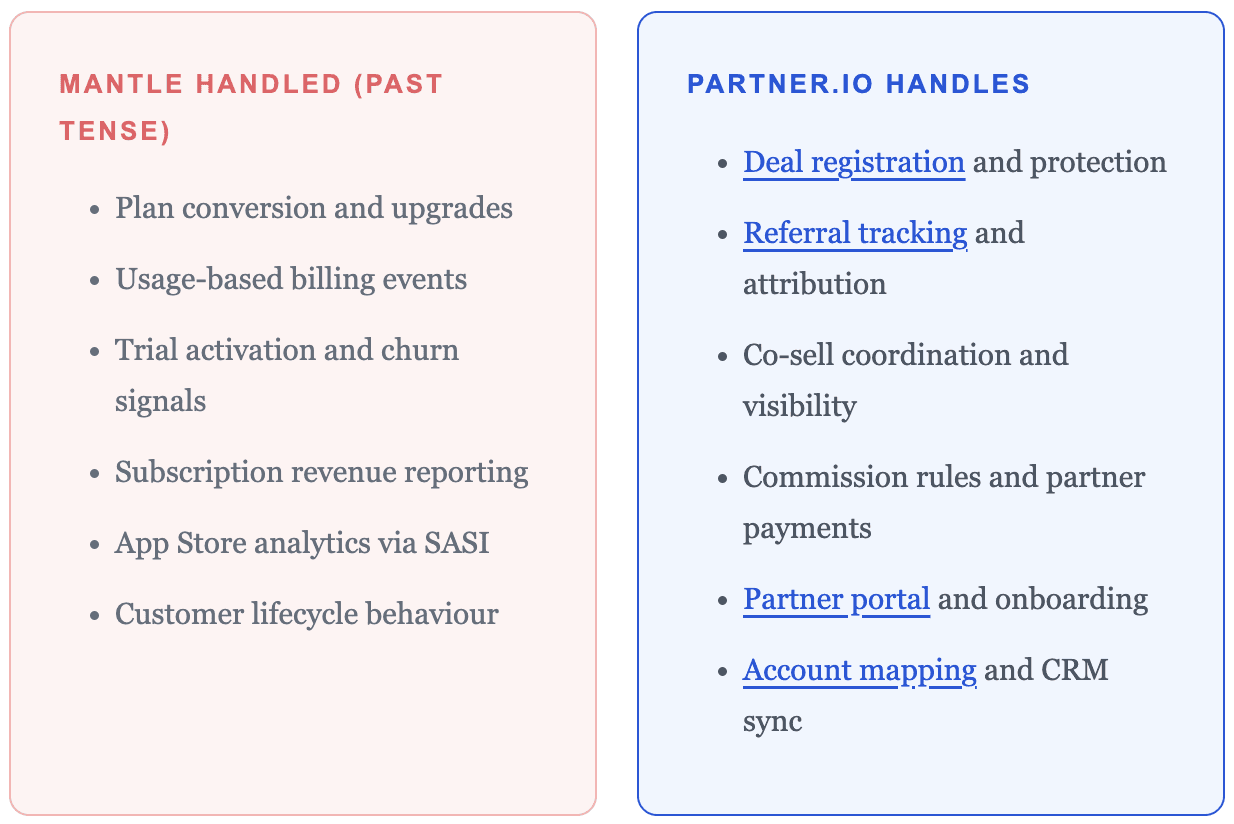
Product revenue mechanics answer one question: what are users doing inside the product, and how does that translate to billing? Mantle answered that well. Shopify now answers it for free.
Partner revenue mechanics answer a different question: who helped create this deal before the customer arrived, and how do you make that happen again? No billing platform answers that. No Shopify update will. That problem belongs to the relationship layer between your company and the people who sell for you, and it requires its own operating system.
Partner.io is live in days, not months. No transaction fees on partner payouts. Clearer.io used it to drive 40% sales growth.
Try Partner.io Free for 14 Days
The Attribution Problem No Platform Will Ever Fix
Mantle tracked what happened inside your app after a customer arrived. Useful. But most partner-sourced deals never get attributed correctly because the record of who introduced the buyer lives nowhere inside the product or the billing system.
The journey typically looks like this: a consultant recommends your tool. The buyer checks your site. They book a demo. Sales marks the source as inbound. Marketing claims the lead. The partner waits for recognition. Finance asks for proof. Next quarter, the consultant recommends someone else. Nobody notices the channel broke because the CRM never showed the channel existed in the first place.
This is why partner-led growth gets chronically underfunded. Not because it fails. Because the business measures it with tools designed for a different motion entirely.
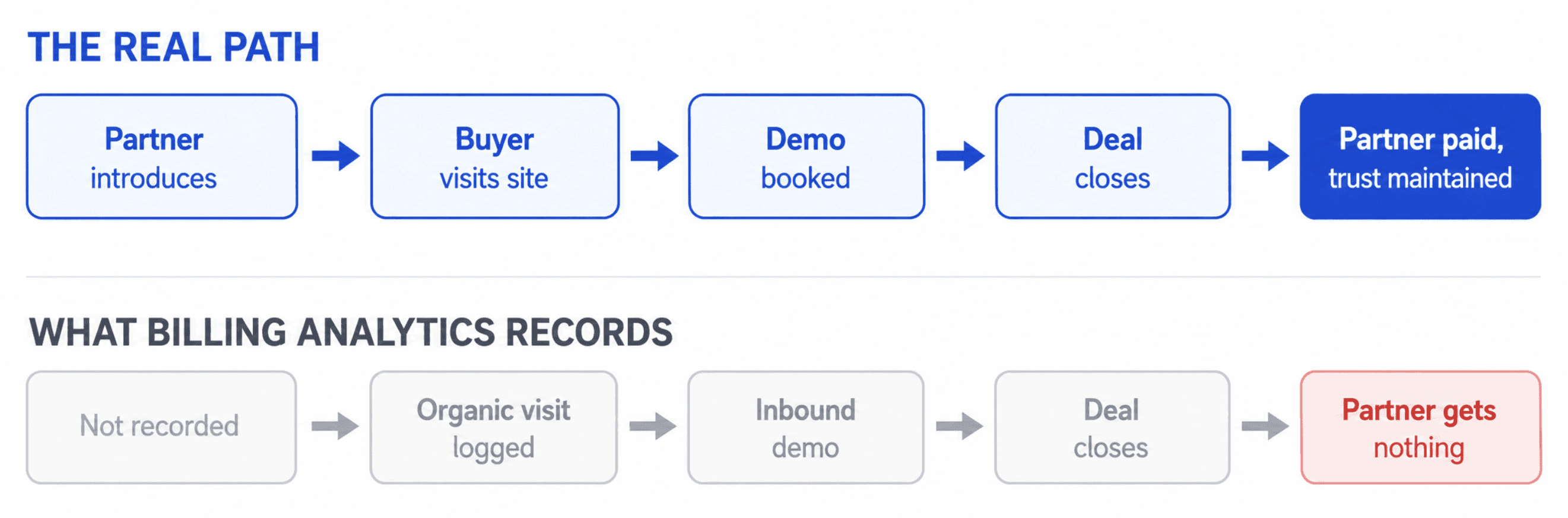
Billing tools see the subscription. They do not see the person who started the conversation. Deal registration closes that gap.
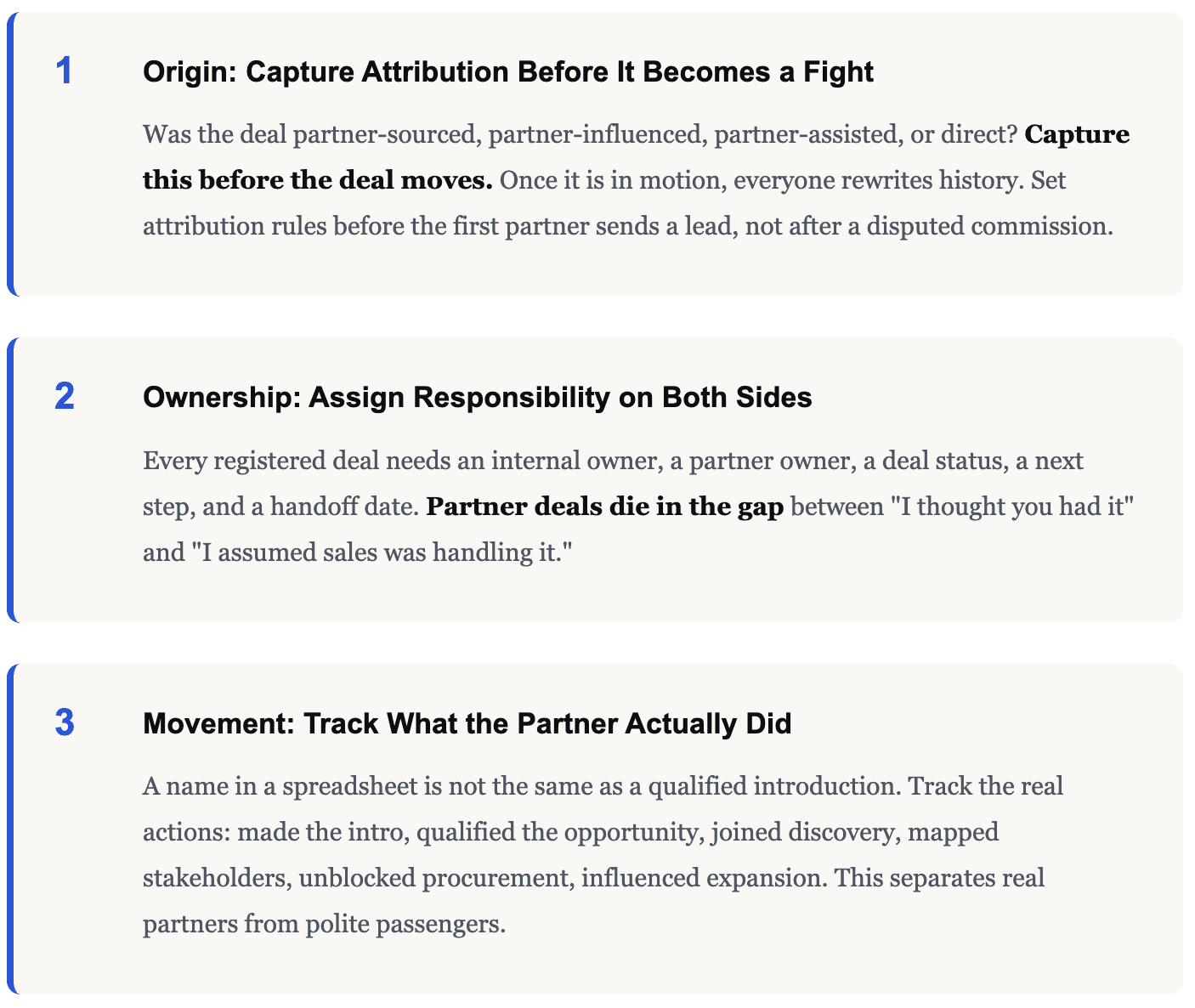
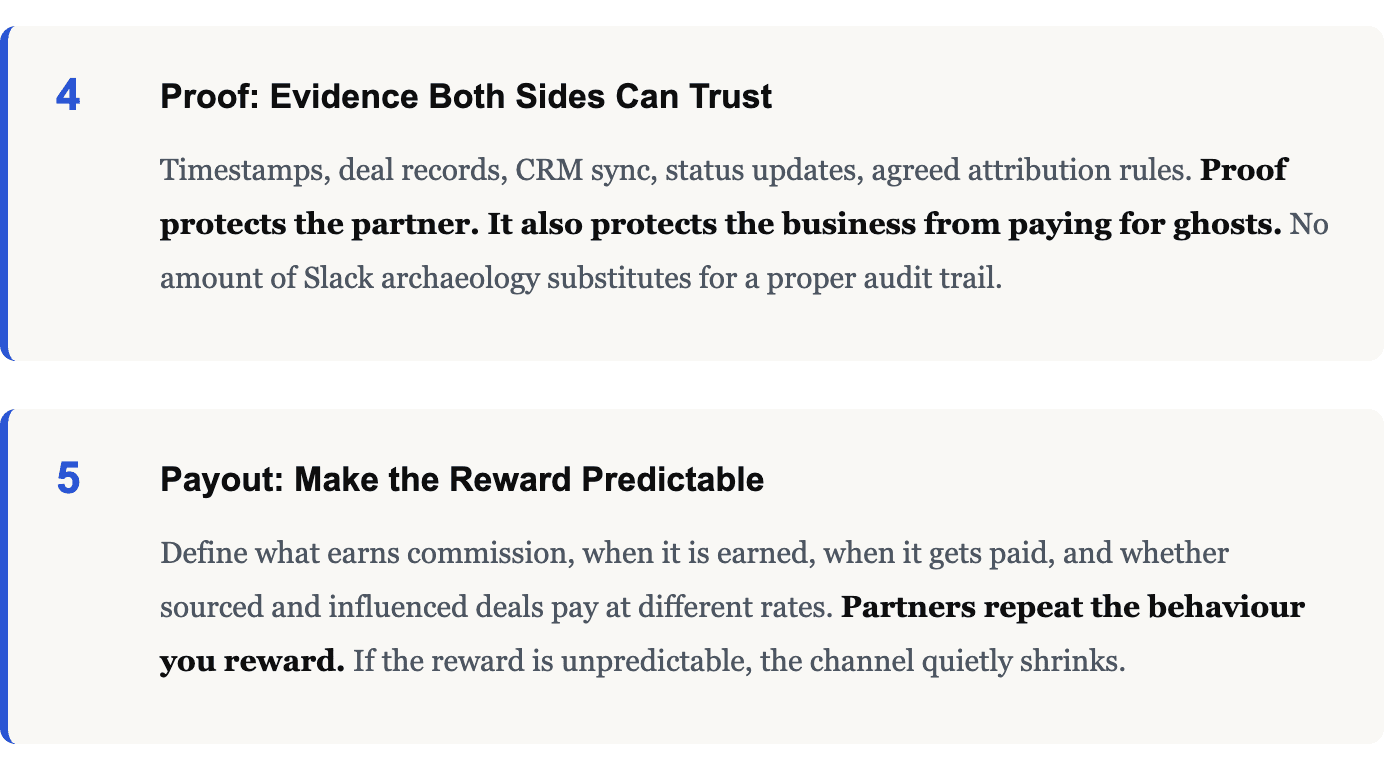
The Partner Revenue Loop: Five Steps That Scale a Channel
Partner revenue does not fail because partners are lazy or the product is weak. It fails because the operating model around it is fragile. Most programmes run on memory, Slack messages, and spreadsheets one person owns and nobody trusts when money is on the line.
What Partner.io Gives You That Mantle Never Could
Partner.io is the operating system for the partner revenue layer that sits above any platform: Shopify, Stripe, HubSpot, or anything else. Shopify can absorb billing. It cannot absorb the trust, attribution, and commercial agreements between your company and the people who sell for you.
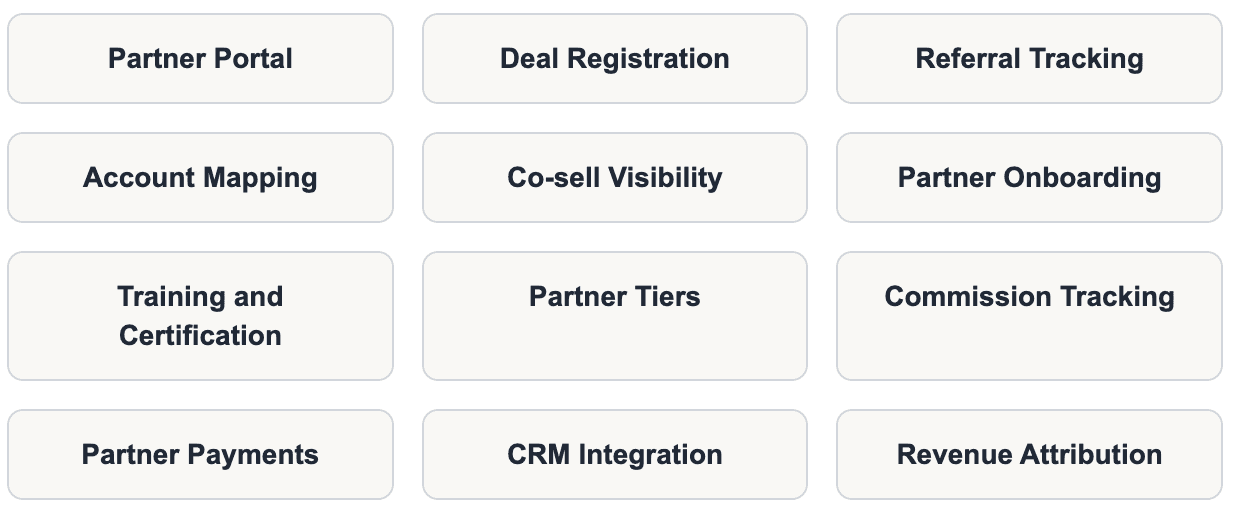
No transaction fees on partner payouts. Live in days. Used by Shopify app developers and B2B SaaS teams who have outgrown spreadsheets. See how Clearer.io drove 40% sales growth by putting structure around their partner motion.
Partner.io runs deal registration, attribution, payments, and reporting in one place. No Shopify update will replace it.
Try Partner.io Free for 14 Days
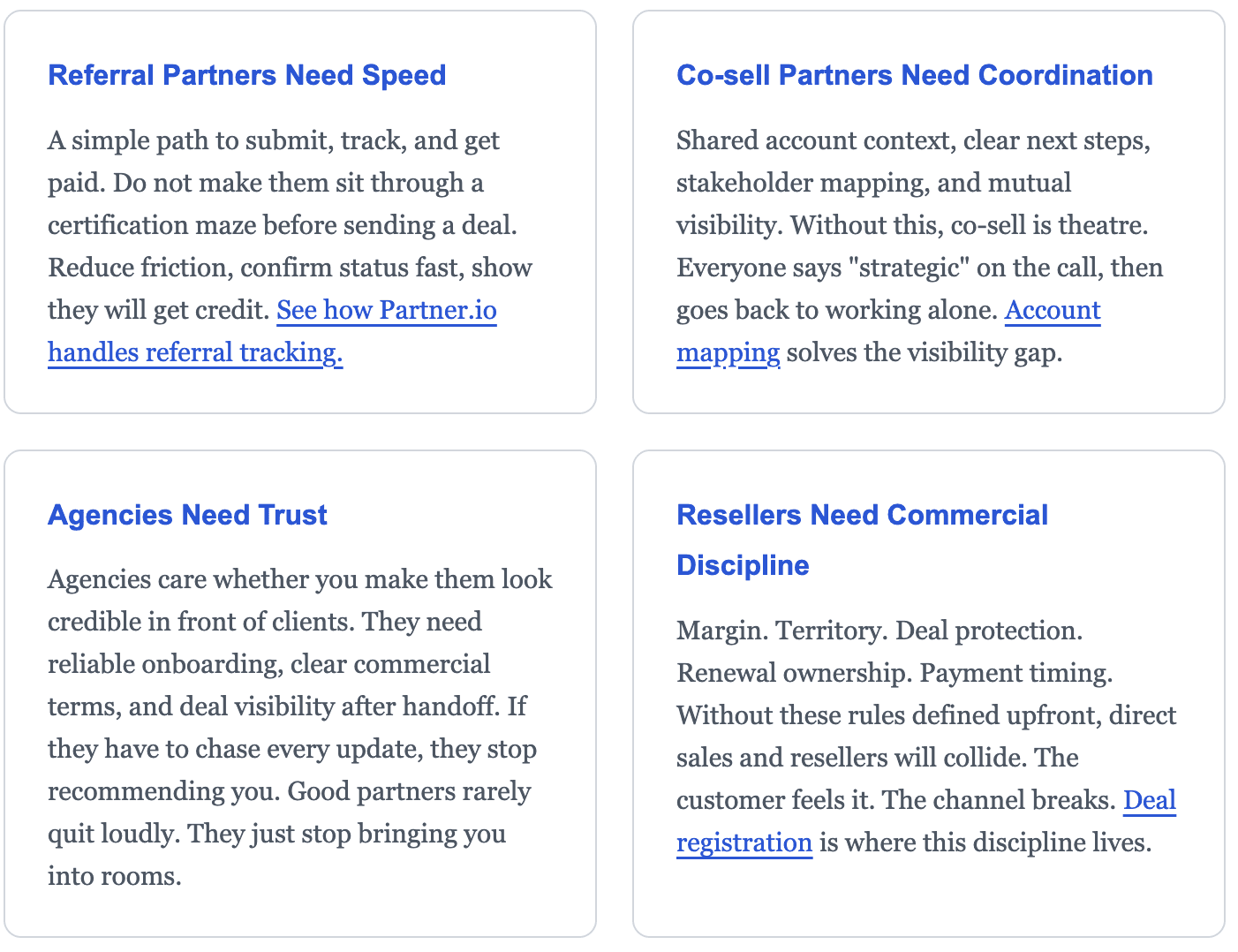
Different Partner Types Need Different Rules
The programmes that fail treat every partner the same. The ones that scale design around the motion each type actually runs.
The Platform Risk Lesson Mantle Teaches Every Operator
The Mantle shutdown is not a story about a bad product or a team that lost focus. It is a story about building close to a capability that a larger platform was always likely to make native. The right question to ask about every tool in your stack is: what is this built on top of, and could the platform underneath absorb it?
Billing abstraction layers: absorbed by Shopify App Pricing
Revenue analytics built on API data: absorbed by the platform that owns the API
App Store analytics: vulnerable to any platform-level reporting update
Partner relationship management: built on human relationships, commercial agreements, and trust. No platform absorbs this.
Shopify cannot dictate who your agency partners recommend to their clients. Stripe cannot manage your reseller margin structure. HubSpot cannot replace the deal registration and attribution logic your channel depends on. The partner relationship layer is yours to build, and no one is going to commoditise it on your behalf.
Before You Scale the Channel: The Operating Checklist
Most teams skip this and then blame the channel. These are the rules to define before you add more partners, not after.
Deal Rules
What counts as a registered deal and how fast must sales respond?
How long is deal protection valid?
What happens if the account already exists in CRM?
How do you separate sourced, influenced, and assisted revenue?
Finance Rules
When is commission earned, and when is it paid?
Do sourced and influenced deals pay at different rates?
What happens on refunds or early churn?
Who approves exceptions, and what does the partner see?
Reporting Rules
What is partner-sourced pipeline versus partner-influenced pipeline?
Which partners create qualified opportunities?
Which partners consume time without moving revenue?
The teams that answer these questions before scaling build channels that compound. The teams that skip them spend every quarter in commission arguments and wonder why the channel is shrinking.
What Changes When Partner.io Becomes the System
Partner.io does not just make partner data tidier. It changes the behaviour around the data. Partners know where to send deals. Sales knows who is involved before the first call. Finance knows what is payable. Leadership knows which partners create revenue and which ones create noise.
Partner managers stop acting as human middleware between a spreadsheet and a CRM. The channel stops running on enthusiasm and starts running on visible rules, clean handoffs, and shared trust.
Mantle ran well for three years until the platform absorbed its floor. Partner.io runs on a layer no platform will absorb. That is the infrastructure bet worth making now.
Partner Revenue Needs Its Own System. Build It Today.
Deal registration, attribution, partner visibility, onboarding, payments, and reporting in one place. No transaction fees on payouts. Live in days.
Try Partner.io Free for 14 Days. No credit card required. Used by Shopify app developers and B2B SaaS teams who have outgrown spreadsheets.