Product
How to Build a B2B SaaS Partner Program That Scales

Most partner programs break at the exact moment they start working.
The first few deals run on memory, goodwill and one person chasing everyone. Then the volume arrives.
Two partners claim the same account. Sales ignores a referral. Finance finds three different commission figures. The partner has to email for an update because the portal shows nothing useful.
That is not a growth problem. It is an operating system problem.
A scalable B2B SaaS partner program needs more than attractive commission rates and a list of friendly companies. It needs a defined route from partner action to verified revenue.
A partner program is not a list of relationships. It is a controlled route from trust to revenue.
Stop Treating Every Partner Like the Same Partner
"Launch a partner program" is not a strategy.
Referral partners, agencies, integration partners, co-sell partners and resellers perform different jobs. They require different workflows, incentives and support.
Force them through one generic process, and the program becomes bloated before it produces meaningful revenue.
Start with one partner motion.
Partner motion | What the partner contributes | What your team must provide | First proof of value |
|---|---|---|---|
Referral | A qualified introduction | Fast qualification, clear ownership and status visibility | An accepted opportunity |
Co-sell | Access, influence or expertise inside an active deal | Shared account plan and defined sales roles | Measurable stage progression |
Agency | Recommendation, implementation or ongoing services | Enablement, client protection and delivery support | An activated customer |
Integration | A connected product use case and shared accounts | Technical ownership, positioning and adoption support | Integration-influenced pipeline |
Reseller | Sales coverage, local expertise or account ownership | Margin, training, pricing rules and governance | Closed revenue from an active seller |
Do not recruit five partner types because the portal allows it. Prove one route to revenue first.

Referral Partners Need Speed, Not Ceremony
A referral partner identifies a suitable prospect, makes the introduction and usually steps back.
The workflow should be brutally simple:
Submit the opportunity.
Receive an acceptance or rejection.
See who owns it.
Follow relevant progress.
Get paid when the agreed event occurs.
Do not make a referral partner complete six training modules before they can send an introduction. Give them the ideal customer profile, qualification questions, referral process and commercial terms. Nothing else is essential at the start.
Partner.io referral management lets partners submit opportunities while keeping attribution, CRM status and partner context attached to the deal.
Co-Sell Partners Need Defined Roles
Co-selling is where vague partnerships become expensive.
The partner may open the door, shape the business case, join technical calls, provide implementation support or reach a stakeholder your sales team cannot. That creates value. It also creates arguments.
Before working an account together, decide:
Who leads the customer relationship?
Which meetings should the partner attend?
Who controls follow-up?
What information can each party see?
What qualifies as partner influence?
What happens if the opportunity already exists?
How will each party receive credit?
Microsoft and AWS both structure co-sell activity around registered opportunities, defined customer records and shared sales stages. They do not manage serious co-selling through informal introductions and hopeful follow-ups. (Microsoft co-sell guidance, AWS opportunity management)
Your partner program does not need Microsoft-sized bureaucracy. It does need the same discipline.
Agencies Need Services Revenue, Not Just Commission
Agencies rarely wake up excited about your referral percentage. They care about winning projects, retaining clients, selling more services and protecting their position as a trusted adviser.
Your software must make the agency more valuable to its clients. A credible agency offer should answer:
What client problem does the product solve?
Which services can the agency sell around it?
Who owns implementation?
Who handles product support?
Can the agency protect its client relationship?
What happens if your direct sales team contacts the account?
How does the agency receive credit?
An agency program becomes attractive when your product helps the agency earn, retain or differentiate. Commission is useful. Commercial relevance is stronger.
Integration Partners Need an Adoption Plan
An integration is not automatically a partnership. Connecting two products creates technical compatibility. It does not create demand.
A productive integration partnership also needs:
A shared customer problem
Meaningful account overlap
Joint positioning
Named product owners
A launch plan
Sales enablement
Adoption tracking
A route to identify influenced revenue
The integration may take three weeks to build and six months to generate a serious opportunity. Do not celebrate the launch and ignore adoption.
Use Partner.io account mapping to identify shared accounts and focus activity where a real customer relationship already exists.
Resellers Need Economics That Survive Contact With Reality
Resellers need enough margin, control and support to justify carrying your product. That may include:
Discount or margin rules
Sales certification
Territory or market definitions
Demo support
Implementation ownership
Customer support responsibilities
Renewal rules
Deal protection
Do not recruit a reseller because it claims to have "thousands of customers." Ask harder questions. Who will sell your product? Which accounts will they target? How many sellers will be trained? What existing offer will your software strengthen? Why would their sales team prioritise it?
A reseller without a route to revenue is just an inactive login with a signed agreement.
The PACT Model for Building a Partner Program
A scalable partner motion needs four things: Position, Advantage, Controls and Traction.
Miss one and the program becomes fragile. Miss two, and it becomes theatre.
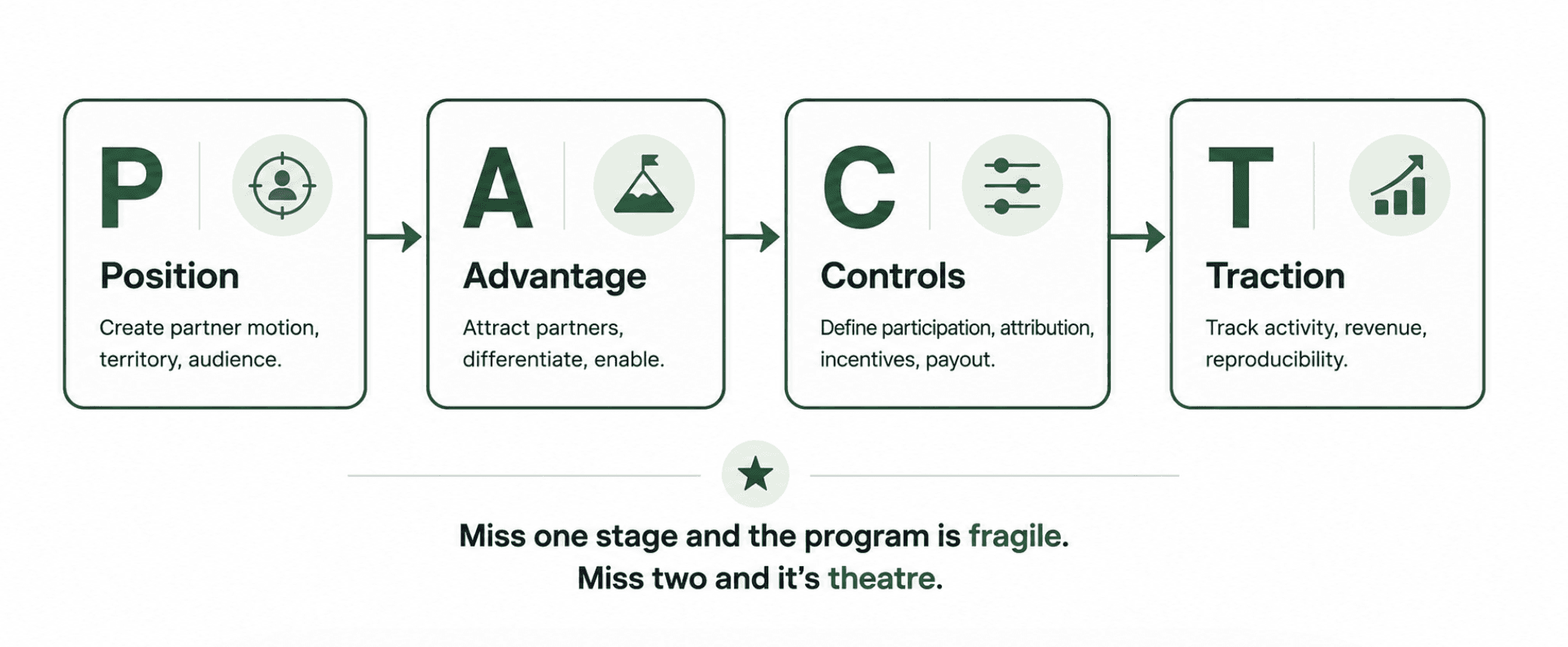
P: Position the Partner Correctly
A partner should have a specific job inside the revenue process.
"Strategic partner" means nothing. "Agency partner that identifies suitable customers, leads implementation and supports adoption" means something.
Before approving a pilot, answer:
Which accounts can the partner reach now?
What customer problem will they lead with?
Why will the customer listen?
Who inside the partner owns the activity?
What will your sales team do?
What can the partner do that your direct team cannot?
If the value of the partnership depends entirely on one personal relationship, it is not scalable. It is borrowed access.
A: Create a Three-Way Advantage
The partnership must create value for three parties.
The customer must win
The customer should receive a better outcome because the partner is involved. That might mean a trusted recommendation, faster implementation, specialist expertise, a connected workflow, lower adoption risk, local market support, or a complete solution rather than isolated software.
If the customer experience does not improve, the partnership is probably adding friction.
The partner must win
The partner needs a commercial reason to act. Possible gains include referral commission, reseller margin, implementation revenue, recurring services revenue, client retention, product differentiation, access to shared accounts, or a stronger market position.
Do not assume the partner will create pipeline because the relationship feels warm. Goodwill does not survive competing priorities.
Your company must win
Your company should gain something expensive or slow to build directly: trusted access, market reach, sales influence, delivery capacity, technical capability, customer retention, or lower acquisition friction.
If the partner adds another meeting but does not improve access, conversion, delivery or retention, the model is weak.
C: Install Commercial and Operational Controls
Rules feel unnecessary when everyone agrees. They become essential the moment a deal closes.
Define what counts as a qualified opportunity, when a registration will be accepted, and what happens when the account already exists. Set how long deal protection lasts, what counts as sourced revenue versus influenced revenue, and which event triggers commission. Decide what happens after cancellation or refund, who approves payouts, and who resolves disputes.
Do not leave this buried in a contract nobody reads. Put the rules inside the workflow.
T: Prove Traction Before You Scale
Traction is not the number of partners who signed an agreement. It is evidence that the motion works.
Look for partners completing a valuable first action, qualified opportunities entering the pipeline, sales responding on time, and deals progressing. Look for data syncing correctly, partners receiving useful visibility, revenue being verified, commissions being calculated without argument, and repeat activity from the same partner.
This is the kind of evidence worth having on hand: Clearer.io grew partner-sourced sales by 40% running on Partner.io, and the platform is currently tracking $75 million in deal value with $24.7 million in closed revenue across its partner base. Numbers like that come from programs that got the traction stage right, not from partner count.
Do not scale a relationship. Scale a working motion.
The controlled pilot model should start with one partner type, one commercial process, one connected workflow and one review period.
Run a Controlled Pilot, Not a Public Launch
A partner pilot should expose weak points before they spread.
Start with one partner, one partner type, one customer problem, one incentive model, one sales process, one CRM workflow and one 30-day review.
That may sound conservative. It is faster than inviting 50 partners and discovering that nobody agrees on qualification, ownership or payment.
Choose a Partner That Will Actually Participate
The best pilot partner is not always the largest. Choose one with access to suitable accounts, a clear reason to participate, an engaged internal owner, enough capacity to act, a willingness to share feedback, and several real opportunities to test.
Avoid partners looking for a badge, a press release or a vague alliance. You need behaviour. Not brand theatre.
Set a Better Pilot Objective
"Generate revenue" is too crude. Revenue may take longer than the pilot, particularly in B2B sales.
The pilot should prove whether the system can support revenue. Test whether the partner can identify suitable accounts, opportunities are submitted correctly, and sales accepts or rejects them quickly. Check whether ownership remains clear, CRM and PRM data stay aligned, and the partner can see relevant progress. Confirm finance can verify the reward and the customer gains from partner involvement.
One closed deal created through frantic manual intervention does not prove scalability. A clean process that can handle the next ten opportunities does.
Pay for Verified Value, Not Partner Activity
Incentives train partners. Pay for poor behaviour and you will get more of it.
Paying for raw leads creates lead dumping. Paying heavily for free trials creates low-intent sign-ups. Paying lifetime commission for one introduction can damage margins long after the partner has stopped contributing.
Tie rewards to verified value.
Stage One: Qualified Contribution
A small fixed reward can work when the partner creates a meaningful commercial action: an accepted opportunity, a completed discovery meeting, a validated use case, or access to a qualified buying group.
Keep the qualification bar high. You should not pay a partner because somebody filled in a form.
Stage Two: Customer Activation
A larger reward should follow a stronger event: the customer starts paying, the first invoice clears, implementation is completed, or the customer reaches an agreed usage milestone.
Shopify, for example, ties referral earnings to eligible merchant subscriptions and paid fees rather than treating the creation of a free account as completed value. (Shopify Partner earnings, Shopify payout calculations)
The principle matters more than the exact model. Pay when value becomes real.
Stage Three: Durable Value
Recurring commission makes sense when the partner continues to contribute. An agency may manage implementation and adoption. A reseller may own the customer relationship. An integration partner may drive sustained product usage.
A referral partner who sent one email may not deserve the same recurring economics. Match the reward to the work.
Partner.io connects commission rules, eligibility and payout status inside the partner workflow, rather than leaving finance to reconstruct the deal from spreadsheets.
Work Backwards From Unit Economics
Do not copy another company's commission rate. Start with what the deal can support.
Maximum partner reward = acceptable acquisition cost minus the internal sales, onboarding and support costs that still apply.
Then test the number against gross margin, contract value, retention and sales cycle. Weigh it against partner effort, services revenue retained by the partner, refund risk, and ongoing involvement.
A partner-sourced deal is not automatically cheaper than a direct deal. A badly designed partner deal can cost more, take longer and create less control.
Make Deal Registration Worth Using
Deal registration should protect partner effort and produce clean pipeline data.
Instead, many programs turn it into a form nobody trusts. A partner submits an opportunity and hears nothing. Sales works the account without updating the record. The registration expires without warning. Another partner claims the same company. Then everybody argues about attribution.
The form is not the problem. The missing operating rules are.
Ask Only for Information You Will Use
A useful registration form might collect account name, customer contact, customer problem, expected use case, partner relationship, estimated timing, potential value and support required.
Every field should support qualification, routing or reporting. Delete the rest.
Accept or Reject Quickly
Set a response target. A qualified opportunity should not sit untouched while the prospect continues evaluating alternatives.
When rejecting a deal, show the reason: existing active opportunity, duplicate registration, poor customer fit, missing qualification, no demonstrated relationship, or unsupported use case.
A rejection without context teaches the partner nothing.
Separate Sourced From Influenced Revenue
A sourced opportunity enters the pipeline because of the partner. An influenced opportunity already exists, but the partner helps move it through access, expertise, services or stakeholder alignment.
Do not combine them. If every influenced deal becomes partner-sourced revenue, reporting turns into fiction. If influence receives no recognition, partners stop helping existing opportunities.
Track both. Reward them according to contribution.
Set a Protection Window That Matches the Sales Cycle
Thirty days may work for a low-cost, self-service product. It is useless for a deal involving procurement, security review, legal negotiation and implementation planning.
Long protection windows create another problem. Dormant registrations can block active sellers and other partners.
Set a reasonable initial period, then require evidence of progress before extending it.
If your attribution policy cannot survive two partners claiming the same account, it is not an attribution policy. It is a future argument.
Your CRM Is Not a Partner Experience
A CRM manages internal sales activity. Partners need something different.
They need onboarding, agreements, resources, deal registration, referral attribution and status visibility. They need communication, incentives, commission confidence and payout information.
A CRM field marked Partner Source = Yes does not provide any of that.
Read more: Your Tech Stack Was Built for Direct Sales and The Hidden Cost of Managing Partners in Spreadsheets.
Give Each System One Clear Job
Partner.io should manage: partner applications, partner profiles, partner types, agreements, onboarding, training and resources. Deal registration, referral workflows, partner communications, tiers, incentive rules, commission eligibility, payout visibility, account mapping and partner reporting all live here too.
The CRM should manage: accounts, contacts, opportunities, sales owners, pipeline stages, forecasts, sales activity, and closed-won or closed-lost outcomes.
Billing and product systems should verify: paid subscription status, revenue, activation, usage, refunds, cancellations and renewals.
There is no single source of truth for every part of the partner program. There are authoritative systems for different records and events. Partner.io connects partner workflows with the tools already used by sales, finance and operations.
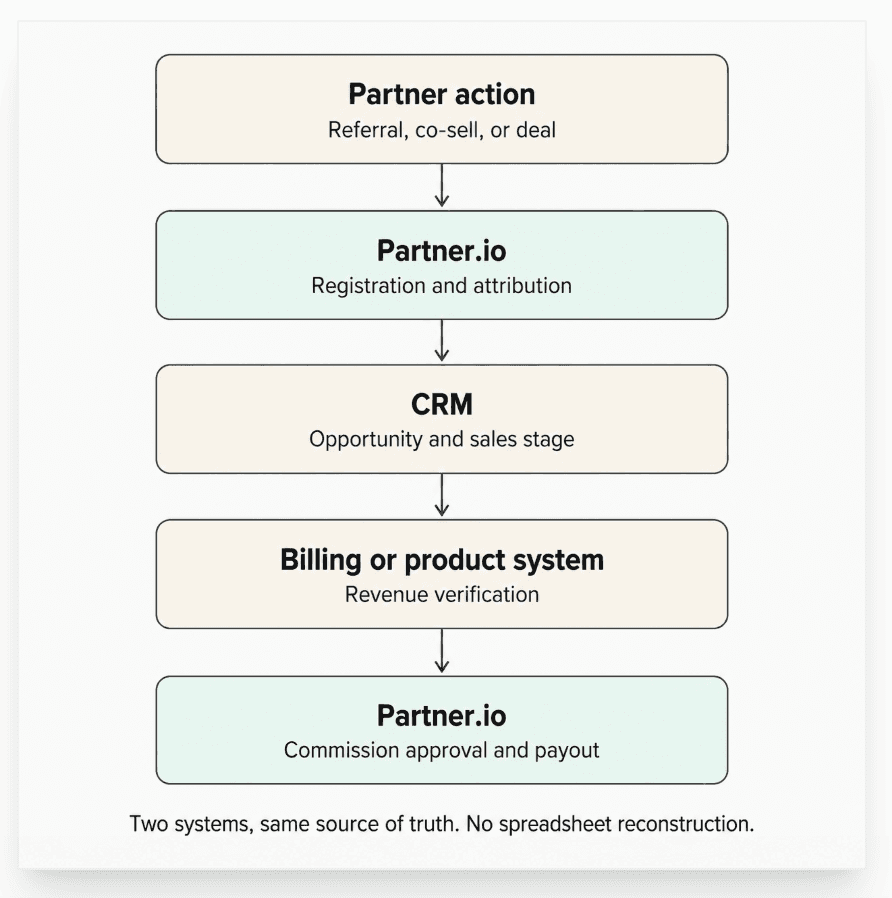
Sync the Fields That Prevent Arguments
At minimum, preserve unique partner ID, partner type, partner owner and sales owner. Keep registration ID and timestamp, sourced or influenced classification, opportunity stage, and expected value alongside closed revenue, commission rule, agreement version, payout status and rejection reason.
The agreement version matters. Commercial terms change. Tiers change. Commission rates change. Without a record of which terms applied when the opportunity was submitted, disputes become guesswork.
Build Partner Onboarding Around First Value
Most onboarding is built around content consumption. Watch the video. Read the deck. Download the battlecard. Complete the quiz.
None of that creates revenue.
The goal of onboarding should be the partner's first valuable action.
For a referral partner, that may be an accepted opportunity. For an agency, it may be a joint client review. For an integration partner, it may be a confirmed shared customer and use case. For a reseller, it may be a live demonstration with a qualified prospect.
Give Partners a Route, Not a Resource Dump
Effective onboarding answers five questions: what should I sell, who should I sell it to, why should the customer care, how do I register the opportunity, and what happens next?
Everything else supports those questions. Create short, usable assets: ideal customer profile, trigger events, qualification questions, core use cases, objection handling, referral instructions, co-sell rules, commercial terms and sales support routes.
The measure of onboarding is not completion. It is movement.
A Practical 30-Day Partner Pilot
Days 1 to 3: Set the Rules
Agree the partner motion, target customer, and partner and sales responsibilities. Settle registration criteria, attribution model, protection window, payout trigger and escalation process before you begin outreach.
Days 4 to 7: Configure Partner.io and the CRM
Set up the partner profile, partner type and agreement, plus the referral or deal form. Map CRM fields, notifications, sales routing, partner permissions and commission logic. Run test submissions before using a live account.
Days 8 to 10: Review Named Accounts
Ask the partner to bring a short target list. Check each account for customer fit, existing pipeline, ownership conflicts, strength of partner relationship, likely use case and sales capacity.
Remove weak accounts before outreach.
Days 11 to 14: Start Live Activity
Submit the first opportunities through Partner.io. Confirm sales receives the opportunity, an owner is assigned, and the partner receives confirmation. Check that status changes sync correctly, rejections include a reason, and permissions remain appropriate.
Day 30: Inspect the Engine
Review opportunities submitted, registration acceptance rate, sales response time and meetings booked. Look at stage progression, partner involvement, data accuracy and partner visibility. Check commercial verification, manual work required and problems raised.
Then decide: scale it, fix it, or stop it.
Do not keep a weak model alive because the relationship sounds strategically important.
What This Looks Like in the Real World
A specialist agency joins the program with access to 18 relevant client accounts.
The agency and partner team review the list together. Eight accounts match the target market. Three are ready for outreach.
The agency registers all three through Partner.io. One is rejected because sales already has an active opportunity. The agency sees the reason. Two are accepted and assigned to sales owners.
The first requires a joint discovery call because the agency will handle implementation. The second moves directly to sales. The agency can track both opportunities without sending status-chasing emails.
One customer signs. Billing confirms payment. The commission becomes eligible and finance approves it.
The 30-day review exposes the real problem. Sales took four days to contact accepted referrals.
The partner was not the bottleneck. The internal handoff was.
Fixing it before recruiting another 50 agencies protects the entire program.
Measure the Engine, Not the Audience
Partner count is not a revenue metric. Neither are signed agreements, portal logins or completed training modules.
Measure behaviour and outcomes.
Partner Activation
Track the percentage of approved partners taking a valuable action, time to first accepted opportunity, active partners in the last 30 or 90 days, and partners producing repeat activity.
Opportunity Quality
Track registration acceptance rate, rejection reasons, meetings created, and qualified, sourced and influenced pipeline.
Sales Execution
Track time to first response, stage conversion, sales cycle, win rate, partner participation by stage and stalled opportunities.
Commercial Quality
Track activated customers, closed revenue, gross margin, retention, refunds and commission as a percentage of gross profit.
Operational Health
Track CRM sync failures, duplicate registrations, attribution disputes, payout errors, time to approved payment and manual work per active partner.
One closed deal does not prove the system works. Clean handoffs, reliable data and repeat partner activity do.
What to Do When the Partner Program Breaks
Partners Submit Poor Opportunities
Tighten the criteria. Show examples of accepted and rejected submissions. Require evidence of a customer problem and a real relationship.
If the same partner keeps submitting rubbish, pause them. Do not let politeness poison the pipeline.
Sales Ignores Partner Deals
Assign a named owner and response target. Push partner opportunities into the normal sales workflow. Make the partner and source visible on the CRM record.
Check compensation too. If a sales rep loses credit when a partner is involved, the rep will resist partner deals. That is not a training problem. It is an incentive problem.
Attribution Becomes an Argument
Use the evidence: registration timestamp, existing CRM activity, partner relationship, recorded actions, the sourced or influenced definition, and the protection window.
Do not award credit based on seniority, persistence or who complains loudest. Then change the rule that allowed the ambiguity.
Partners Join and Do Nothing
Stop sending generic newsletters. Give them a specific play: a five-account review, a referral sprint, an integration campaign, a joint webinar, a vertical offer, a renewal rescue campaign, or a client health check.
Inactive partners rarely need more content. They need a reason to act.
Finance Does Not Trust the Payouts
Connect commission eligibility to verified commercial data. Every payment should show the partner, opportunity, agreement version, trigger event, commission rule, amount, approval and payment status.
If the calculation depends on an editable spreadsheet, finance is right not to trust it.
Every Partner Needs an Exception
The program is too broad. Separate referral, agency, integration, co-sell and reseller workflows.
They can run through the same PRM. They should not run through the same rules.
When PRM Software Stops Being Optional
A spreadsheet is useful for designing a partner program. It is a terrible place to run one.
The breaking point arrives when partner revenue depends on coordinated applications, agreements, onboarding and deal registration. It arrives when CRM updates, attribution, commission rules, partner communication and payment approval all have to move in sync.
At that point, the spreadsheet is not saving money. It is hiding cost.
Partner.io becomes the operating layer between partners and the revenue systems your business already uses. Partners get a clear place to act. Sales keeps working in the CRM. Finance receives traceable commission data.
The partner team stops functioning as the human integration between spreadsheets, inboxes, CRM records and payment systems.
That is what partner relationship management software should do. Not add another dashboard. Remove the operational drag that stops partner revenue from scaling.
"We're not just seeing more referrals, we're seeing better ones. The quality, the consistency, the visibility, it's all gone up since we moved to Partner.io."
Darren Matthews, Head of Partnerships at Salesfire
Build the System Before You Recruit the Crowd
Partner recruitment is visible. Partner operations are not.
That is why companies spend months designing launch campaigns, tier names and partner badges, then leave deal ownership, attribution and commission rules half-finished.
The result is predictable. Inactive partners. Ignored referrals. Disputed revenue. Commission spreadsheets nobody trusts.
There is a better route. Choose one motion. Define the customer problem and three-way advantage. Write the rules before the first opportunity arrives. Connect Partner.io to the CRM and billing data. Run real deals through the process. Fix every weak handoff.
Then recruit.
Your next stage of partner growth will not come from adding more names to a portal. It will come from building a system good partners trust enough to use.
Try Partner.io Free for 14 Days
Build your partner portal, configure referrals, connect your CRM and test the complete partner journey using live opportunities.
No six-month implementation project. No commission spreadsheets. No credit card required.
Try Partner.io Free for 14 Days and turn your partner program into a revenue system.
Recommended Reading