Product
Partner Relationship Management Software for Mid-Market SaaS
Your partner programme is not failing because partners are lazy.
It is failing because the system is sloppy.
A lead comes in through LinkedIn. Someone forwards it to sales. The AE forgets to update the partner. The partner chases. Finance asks who should be paid. Nobody can prove anything without digging through email, HubSpot notes, Slack threads and a spreadsheet called "Partner pipeline final final."
That is the moment a SaaS business needs partner relationship management software.
Not when it has 500 partners. Not when it has a global channel team. When partner revenue is real enough to lose.
What Partner Relationship Management Software Is Really For
A PRM is not a login page with a logo on it.
A PRM is the operating system for partner revenue. It should tell you:
Who your partners are
What type of partner are they
What they are allowed to submit, sell or influence
Which deals came from them
What sales did next
What they are owed
Which partners deserve more attention
Which partners should be cut loose
That last point matters. Most partner programmes carry too much dead weight: dormant agencies, "strategic" logos that have never referred a buyer, integration partners that launched once and disappeared, resellers with no pipeline and too many excuses.
Partner relationship management software does not make weak partners strong. It exposes the difference. That is why mid-market SaaS companies need it before the channel becomes too messy to fix.

The Mid-Market Problem: Too Big for Spreadsheets, Too Early for Enterprise Bloat
Early-stage partnerships are forgiving. You know every partner by name. You remember who sent the lead. Sales can shout across the room. Commission is handled manually because there are only two deals to check.
That works until it does not.
The break usually happens when the business has:
10 to 30 active partners
More than one partner type
Sales reps handling partner-sourced deals
Referrals landing outside the CRM
Agencies asking for client updates
Resellers needing deal protection
Integration partners are asking for co-marketing
Leadership is asking what partnerships actually contributed
At that point, spreadsheets stop being scrappy. They become a liability. A spreadsheet will not remind sales to accept or reject a partner lead, keep a reseller updated, stop two partners claiming the same account, enforce partner tiers, or show which agencies drive pipeline and which only join webinars.
It will let everything look fine until trust is already damaged. That is the hidden cost. Partners do not stop sending leads because they are offended by your tech stack. They stop because the process makes them feel ignored, exposed or unpaid.
Why This Matters Now
SaaS teams have less room for vague growth stories. Paid acquisition is expensive. Outbound is crowded. Buyers are harder to reach cold. The old plan of hiring more salespeople and sending more email is wearing thin.
Partnerships look attractive because they borrow trust. A good agency referral beats a cold email. A strong reseller can open a market faster than a direct team. An integration partner can turn product compatibility into commercial urgency.
The channel data backs this up. Jason Lemkin, founder of SaaStr, has pointed out that Shopify's partner ecosystem grew from roughly 8% of revenue in 2018 to around 20% by 2020, and that partners are frequently what carries SaaS businesses from their first million in ARR toward their first hundred million. Klaviyo has reportedly driven around 40% of its revenue through agencies and partners.
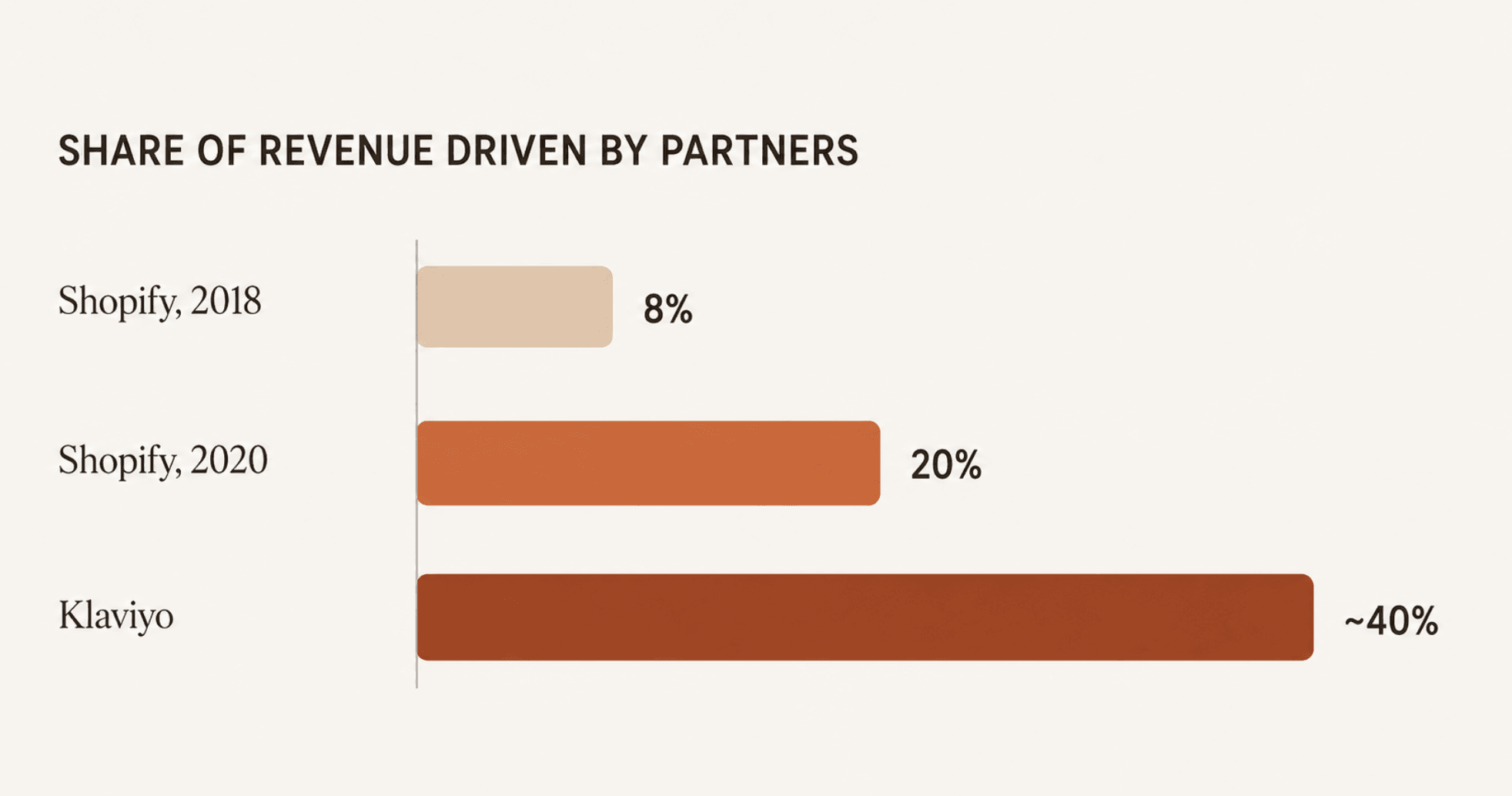
Figures as reported in SaaStr's coverage of Shopify and Klaviyo's partner programmes.

But only if the motion is managed. Partner-led growth does not scale through charm. It scales through rules, visibility and follow-up. That is where PRM software earns its place.
Wrong move.
More partners create more noise unless the system underneath can handle them. Before scaling recruitment, you need a clean operating model: clear partner types, clear submission rules, clear CRM routing, clear sales ownership, clear partner visibility, clear incentives, clear reporting.

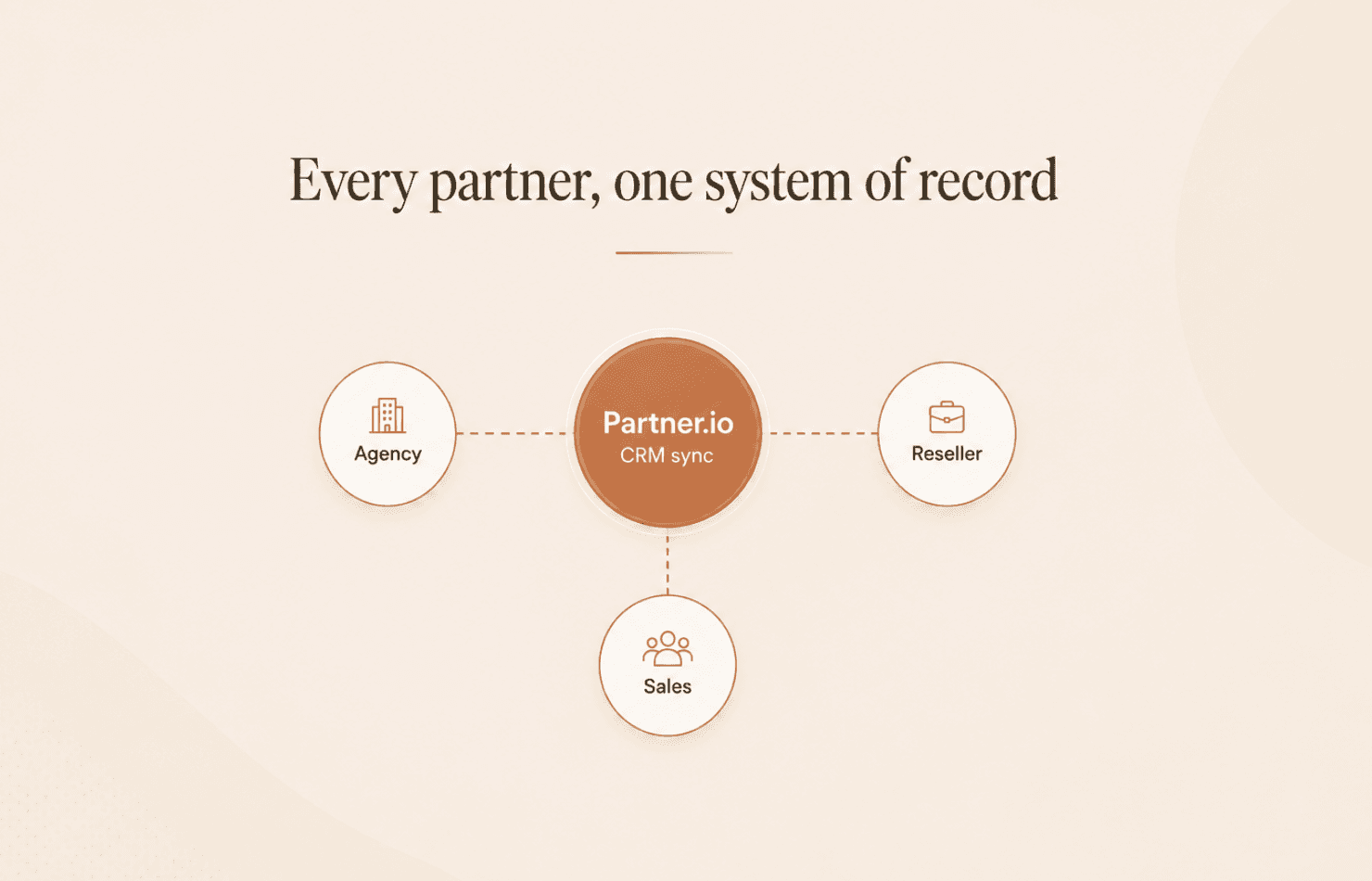
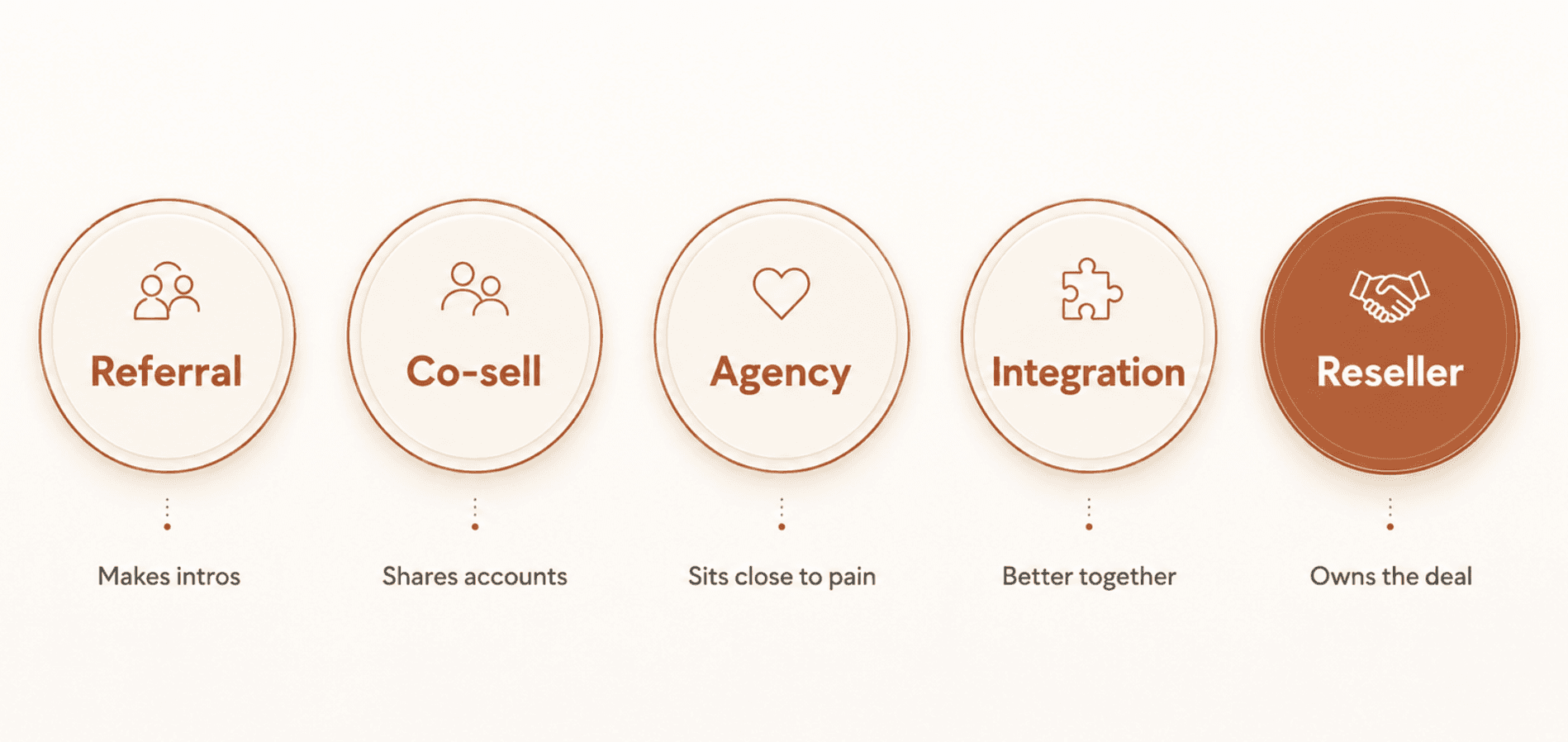
Partner.io is built around that exact gap. It gives SaaS teams a practical way to manage referrals, co-sell, agencies, integrations and resellers without stitching together forms, spreadsheets, Slack reminders, CRM workarounds and payout trackers.
The point is not to "have a portal." The point is to make partner revenue visible enough to manage.
Stop chasing partner updates across five different tools.
Try Partner.io Free for 14 Days
The Four-Part Partner Revenue Model
Forget complicated ecosystem theory. A mid-market partner programme needs four things to work.

The four-part model: each stage feeds the next.
1. Fit
Bad partners create admin. Good partners create leverage. Fit means knowing why each partner belongs in the programme. Do not recruit partners because the logo looks nice. Recruit against a job.
Ask: What customer segment can this partner reach? Why would that buyer trust them? What proof do they have? What would make this partner a poor fit? If you cannot answer those questions, the partner is not ready for your programme. They are just another name in the CRM.
2. Routing
Partner revenue dies in the handoff. A referral gets sent to sales, a reseller registers an account, an agency introduces a client. Then what? Who accepts it? Who owns it? These questions need rules before money is involved.
Routing should cover lead acceptance criteria, partner-sourced versus partner-influenced definitions, duplicate account rules, sales owner assignment, follow-up SLAs, rejection reasons, deal registration expiry, commission eligibility and conflict resolution.
Partner.io's referral and lead tracking gives partner teams structured lead and deal management, CRM sync and workflows that keep partner activity connected to the sales process. A PRM that sales ignores is just another database.
3. Activation
Signed partner agreements do not create revenue. Activated partners do. Treating every partner the same is lazy: a reseller does not need the same onboarding as a referral partner, and an agency does not care about the same incentives as an affiliate.
Partner.io's branded partner portal gives teams the building blocks to shape those paths: partner tiers, badges, training, certification, deal rooms, workflows and analytics. That is the difference between "we have partners" and "partners know how to create revenue here."
4. Proof
Partnerships lose budget when they cannot prove impact. Nobody cares that you have "180 partners." They care that fourteen partners submitted qualified opportunities this quarter, nine were accepted, five created a pipeline, three closed, and twenty should be removed from active status.
Track leads submitted, leads accepted, opportunities created, pipeline value, revenue closed, response time and commission due. If those numbers are missing, you are not managing a partner programme. You are hoping one appears.
The Five Partner Motions Your PRM Needs to Handle
A strong PRM does not force every partner into the same box. Each motion breaks in a different place.
Referral Partners
Referral partners are often the easiest place to start. They know the buyer, they make the intro, and your team sells. Until the referrals become messy: leads arrive through email or WhatsApp, sales forgets to update the partner, commission rules live in old messages.
The fix is qualification. Do not tell partners, "send us anyone interested in partnerships." Give them a specific, narrow brief instead, backed by one clear lead submission route and visible commission logic.
Co-Sell Partners
Co-sell sounds sophisticated. Often it is chaos with better branding. A real co-sell motion has shared accounts, a specific buyer, a clear reason to collaborate and named owners on both sides.
Before calling anything co-sell, answer six questions: which accounts, why this partner, what is the buyer's problem, who owns the next step, what will sales say, and what counts as success. If you cannot answer those, it is not co-sell. It is networking. Account mapping is what turns vague collaboration into a defined, trackable motion.
Agencies and Service Partners
Agencies can be your best partners because they sit close to the pain. They hear the client say the current setup is too manual. What fails: the agency does not understand your ICP, enablement is too generic, client intros get swallowed by sales.
Do not lead every agency conversation with commission. Many agencies care more about client retention and looking clever in front of their customers. Help them win that game
Integration Partners
An integration launch is not a partnership strategy. It is a press release unless sales, marketing and customer teams know what to do with it. Build the go-to-market motion before launch day: shared positioning, joint use cases, lead routing, influence tracking, and 30-day and 90-day reviews. Otherwise, the integration becomes another marketplace tile nobody touches.
Resellers
Resellers require the most discipline. They may own buyer access, local relationships, procurement and first-line trust, which means they need protection: formal deal registration, approval workflows, price and margin rules, reseller tiers and clear escalation paths.
Do not launch a reseller channel unless you are prepared to defend it. If a reseller registers a deal and direct sales can take it without consequence, the channel is already dead. The reseller just has not told you yet.
What This Looks Like in the Real World
A small ecommerce agency has five Shopify clients. Two are struggling with referral tracking. One is already comparing tools. The agency likes your product and sends an intro by email.
Without a PRM, the intro gets forwarded to sales. The AE replies three days later. The partner manager forgets to update the agency. The deal closes months later. Finance asks whether a commission is due. The agency feels awkward chasing. Nobody meant to make it messy, but messy is what happened.
Now run the same motion through Partner.io. The agency is set up as a service partner, completes a short onboarding path, and registers the client through the portal. The opportunity syncs to the CRM. Sales accepts it. The agency sees progress without chasing. When it closes, credit is clear.
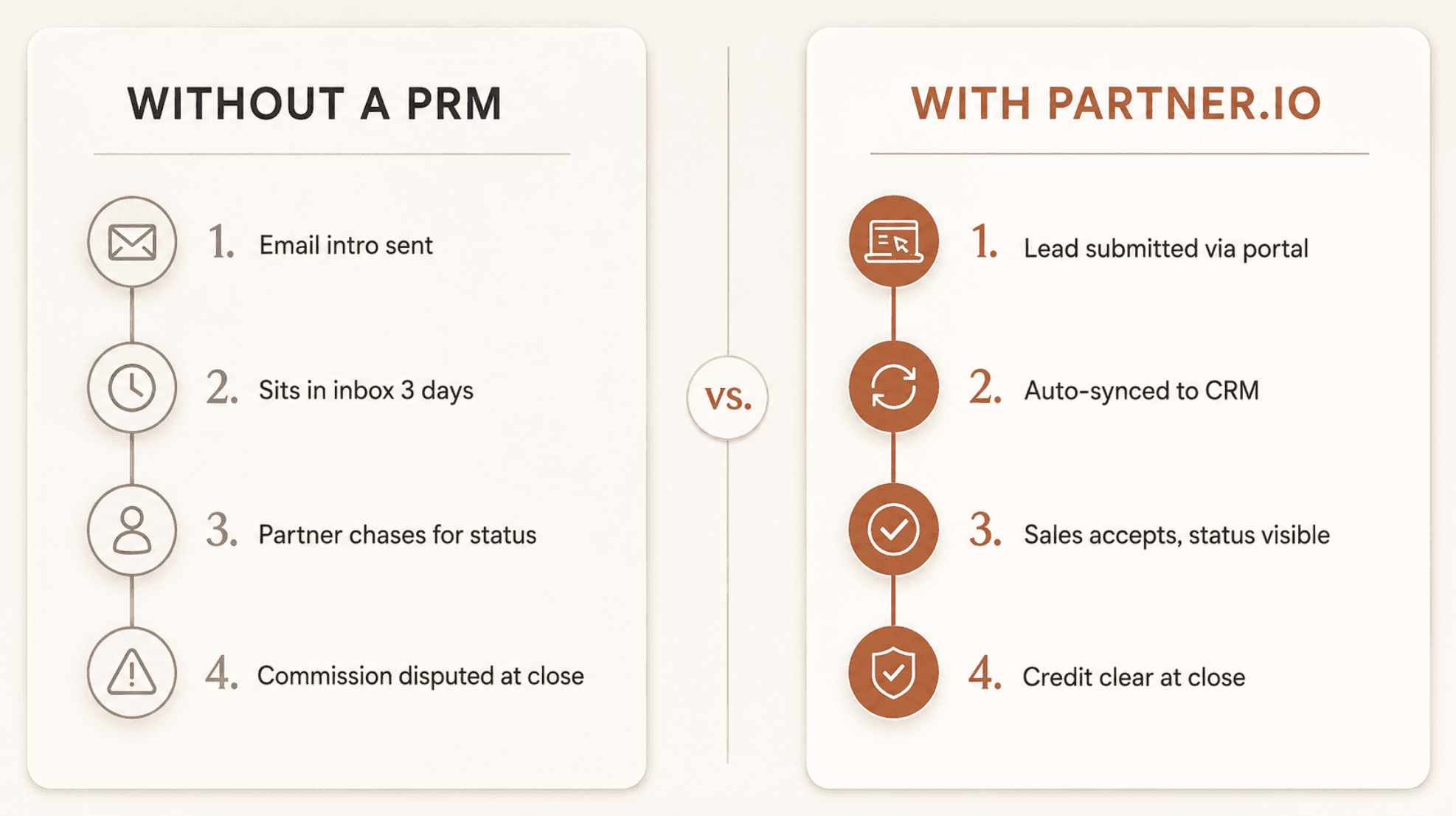
The next referral comes faster. Not because the agency suddenly loves your brand more. Because they trust the process.
How to Choose Partner Relationship Management Software
Do not buy PRM software because it has the longest feature list. Buy the system that removes the most friction from your actual partner motion.
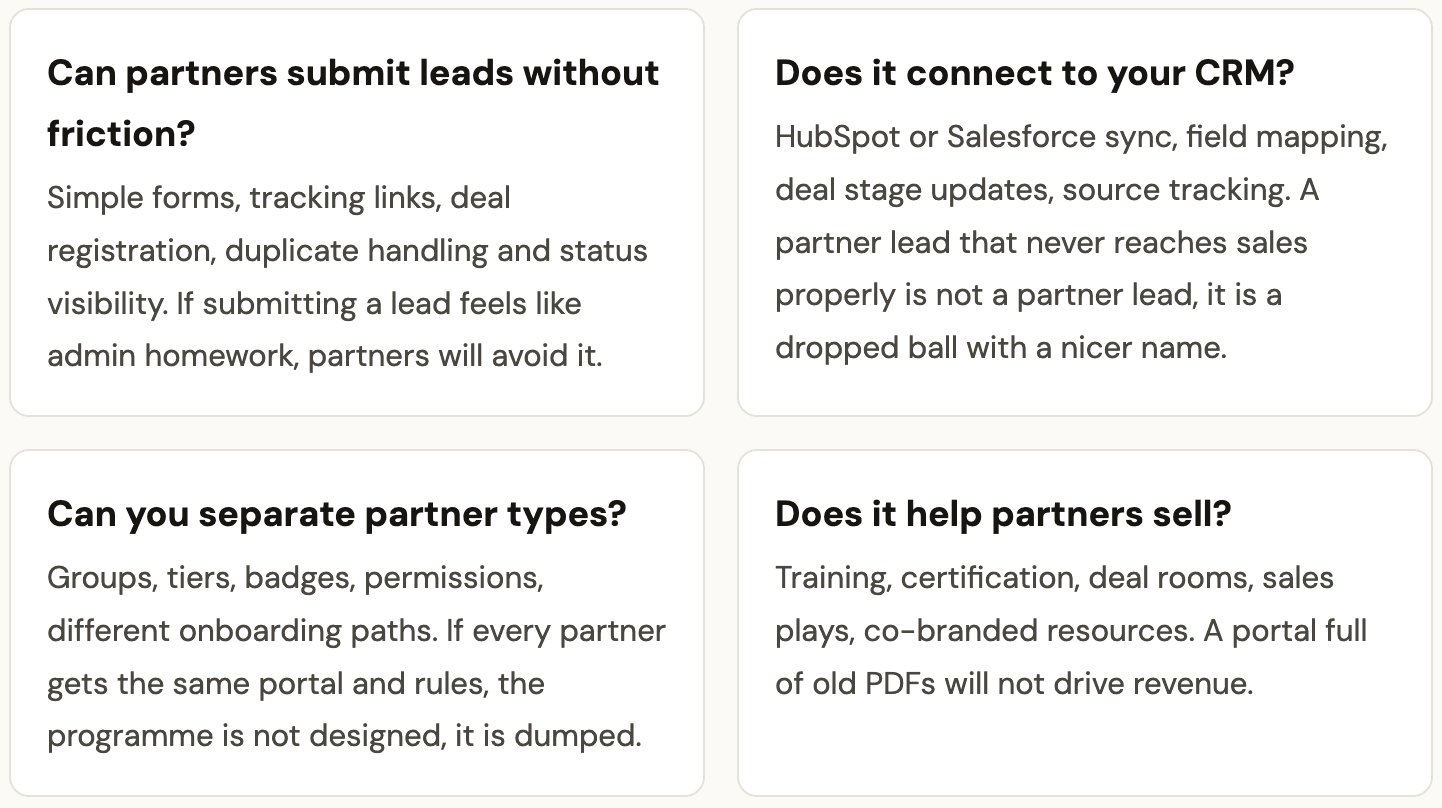
The best PRM makes the board conversation cleaner. Less storytelling. More evidence.
"Growing your SaaS business takes a team."
-Atlassian, on building a partner ecosystem
Not the entire team needs to be on your payroll. Partners extend it, if the process behind them can be trusted.
The Partner.io Fit
Partner.io fits SaaS teams that have outgrown manual partner management but do not want a bloated enterprise channel system. You have partners, partner-sourced opportunities, sales involved, CRM data, and enough activity that mistakes now cost money.
Partner.io gives you the structure to manage that properly: branded partner portals, lead and deal management, partner tiers and badges, training and certification, CRM sync, account mapping, partner events, workflows and automations, Stripe and Slack integration, and partner analytics.
The value is not one feature. It is the way those pieces connect. A partner submits a lead. Sales sees it. The CRM updates. The partner gets visibility. The partner manager has control. Leadership gets proof.
The Partner Programme Health Check
Run this before scaling the programme.
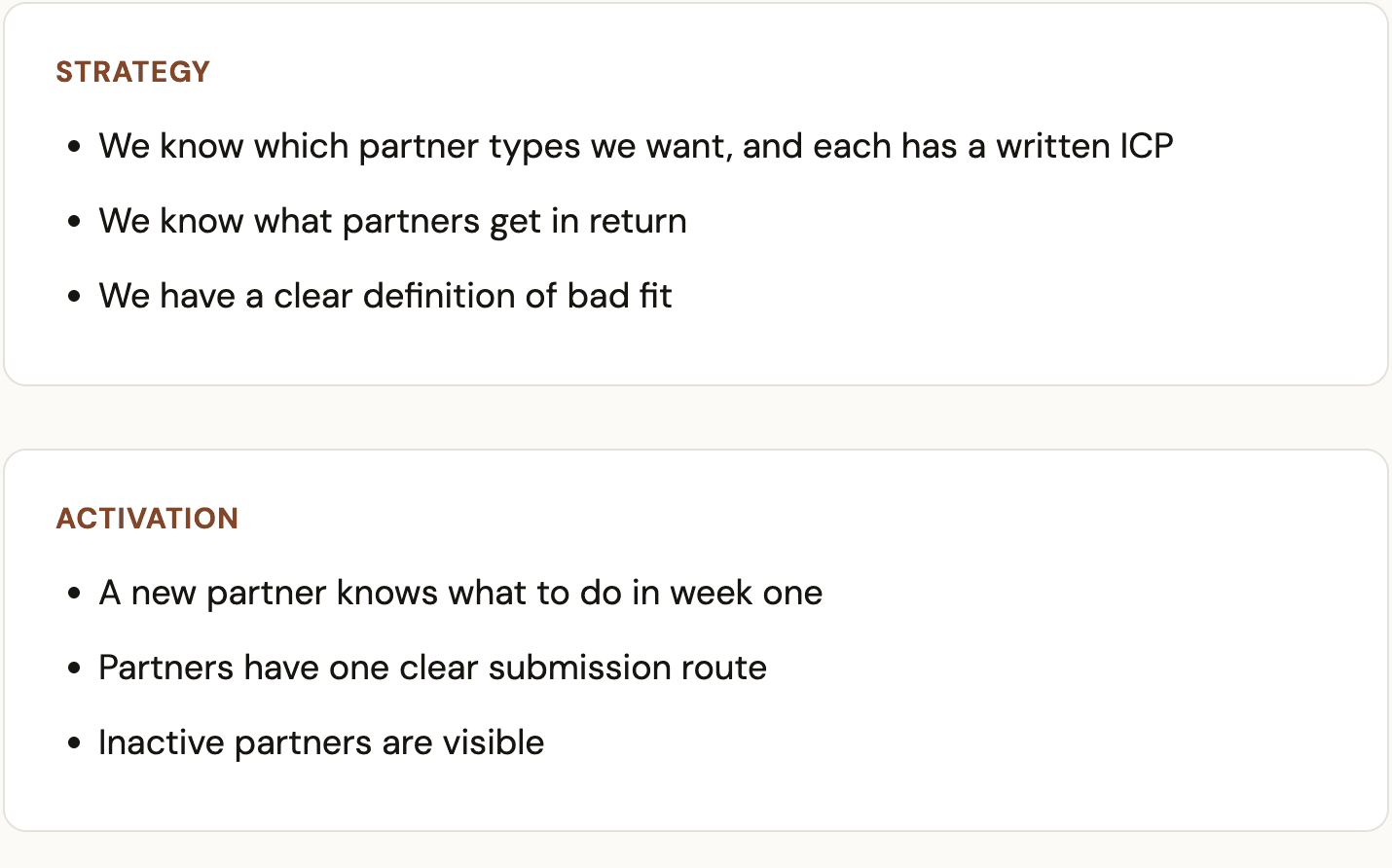
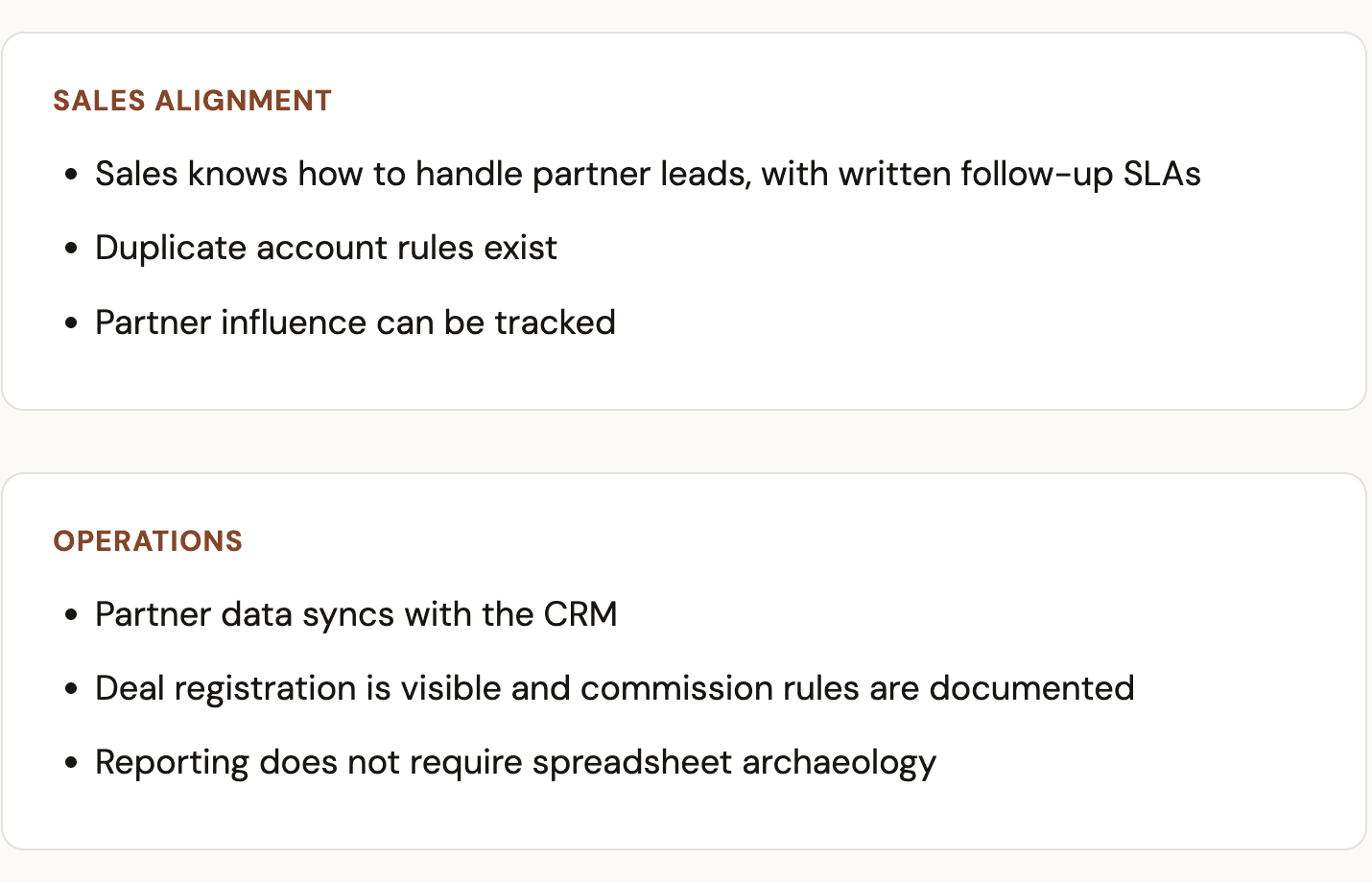
If more than five are missing, do not recruit harder. Fix the system. If more than ten are missing, the problem is not partnerships. It is operational debt wearing a partner badge.
What to Do When Things Break
Every partner programme breaks somewhere. The strong ones find the break quickly.
If partners send poor leads, fix the brief. Show good and bad examples, tighten qualification fields, and reject poor-fit leads with a reason.
If sales ignores partner leads, make the delay visible. Set an SLA, assign ownership, and escalate stale accepted leads.
If two partners claim the same deal, use deal registration rules. The first accepted registration should usually win, but only if the opportunity meets the agreed criteria. Do not create policy after the commission is disputed. That always ends badly.
If attribution gets messy, simplify it into three categories: partner-sourced, partner-influenced, and partner-assisted expansion. Then make the PRM and CRM match those definitions.
If partners stop logging in, the portal is not useful enough. Give them live deal visibility, relevant resources, training progress and reasons to return. A partner portal should feel like a working room, not a cupboard.
The Uncomfortable Truth About PRM Software
PRM software will not rescue a vague partner strategy. It will expose it.
If you do not know who your best partners are, Partner.io will make that visible. If sales ignores partner leads, Partner.io will make that visible. If your commission logic is messy or half your partners are inactive, Partner.io will make that visible too.
Good. Visibility is the first step towards a partner programme that earns its place in the revenue plan.
The companies that win with partnerships are not the ones with the most partner logos. They are the ones who make it easy for the right partners to create revenue again and again. That takes a system. Partner.io is the system for SaaS teams ready to stop managing partnerships through memory, favours and spreadsheets.
Start with one clean motion: a partner submits a lead, sales accepts it, the CRM updates, the partner sees progress, revenue closes, credit is clear. Then build from there. That is how partner revenue compounds.
Ready to stop managing partnerships through spreadsheets?
Try Partner.io Free for 14 Days