Product
PartnerStack vs Partner.io: Which PRM Fits Better?

Compare PartnerStack vs Partner.io across pricing, CRM sync, partner recruitment, co-sell, payouts and scalability for growing B2B SaaS teams.
PartnerStack is the obvious choice until you look at what most growing SaaS companies actually need.
A huge partner network sounds valuable. So does a long feature list. But neither fixes slow deal approvals, broken attribution, stale partner updates, messy payouts or a sales team working from a different version of the truth.
That is the real PartnerStack vs Partner.io decision.
PartnerStack is built to help companies recruit and manage partners at scale, particularly through its established B2B SaaS network.
Partner.io is built for companies that already have the right partners or know how to find them and need a cleaner way to turn those relationships into revenue.
For most SaaS companies below roughly $25 million ARR, execution is the harder problem — and it is a bigger problem than most vendors admit. 40% of HubSpot's and Shopify's revenue now runs through partners, and most of ServiceNow's enterprise revenue does too, but none of those companies got there with a big network and a light-touch programme. They got there by running the mechanics well.
PartnerStack vs Partner.io: the verdict
Choose PartnerStack when access to a large partner marketplace is central to the strategy, affiliate recruitment is a priority, and you are prepared for quote-based pricing and a more involved rollout.
Choose Partner.io when you need to run referrals, agencies, co-sell, integrations and reseller relationships from one system, without adding enterprise cost or operational weight.
Partner.io gives growing teams the core infrastructure they need:
CRM-connected deal registration and referral tracking
Training and certification
Automated workflows
Tiering and incentives
Manual or automated payouts
Public pricing
A faster route to launch
The difference is not feature count.
It is whether you need a partner network or a partner operating system.

PartnerStack vs Partner.io at a glance
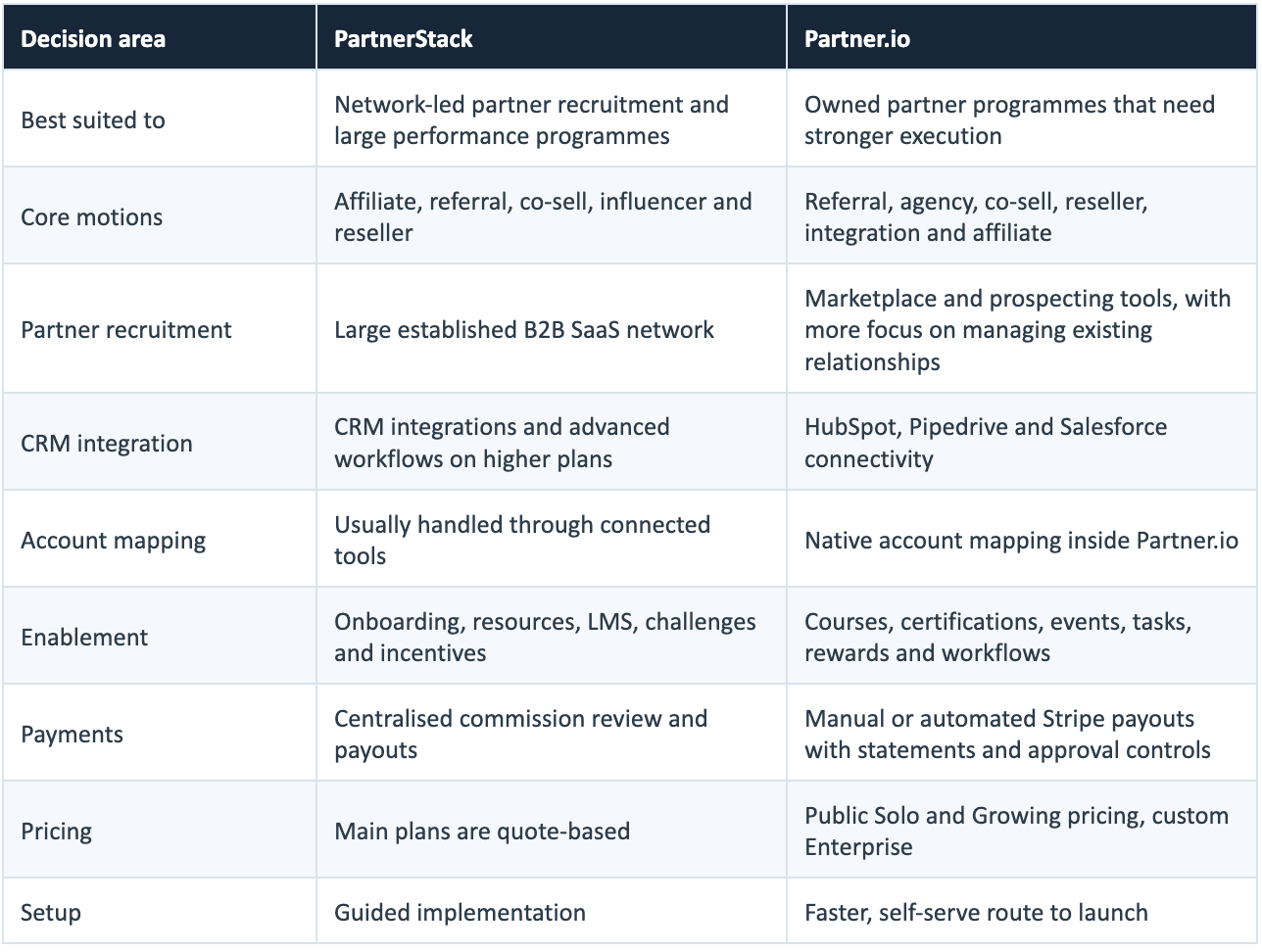
A comparison table helps. It does not tell you what will break six months after launch.
For that, use the RAIL test.
The RAIL test for choosing a PRM
RAIL forces you to judge a PRM against how your programme actually works.
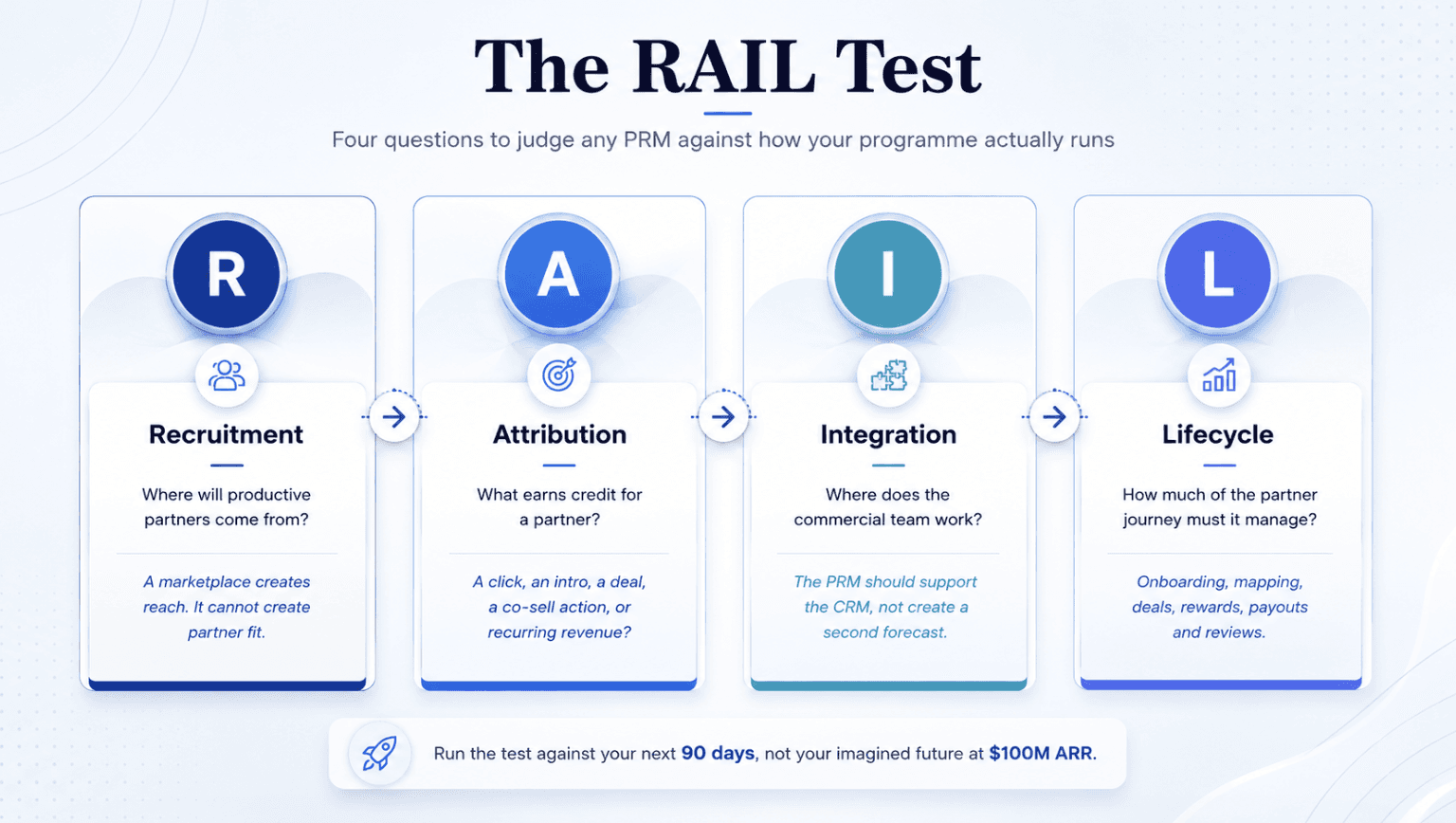
Recruitment
Where will productive partners come from?
A marketplace can create reach. It cannot create partner fit.
Attribution
What earns credit?
A click, an introduction, a registered opportunity, a co-sell action, recurring revenue or all five?
Integration
Where does the commercial team work?
If the pipeline lives in HubSpot, Salesforce or Pipedrive, the PRM must support that. It should not create a second forecast.
Lifecycle
How much of the partner journey needs managing?
Recruitment, onboarding, certification, account mapping, deal collaboration, rewards, payouts and reviews all create operational work.
Run both platforms through RAIL using your next 90 days, not your imagined future at $100 million ARR.
1. Partner recruitment: reach versus relevance
PartnerStack's strongest advantage is its network.
It gives SaaS companies access to a large pool of affiliates, publishers, agencies and referral partners already familiar with software partnerships. For businesses that need distribution fast, that matters.
Partner.io takes a different approach.
Its value appears after the relationship starts. It helps teams qualify partners, onboard them, train them, map accounts, register opportunities, collaborate on deals and manage commissions.
The decision is simple. Choose PartnerStack when the main problem is:
We cannot find enough partners
Choose Partner.io when the main problem is:
We have partners, but the programme is badly run
That second problem is more common than most companies admit.
They recruit dozens of partners, issue login details, upload a few sales decks and wait for the pipeline. Nothing happens.
A better recruitment process answers five questions before anyone gets portal access:
Which customers can this partner reach?
Which buyer do they influence?
What will both sides do together?
What should happen in the first 30 days?
What makes the relationship worth continuing?
A large network magnifies a strong programme. It also magnifies a weak one.
2. Attribution: clicks are easy, influence is not
Affiliate attribution is straightforward.
A partner shares a link. A customer converts. The platform records the event.
Agency referrals, co-sell and reseller deals are messier.
An agency may introduce the account, join discovery, shape the commercial case and help close the deal. A reseller may own the customer relationship. An integration partner may influence a renewal without ever submitting a lead.
Last-click attribution misses that work.
Loose “partner-influenced” fields create the opposite problem. Everyone claims credit.
Both platforms support deal registration and partner attribution. The difference is how comfortably the system fits the wider sales process.
Partner.io is designed around CRM-connected leads and deals. Partners can submit opportunities, follow progress and collaborate without forcing sales to manage another pipeline.
Before choosing a PRM, define what earns partner credit.
Referral rules
The account must be new or outside an active sales cycle.
The partner must provide a named contact and clear context.
Sales must accept or reject the referral within a fixed period.
Protection periods must be explicit.
Commission should follow collected revenue, not vague intent.
Co-sell rules
Record who introduced the opportunity.
Track the action that moved the deal forward.
Separate sourced revenue from influenced revenue.
Resolve competing claims before the deal closes.
Keep partner involvement visible inside the CRM.
Reseller rules
Decide who owns the opportunity.
Decide who contracts with the customer.
Decide who invoices.
Define renewal responsibility.
Separate commission, discount, margin and rebate models.
A PRM should make those rules executable.
If finance still needs a spreadsheet to work out who gets paid, the software has failed.
3. CRM integration: one pipeline, not two
The CRM should own the commercial record.
The PRM should manage the partner relationship around it.
That separation prevents one of the most common failures in partner operations.
The partner submits a deal into the portal. Sales updates HubSpot. Finance checks Stripe. The partner manager keeps a spreadsheet because the portal is out of date.
Four systems. Four answers.
PartnerStack supports CRM integrations and deeper workflow options on higher plans.
Partner.io connects partner activity directly to HubSpot, Pipedrive and Salesforce, depending on plan. Deal stages, values and partner data can move between systems while partners see the updates relevant to them.
Do not accept “native integration” as proof.
Test these five events:
A partner submits a new deal.
Sales rejects it as a duplicate.
The deal changes stage twice.
The contract value changes before close.
The customer churns or receives a refund.
Then watch what updates.
If anyone has to re-enter data, chase sales or correct a payout manually, the integration is incomplete.
4. Account mapping: built in or bolted on
PartnerStack can support account mapping through specialist integrations.
That makes sense for larger ecosystem teams already using dedicated platforms for overlap analysis, sales intelligence and partner scoring.
Partner.io includes account mapping inside the PRM.
Teams can compare customer lists, open opportunities, target accounts and prospects without buying another platform. Once an overlap appears, the same system can carry the opportunity into co-sell, attribution, collaboration and payout.
For a growing SaaS company, that is a meaningful advantage.
Choose specialist account mapping when:
Account mapping already drives a major part of the sales motion.
A large commercial team needs deeper ecosystem intelligence.
The business has budget for another platform.
The extra complexity is justified.
Choose native account mapping when:
You need actionable overlap data without another contract.
One team owns recruitment, activation and partner pipeline.
You want to move from overlap to opportunity in the same system.
Speed matters more than specialist depth.
Most growing teams do not need another platform. They need fewer disconnected ones.
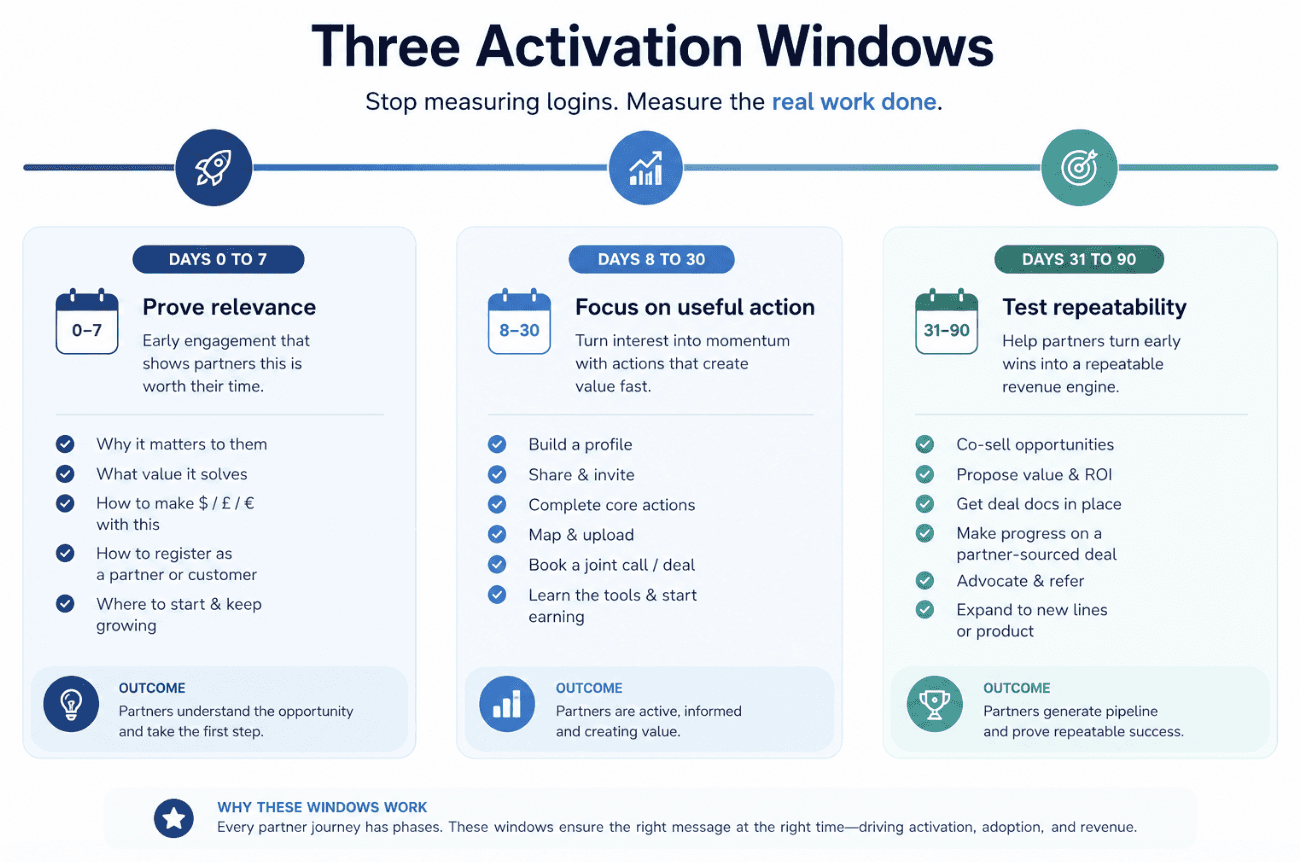
5. Partner activation: stop measuring logins
A partner is not active because they logged in.
They are active when they do something that creates commercial movement.
That might be:
Submitting an accepted referral
Mapping a target account
Completing sales certification
Joining a customer call
Launching a joint campaign
Creating their first revenue
Creating revenue again
Both platforms support onboarding and enablement.
Partner.io brings courses, certifications, tasks, events, rewards, tiers and workflows into the same environment as deals and partner communication.
That matters because enablement should lead somewhere.
Do not automate empty “we miss you” messages.
Automate the next useful action.
6. Payments: disputes start before payout day
Most commission disputes are not payment problems. They are attribution problems wearing a finance hat.
PartnerStack centralises commission review and partner payouts.
Partner.io supports manual or automated payouts through Stripe, alongside approval controls, partner statements, invoice generation and real-time earnings visibility.
Commission ranges in B2B SaaS typically run 25 to 40%+ of first-year contract value for a partner-closed deal, so getting the payout mechanics right is not a rounding error. It is one of the largest line items in the programme.
The right system should answer seven questions without a finance investigation:
What event made the commission payable?
Was the reward based on contract value or collected revenue?
What happens after churn, refunds or non-payment?
Who approved the amount?
Which deal and customer produced it?
Can the partner see pending, approved and paid amounts?
When should the money arrive?
Partner.io's advantage is not simply payment automation.
It connects the payout to the same partner, deal and revenue history used by the commercial team. That reduces arguments because the evidence is already there.
What this looks like in the real world
Clearer.io grew sales 40% after moving to a CRM-connected partner programme.
Proof point: Clearer.io on Partner.io
An agency introduces a prospect worth £36,000 in annual recurring revenue.
The account already exists in HubSpot because someone downloaded an ebook six months earlier. Sales creates a new opportunity but never attaches the partner.
Three weeks later, the agency asks for an update.
The partner manager finds two company records and sends a vague reply. The deal closes. Finance cannot prove the introduction created the opportunity, so the payout is delayed.
Nobody set out to cheat the agency.
The process failed.
A working system would do this:
The agency submits the opportunity with context.
The platform checks the account against duplicate rules.
Sales accepts or rejects the deal within the agreed SLA.
The accepted opportunity is attached to the partner in the CRM.
Stage updates flow back to the partner.
Notes and next actions stay with the deal.
The revenue event triggers the correct commission rule.
Finance approves the payout with the full evidence in front of them.
That is what partner management software should do.
Everything else is decoration.
7. Pricing: compare total cost, not licence cost
PartnerStack's core plans use quote-based pricing.
Partner.io publishes Solo and Growing prices, offers a free trial and gives smaller teams a clearer route to launch.
That makes Partner.io easier to evaluate.
Still, the licence cost is only one line.
Calculate:
Subscription cost
Implementation
Commission fees
CRM integration work
Account-mapping tools
Data migration
Training
Internal administration
Support
Reporting and reconciliation time
Revenue lost through slow deal handling
A cheap tool becomes expensive when the team works around it.
An expensive platform can justify itself when its network creates profitable distribution that the company could not build alone.
The decision should come down to one number:
How much partner-sourced gross profit must this platform create or protect within 12 months?
Work backwards from that.
Do not build the case around hundreds of inactive partners suddenly becoming productive. They will not.
TRY PARTNER.IO FREE FOR 14 DAYS
Where PartnerStack is the better choice
PartnerStack is the stronger option when:
Partner recruitment is the main constraint.
Affiliate and performance partnerships dominate the programme.
The company wants access to an established SaaS partner network.
The programme will operate across a large number of partners.
Dedicated account-mapping software is already in place.
Quote-based pricing is acceptable.
The team can support a more involved implementation.
PartnerStack is a serious platform.
Its network is the reason to buy it.
Do not pay for that advantage unless you plan to use it.
Where Partner.io is the better choice
Partner.io is the stronger choice when:
The business already attracts partners through customers, agencies, integrations, communities and direct outreach.
The programme mixes referrals, agencies, co-sell, reseller and integration relationships.
HubSpot, Pipedrive or Salesforce must remain the source of commercial truth.
Partners need live deal visibility.
Account mapping should live inside the PRM.
Training, tasks, events, workflows, tiers and payouts need to work together.
Public pricing matters.
The team wants to launch without an enterprise implementation project.
The business does not want another percentage taken from partner commissions.
This is where Partner.io separates itself.
It is a tighter operating system for companies that want to own their partner relationships, not rent access to a network.
Before switching PRMs
A migration is not a file import. It is a chance to remove the mess.
Before moving:
Export partners, contacts, groups, tiers and statuses.
Separate active partners from dead accounts.
Classify each relationship by motion.
Document every commission rule and exception.
Make the CRM the source of truth for pipeline and revenue.
Map old stages to the new workflow.
Decide which historical deals and payouts must remain visible.
Remove duplicates.
Rebuild training around the first commercial action.
Test one referral, one duplicate, one closed-won deal, one refund and one payout.
Reconcile the results with finance.
Invite the wider partner base only after the process works.
Do not import every broken field because it exists.
Leave the clutter behind.
What to fix when the programme breaks
Leads sit untouched
Set an acceptance SLA. Assign an owner. Escalate missed deadlines. Track response time by salesperson and partner type.
Sales ignores partner attribution
Put partner fields inside the normal opportunity view. Make attribution part of the sales process, not separate admin.
Partners stop sending deals
Find the cause. They may lack knowledge, account overlap, support or trust. Some were never a fit. Do not send all of them the same reactivation email.
Finance disputes commissions
Trace each amount back to the payment, customer, deal, partner agreement and reward rule. Stop creating undocumented exceptions.
CRM and PRM stages drift apart
Choose one authoritative system. Reduce the number of synced fields. Test every stage change.
Nobody uses the portal
Remove the generic content library.
Give partners what they need during a live deal:
Qualification criteria
Discovery questions
A short pitch
Objection handling
Pricing guidance
A clear route to support
The choice is simpler than vendors make it sound
PartnerStack is the better choice when the network is the product.
Partner.io is the better choice when execution is the problem.
Most growing SaaS companies do not suffer from a shortage of possible partners. They suffer from slow follow-up, weak attribution, scattered data, poor enablement and payouts nobody can explain.
Buying access to more partners will not fix that.
A cleaner operating system will.
Start with one real partner, one real opportunity and one real commission rule. Put the full journey into Partner.io, from introduction to revenue.
If the process works without a spreadsheet, a status chase or a finance argument, you have your answer.
TRY PARTNER.IO FREE FOR 14 DAYS
Sources and further reading
SaaStr - Dear SaaStr: How Should I Get Our First Partner Program Going?
SaaStr - Typical commission ranges for referral partners in Enterprise B2B SaaS
Atlassian - How a partner ecosystem helps grow your SaaS business