Product
Partner.io vs Impartner: Which PRM Fits SaaS?

A practical PRM comparison for B2B SaaS teams that need partner revenue this quarter, not a software implementation programme.
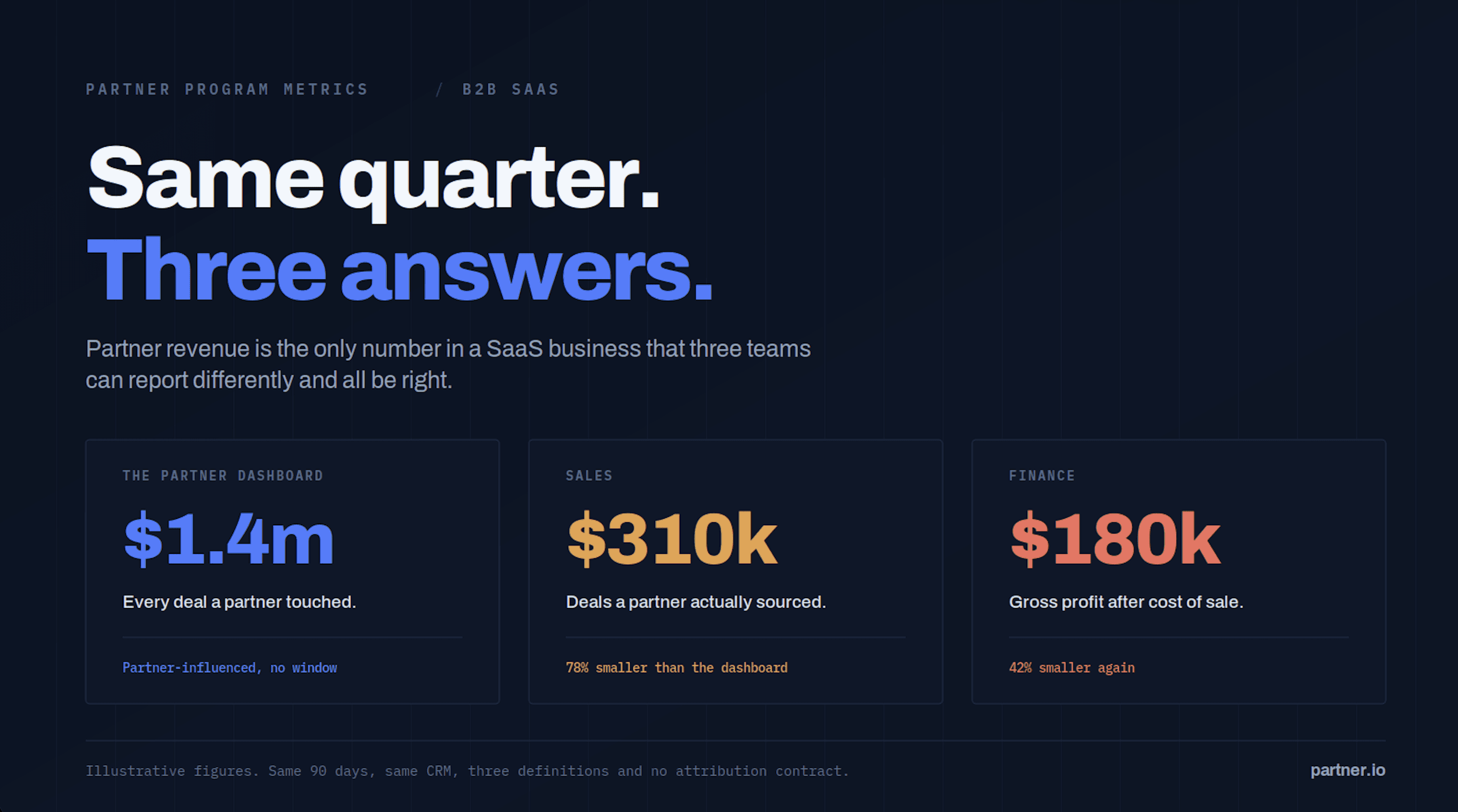
A bigger PRM is not automatically a better PRM. It is a bigger commitment.
That distinction decides budgets. When a partnership programme has to produce pipeline now and the team running it is two people, the wrong purchase is not the cheap one. It is the one that turns partner management into a second job.
Buy too little and referrals disappear into inboxes. Buy too much and the next quarter vanishes into scoping workshops, field mapping, permissions, module enablement and internal adoption.
Partner.io and Impartner both manage partners. They are not the same purchase. Impartner is a wide enterprise platform built to govern complex ecosystems. Partner.io is a focused partner relationship management platform built to get referrals, co-sell activity, reseller deals, enablement and commissions moving without a transformation project.
Buy too little and referrals disappear into inboxes. Buy too much and the next quarter disappears into scoping workshops.
The short answer
For most B2B SaaS companies below roughly $25 million ARR, Partner.io is the stronger operational fit. The programme is still changing shape every month, the team is small, and the cost of slow change is higher than the cost of missing features.
Impartner earns the decision when complexity is already real, funded and unavoidable. Multi-language channel programmes, formal MDF governance, distributor layers, structured business planning, hyperscaler marketplace workflows or CPQ are not things you grow into by accident. If they are on your requirements list today, buy for them.
Confidence in that split: high. It follows directly from what both vendors publish about pricing, packaging and implementation. Confidence in any specific feature-by-feature verdict: moderate at best, because package contents and limits change and neither company publishes a full functional specification.
Partner.io vs Impartner at a glance
Decision area | Partner.io | Impartner |
Best fit | Lean and scaling SaaS partner programmes | Mature, complex and global channel ecosystems |
Buying motion | Self-serve trial and published pricing | Demo-led purchase with personalised pricing |
Public price | $79 per seat per month | Not publicly stated |
Free trial | 7 days, no credit card, cancel anytime | Not offered publicly |
Implementation | Self-serve, designed to launch the same day | Guided implementation across all packages |
Core revenue loop | Leads, deals, CRM sync, commissions and payouts | Partner lifecycle, pipeline, enablement and analytics, with specialist add-ons |
Notable depth | Account mapping, Stripe payouts, multi-motion simplicity | MDF, TCMA, business planning, CPQ, distribution, hyperscaler workflows |
CRM position | HubSpot, Salesforce and Pipedrive, plus API and webhooks | Salesforce, Dynamics 365 and HubSpot, with advanced object and field mapping |
Commercial risk | Low entry cost, validate with a live programme | Scope and total cost must be established through sales discovery |
This table is a buying guide, not a claim that every capability is identical. Configuration limits, package contents and integration requirements should be tested against your own workflow before you sign anything. All figures verified against both vendors' public pages in September 2026.
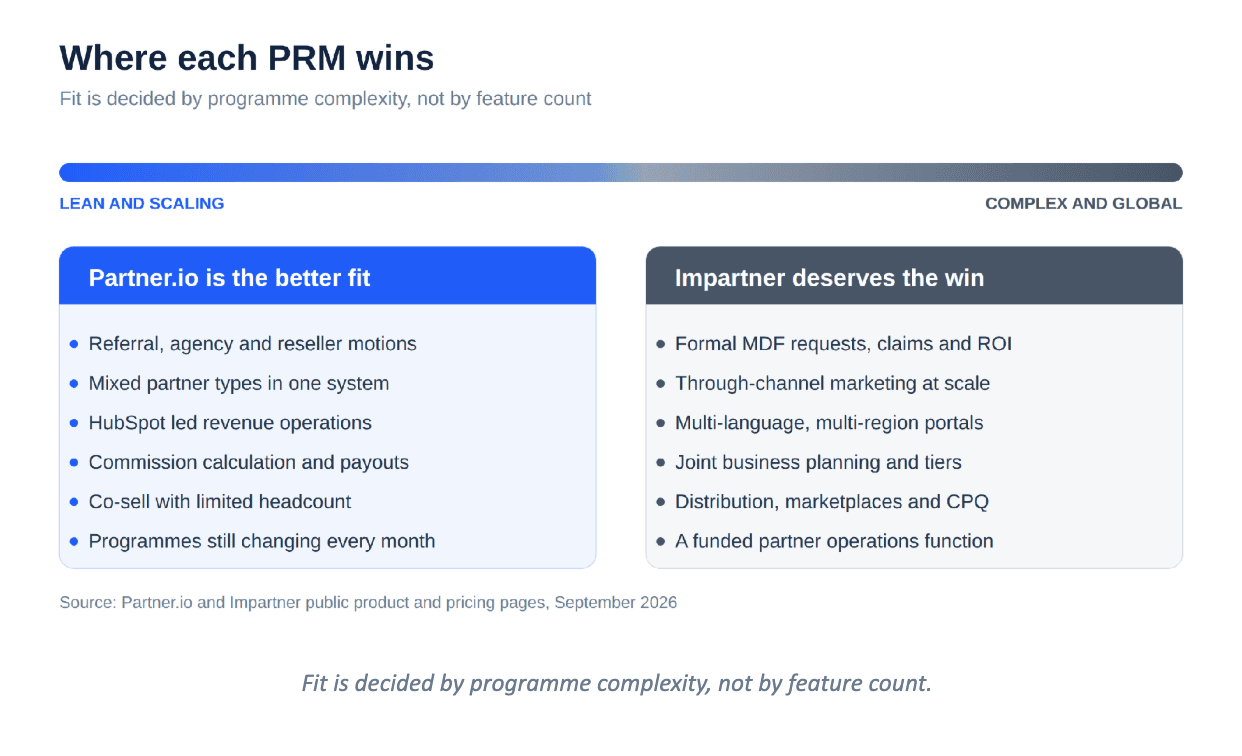
The real choice is operating model, not feature count
PRM comparisons collapse into tick boxes almost immediately. Both products onboard partners, distribute content, register deals, connect to a CRM, train users and report performance. That tells you close to nothing about what Monday morning feels like after launch.
The useful question is narrower: how much machinery does your partner motion actually need?
What Impartner is built to do
Impartner's public product range spans partner lifecycle management, partner marketing automation, communications, market development funds, business planning, tier compliance, marketplace tools, referral automation, distribution, CPQ and hyperscaler go-to-market. Its own site positions the platform across the full partner revenue lifecycle and showcases global brands including Honeywell, Siemens, Visa, Samsung and Xerox.
That breadth is a genuine strength when an organisation needs it. Governing a 3,000-partner, 14-country channel with co-branded campaigns and fund claims is a real problem, and a lightweight tool will not solve it.
What Partner.io is built to do
Partner.io starts at the recurring jobs a SaaS partnership team has to complete every week: accept a partner, give them the right resources, register and route a deal, sync it with sales, attribute the revenue, calculate commission, pay the partner.
Its published package includes partner management, lead and deal management, a branded partner portal, a training academy, custom tiers and rewards, workflows, account mapping and commissions with payouts. One price, one package, no module matrix to decode.
A platform can be excellent and still be the wrong size. Buying enterprise breadth before the operating model requires it is how teams end up administering software instead of building partner revenue.
Buying enterprise breadth before your operating model requires it is how teams end up administering software instead of building partner revenue.

Run the FIRST Deal test before you run a demo
The cleanest PRM evaluation starts with one outcome: can a newly recruited partner reach a properly attributed first deal without staff heroics?
Five questions expose the gap between a good demo and a workable system. Score both vendors out of five and the shortlist usually settles itself.
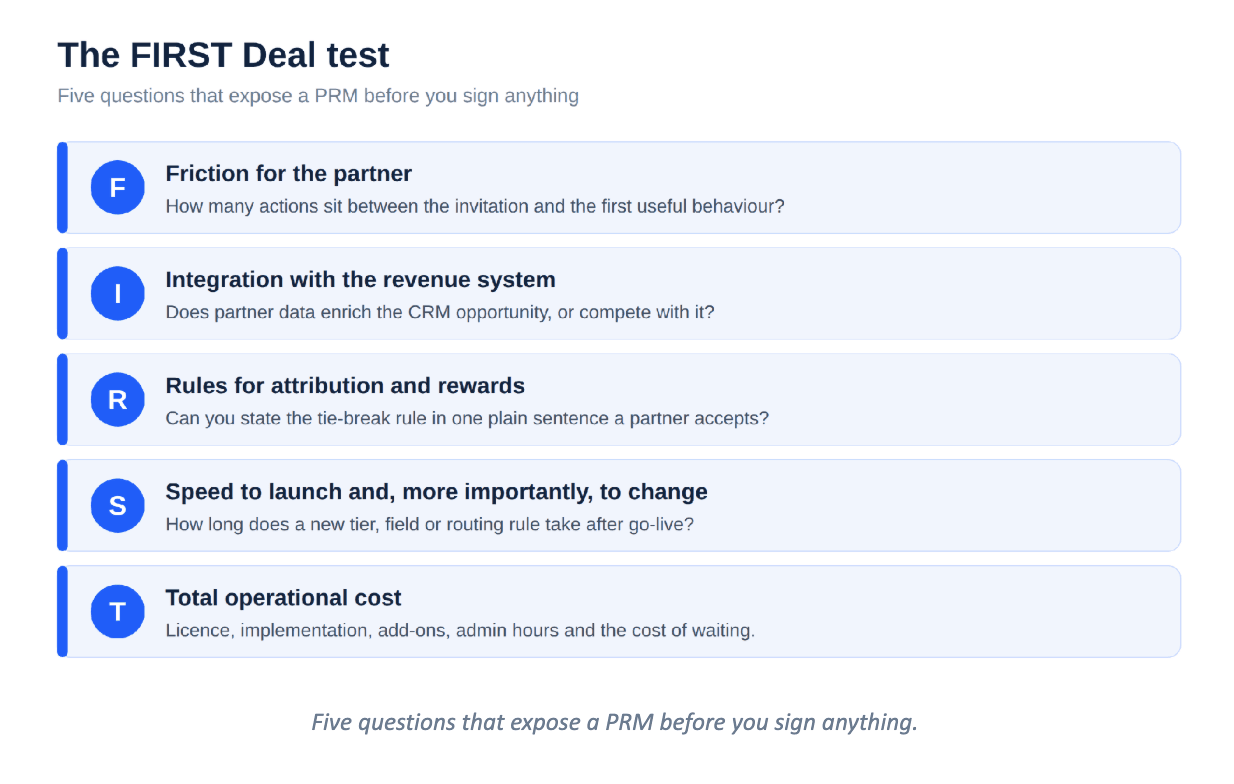
F: Friction for the partner
Count the actions between invitation and useful behaviour. Can an agency accept terms, learn the pitch, find a battlecard and submit a lead without asking where anything lives? Can a reseller see deal status and commission? Can a technology partner identify a shared account and request an introduction?
Every extra login, generic content library and unexplained form field weakens activation. Test the portal with a real partner, not with the internal project team. Your project team already knows where everything is, which makes them the worst possible test subjects.
I: Integration with the revenue system
The CRM must remain the commercial system of record. Partner data should enrich the opportunity, not create a competing version of it.
Confirm object mapping, record ownership, stage updates, deduplication, attribution fields and failure alerts. Deduplication is the one that bites: HubSpot's own duplicate management tooling covers contacts and companies, and gates bulk handling and custom rules behind higher tiers, so a PRM that creates records carelessly will hand you a cleanup project.
Partner.io connects with HubSpot, Salesforce, Pipedrive, Shopify and Slack and supports API and webhook workflows. Impartner supports Salesforce, Dynamics 365 and HubSpot, and describes real-time, bi-directional mapping across standard or custom objects and fields.
Impartner has the deeper public story for intricate enterprise data models. Partner.io covers the common SaaS stack with less ceremony. Both statements are true at once.
R: Rules for attribution and rewards
Write down what happens when two partners touch the same account, when sales already has an open opportunity, when a customer expands, and when an invoice is refunded.
If the rule cannot be stated plainly in one sentence, automation will only make the dispute arrive faster.
Partner.io puts commission tracking, approvals, invoices, statements and payouts in the operating flow. Its payments product runs rewards through Stripe with a choice of manual approval or automatic payment, which maps onto Stripe's own payout controls for connected accounts. Impartner lists Rewards Management as an add-on on its PRM pricing page, so buyers who need cash commission operations should ask exactly what calculation, approval, invoice and payout work remains outside the platform.
S: Speed to launch, and speed to change
Launch speed matters. Change speed matters more.
Your first tier model will be wrong. A lead form will need another field. Sales will ask for a new routing rule. Finance will change the payment approval process. The question is not how fast you can go live, it is how fast you can be wrong and recover.
Partner.io is self-serve and designed to go live the same day. Impartner includes guided implementation across its packages. Neither model is universally superior. Guided implementation is valuable when the programme spans multiple regions, languages, CRM objects and governance groups. For a lean team still proving its motion, fast configuration protects learning velocity.
T: Total operational cost
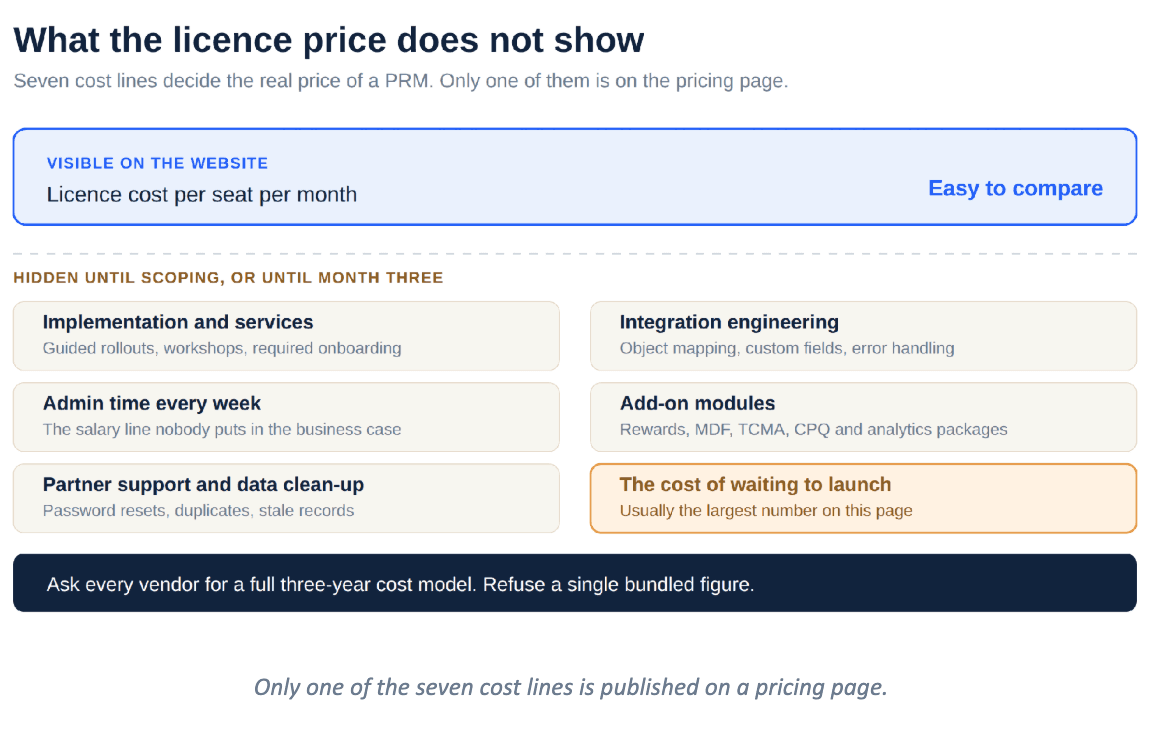
Licence price is the visible part and usually the smallest part. Add implementation, integration work, admin hours, specialist modules, partner support, data clean-up and the cost of waiting to launch.
Partner.io publishes $79 per seat per month, unlimited partners, a 7-day free trial, no credit card and no contract. Impartner publishes four package names, Emerge, Ignite, Pro and Enterprise, and asks buyers to request personalised pricing. Several capabilities appear as add-ons, including Rewards Management, MDF, TCMA, CPQ, Orchestration Studio and Analytics Studio.
That does not make Impartner poor value. It means you cannot calculate total cost from the website, so demand a complete three-year cost model before comparing proposals.
Test the cheaper hypothesis first
Partner.io gives you 7 days free, no credit card and no contract. That is long enough to connect a CRM, register one real deal and run a mock payout. Run the FIRST Deal test with your own process before you book a single enterprise scoping call.
→ Start your free 7-day Partner.io trial
Where Partner.io is the better fit
Partner.io makes its strongest case when the partner programme is commercially serious but the operating team is not large.
Referral and agency programmes. Partners need a clean way to submit opportunities, follow progress and understand earnings.
Mixed partner models. Referrals, agencies, resellers, affiliates, solution partners and technology partners sit in one system instead of one tool each.
HubSpot-led revenue operations. Partner records and deals flow into the same pipeline the direct sales team already uses.
Commission-heavy programmes. Reward rules, approvals, statements, invoices and payouts stay connected rather than split between spreadsheets and finance tickets.
Co-sell with limited headcount. Account mapping has to produce warm-path actions, not another dashboard nobody opens.
Programmes still learning. Pricing, tiers, forms, onboarding and automations will change often, so the cost of change must stay low.
That last point is the real Partner.io advantage. It is not simply cheaper software. It compresses the distance between programme design and live partner behaviour.
“We're not just seeing more referrals - we're seeing better ones. The quality, the consistency, the visibility... it's all gone up since we moved to Partner.io.”
Darren Matthews, Head of Partnerships, Salesfire
Where Impartner deserves the win
Choosing Partner.io purely because it is simpler would be false economy in some businesses. Impartner should lead the shortlist when several of the following are true now, not in a speculative future.
Formal market development fund requests, approvals, claims and ROI analysis across a large channel.
Through-channel marketing automation or paid media orchestration at scale.
Multi-language, multi-region partner experiences with complex segmentation and compliance requirements.
Joint business planning with structured goals across strategic partners.
Distribution hierarchies, cloud marketplace workflows, advanced CPQ or a broad enterprise object model.
A dedicated partner operations function, an implementation budget and enough process maturity to govern the configuration.
Impartner's lead and pipeline management also shows real operational depth: assignment based on certification, capacity and performance, response timers, stalled-lead reassignment, multiple-partner opportunities, currency controls and CRM-connected attribution.
If those are written requirements rather than impressive demo moments, the heavier platform is justified. If they arrived in your notes because a salesperson demonstrated them, they are not requirements.
If a capability arrived on your requirements list because a salesperson demonstrated it, it is not a requirement.
What this looks like in the real world
Consider a composite SaaS company at $14 million ARR. It has 72 partners: 45 agencies, 17 referral partners and 10 technology partners. One person owns partnerships, RevOps helps part-time, and HubSpot plus Stripe run the commercial back end.
There is no MDF programme, no distributors and no regional price books. The pain is more ordinary than that. Leads arrive by email. Sales forgets to update partners. Commission is calculated at month end in a spreadsheet that only one person understands. Technology partners share target-account lists that are stale before the next call. This is the spreadsheet tax most programmes pay without measuring it.
An enterprise PRM could solve every one of those issues. It would also invite months of design work around capabilities this team will not use for three years.
The smarter rollout is narrower. Import partners. Separate the agency, referral and technology journeys. Connect HubSpot. Define duplicate and ownership rules. Build two commission plans. Publish five essential assets. Map accounts with the ten technology partners.
In month one, success is not portal logins. It is accepted registrations, response time, active co-sell plays, attributed pipeline and correct payouts. That is a Partner.io-shaped problem.
“We moved from a legacy PRM that just couldn't meet our needs. Partner.io has been incredible. They built us a custom solution and had us live in under two weeks.”
Tom Shinners, CEO, Infinite Wireless
The loop a PRM has to close
Strip away the module names and every partner programme runs the same eight-step loop. A PRM is worth its price if it closes that loop without manual intervention, and worth nothing if it does not.
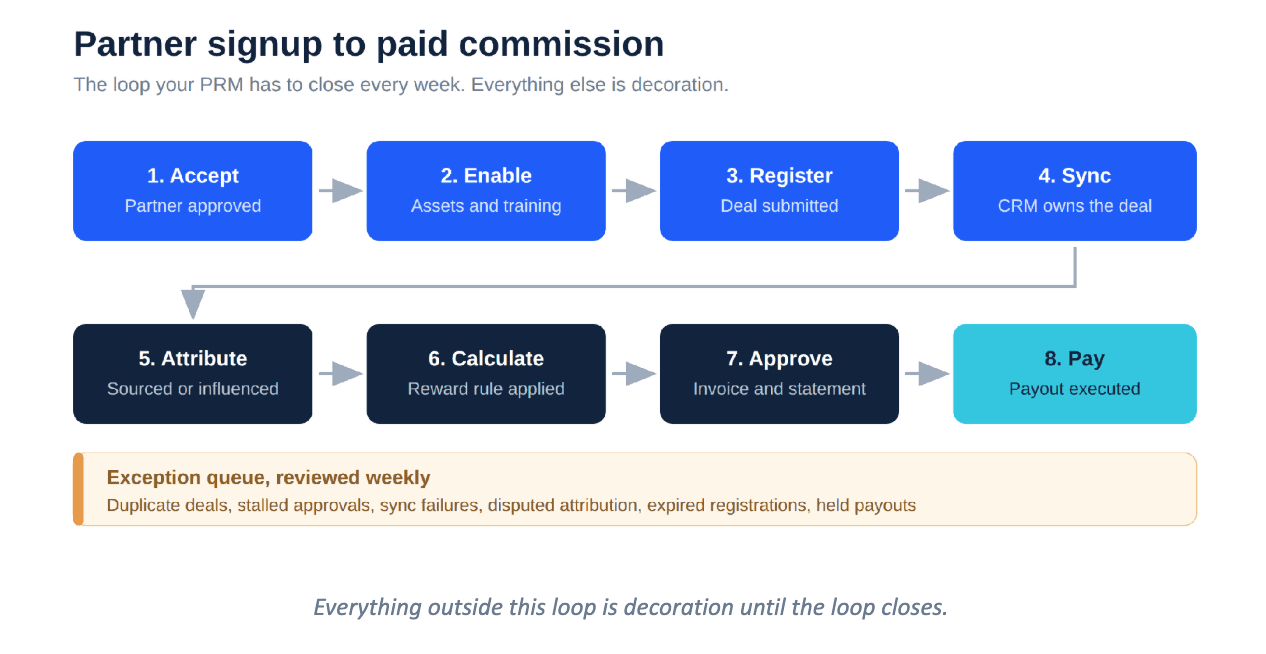
Note the exception queue at the bottom. Automation handles the normal path. Operators work the exceptions. A small, visible exception list is healthier than pretending every workflow is perfect.
Seven operating patterns that make either PRM work
The platform decision matters less than the operating decisions below. Get these wrong and both products will disappoint you.
1. Design for activation, not recruitment
A database full of approved partners is not a channel. Define activation separately for each motion.
A referral partner becomes active after an accepted lead. An agency becomes active after completing enablement and joining a live opportunity. A reseller becomes active after an approved registration. A technology partner becomes active after a shared-account action or a qualified co-sell play.
Build onboarding backwards from that event and remove anything that does not help the partner reach it. If you are still recruiting partners faster than you activate them, read the difference between having partners and running a partner program before you buy anything.
2. Give every deal one commercial record
The CRM opportunity holds the deal amount, stage, owner and forecast. The PRM holds the partner relationship, registration, influence, reward rules and partner-facing status. Sync only the fields each team needs to do its job.
Do not let a PRM create duplicate opportunities whenever a partner submits a known contact. Test the existing-contact, existing-company and existing-open-deal scenarios before launch, not after.
3. Put an SLA behind deal registration
A deal registration form without a response promise is a complaint generator.
Set an internal review target, assign an owner and escalate breaches. When a lead is rejected, require a reason the partner can understand. When it is accepted, show the protection period, the next step and the responsible seller.
4. Make commission logic boring
Commission should be predictable enough that a partner can calculate it before submitting a deal.
Define the trigger, eligible revenue, percentage or fixed amount, duration, exclusions, refund treatment, currency and payment timing. Version the rule when it changes. Never silently rewrite a plan against an open deal. That is how you lose your three best partners in one month.
5. Separate partner motions
An agency, a reseller and an integration partner do not need the same portal journey.
Use partner types, attributes, tiers and workflows to give each group the right form, content, training and call to action. One portal does not have to mean one generic experience.
6. Turn account overlap into an action
Account mapping has value only when ownership and timing follow it.
For each overlap, choose one action: introduction, opportunity support, co-marketing, customer expansion or no action. Assign it, set a due date and write the outcome back to the opportunity. Partner.io's account mapping is useful here because it connects customer, prospect and open-opportunity overlaps to specific plays rather than to a list.
7. Run an exception queue
Review it weekly: duplicate deals, stalled approvals, sync failures, disputed attribution, expired registrations and held payouts.
The queue is your early warning system. When it grows for three weeks in a row, something in the configuration is wrong, and no amount of partner recruitment will compensate.
A 30-day PRM rollout plan
A smaller platform does not remove the need for discipline. It makes disciplined rollout possible without a transformation programme.
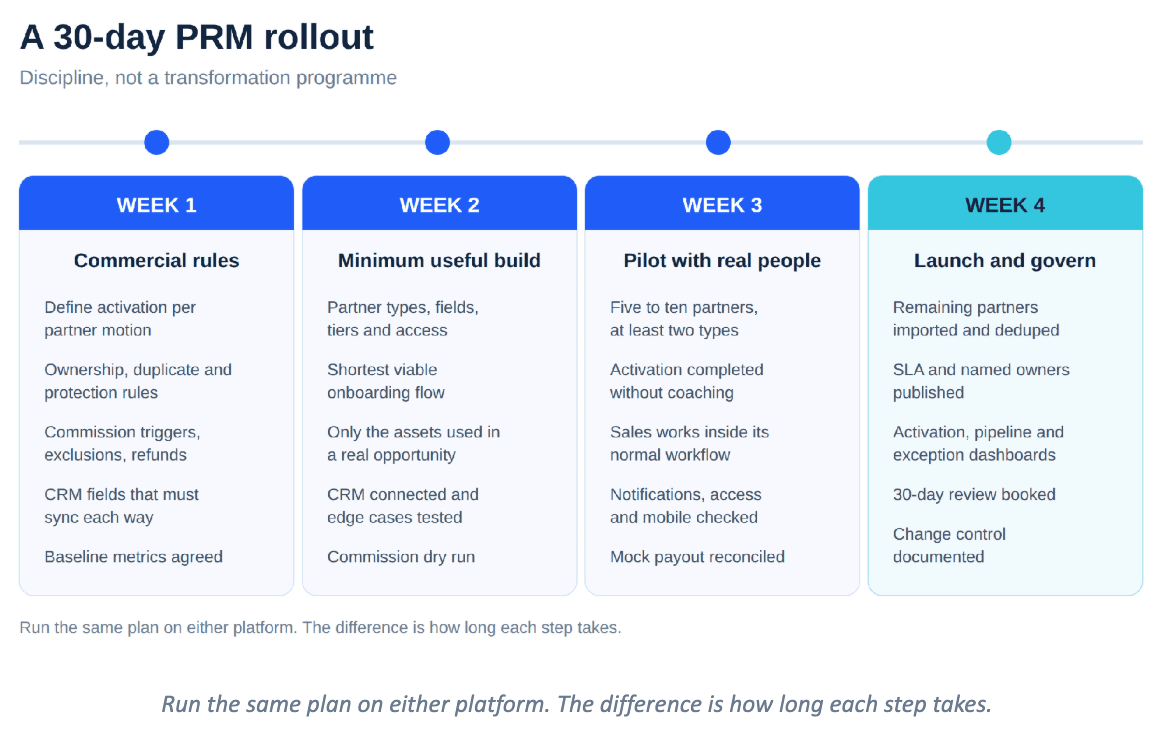
Week 1: define the commercial rules
List the partner motions and define activation for each one.
Write the deal ownership, duplicate, protection and attribution rules.
Define commission triggers, exclusions, refunds and approval owners.
Choose the CRM fields that must sync in each direction.
Set baseline metrics: active partners, accepted deals, response time, sourced pipeline, influenced pipeline and payout accuracy.
Week 2: build the minimum useful programme
Configure partner types, fields, tiers and access.
Create the shortest viable application and onboarding flow.
Publish only the sales assets partners use during a real opportunity.
Connect the CRM and test create, update, duplicate and closed-lost cases.
Create commission rules and run sample deals before real money is involved.
Week 3: pilot with partners and sales
Use five to ten partners across at least two partner types.
Ask each partner to complete the activation event without coaching.
Have sales accept, reject and update registrations inside its normal workflow.
Test notifications, permissions, mobile access and partner-visible status.
Reconcile a mock payout from source transaction to partner statement.
Week 4: launch and govern
Import the remaining partner records after deduplication.
Publish the SLA and the named owners.
Launch dashboards for activation, pipeline and exceptions.
Book a 30-day review to remove friction and retire unused content.
Document who can change integrations, rewards, payouts and partner access.
What to do when the partner motion breaks
Most PRM failures are diagnosable in a morning. Match the symptom to the cause before you blame the software.
Symptom | Probable cause | First fix |
Many partners, few deals | Recruitment is being counted as success | Define activation by partner type and rebuild onboarding around it |
Sales ignores registrations | The PRM sits outside the sales workflow | Sync ownership and status into the CRM, then add an SLA and escalation |
Duplicate CRM deals | Create logic does not check existing records | Match contact and company, then check for an open opportunity before creating |
Commission disputes | Rules are ambiguous or transaction data is wrong | Freeze the affected payout, trace the source record, publish the rule |
Partners stop logging in | The portal is a content cupboard | Send event-driven tasks so every visit leads to a useful action |
Co-sell produces meetings, not pipeline | Overlaps have no owner or next step | Assign one action, one seller and one date to every selected account |
Reports disagree | Two systems own the same metric | Name one source of truth for amount, stage, attribution and payment |
Seven questions to put into both demos
Send these in writing before the call. A vendor that cannot demonstrate them with your data model is selling you a feature tour.
Show an existing CRM contact with an open opportunity. What happens when a partner registers that same account?
Create a referral, a reseller and a technology partner. Show how their onboarding and portal experience differ.
Change a commission rule for future deals without changing an existing deal. Show the audit trail.
Break the CRM sync. Who is alerted, what retries, and how is the failed record repaired?
Show a partner-visible deal from registration through closed won to paid.
Show an account overlap becoming an owned co-sell task, then show how its influence appears in reporting.
Provide the full first-year and three-year cost, including implementation, integrations, add-ons, support and required services.
Partner.io vs Impartner FAQs
Is Partner.io better than Impartner?
For lean B2B SaaS teams that want referrals, agencies, resellers, co-sell, CRM attribution and partner commissions in one manageable system, Partner.io is the better fit. Impartner is stronger when the requirement includes enterprise channel complexity such as MDF, business planning, distribution, multiple languages, hyperscaler workflows or advanced CPQ.
How much does Partner.io cost?
Partner.io publishes pricing at $79 per seat per month, with unlimited partners, a 7-day free trial, no credit card required and the ability to cancel at any time. Pricing changes, so confirm the live pricing page before you buy.
Does Impartner publish its pricing?
No. Impartner publishes four package names and capability coverage, but no dollar prices. Buyers request personalised pricing. Ask for implementation, integrations and add-on modules to be itemised rather than bundled into one figure that cannot be compared.
Can both platforms manage deal registration?
Yes. Both support partner lead and deal workflows with CRM integration. Impartner publicly describes advanced lead distribution, response timers, reassignment and multi-partner opportunities. Partner.io combines lead and deal management with partner workflows, account mapping, commission calculation and payouts in a simpler commercial package.
Which PRM is better for HubSpot?
Both offer HubSpot integration, so the decision rests on workflow depth and operating load rather than on the existence of a listing. Test duplicate handling, object mapping, ownership, stage sync, attribution and error recovery against a copy of your real process.
Which PRM is better for partner payouts?
Partner.io has the clearer public proposition for direct commission operations, combining calculation, approval controls, partner statements, invoices and Stripe payouts. Impartner offers Rewards Management as an add-on, so its fit for cash commissions and payment execution needs to be confirmed during scoping.
What are the main Impartner alternatives?
The PRM category is crowded. G2 lists more than 80 products under partner relationship management. Shortlist on operating model rather than category presence: published pricing, trial availability, CRM depth, payout capability and how quickly the configuration can change after launch.
Choose the PRM your team can operate
Impartner is built for breadth. Partner.io is built for momentum.
The wrong decision is not choosing the product with fewer features. It is choosing a system whose operating burden is larger than the programme it is meant to support.
If your programme needs global channel architecture, extensive MDF, business planning, distribution and marketplace controls, put Impartner through a formal requirements process and budget properly for the implementation it deserves.
If the immediate job is to turn referrals, agencies, resellers and technology relationships into attributed pipeline and accurate payouts, test the cheaper hypothesis first. Connect the CRM. Register a deal. Move it through sales. Calculate the reward. Then pay it.
“Partner.io has been a game changer for our partnership GTM. It's helped us grow partner sourced revenue without needing to grow the team.”
Paul Wilson, Director of Partnerships, Videowise
Run the FIRST Deal test this week
Seven days is enough to connect HubSpot, register one real deal, map ten accounts and reconcile a mock payout. If the loop closes, you have your answer. If it does not, you have lost a week instead of a quarter.
→ Start your free 7-day Partner.io trial
Prefer a walkthrough with your own data first? Book a Partner.io demo
Keep reading