Product
Account Mapping for Mid-Market SaaS That Drives Revenue Copy

Account mapping finds the overlap. It does not build the motion. Here is the operating system that turns shared logos into pipeline a seller will work on a Tuesday morning.
Most co-sell motions die within a week of the account mapping call.
The two partners find 300 overlapping logos, congratulate each other on the length of the list, then hand it to sales. Nothing moves. Overlap is not intent, and a relationship is not a sales process.
Here is the only test that matters. Can a seller open a live opportunity, identify the right partner, explain in one sentence why that partner belongs in the deal, and trigger a useful action before the buyer loses interest?
If the answer is no, you do not have a co-sell motion. You have a partnership announcement.
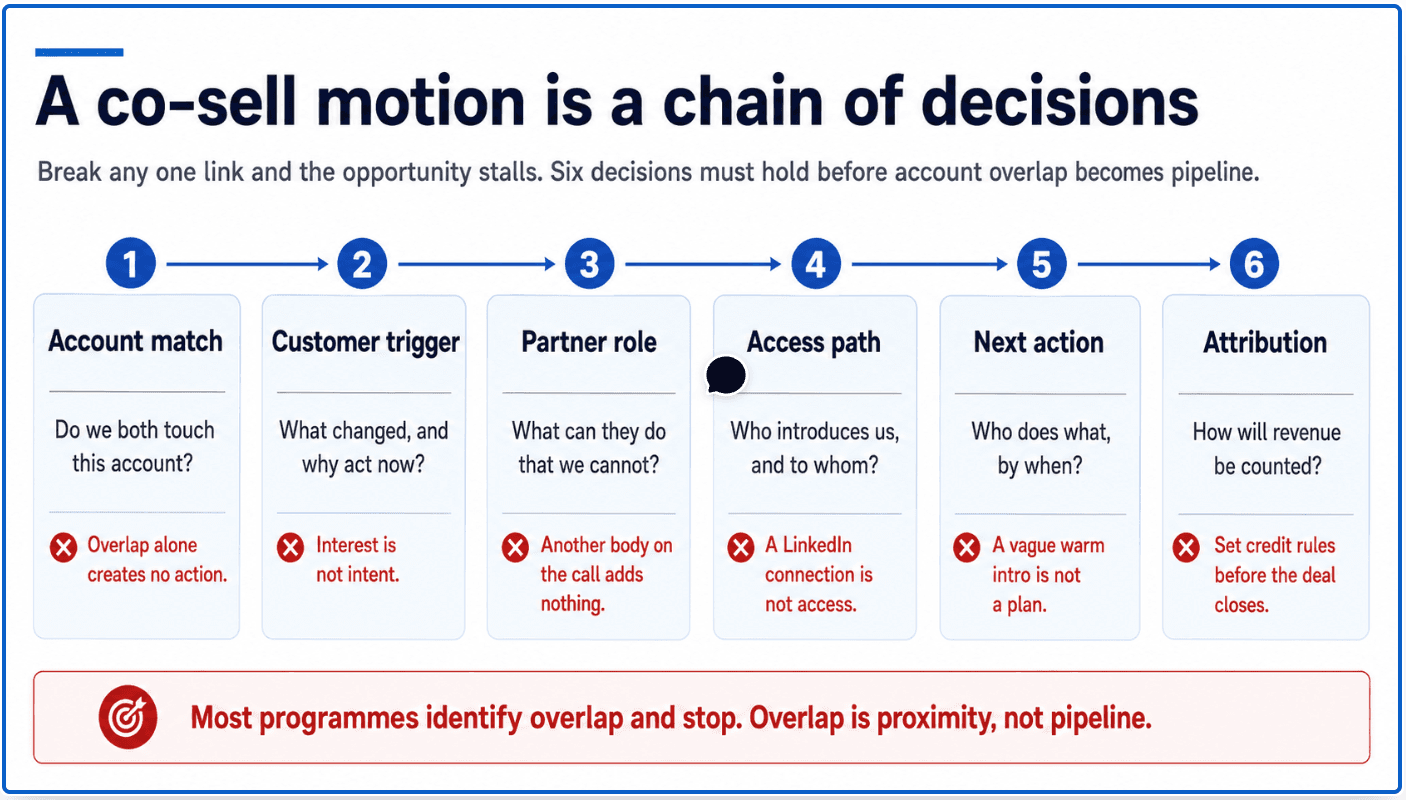
Figure 1. Six decisions have to hold before a shared logo becomes a workable deal.
What co-selling actually is
Co-selling works when two companies improve the same buying decision. Nothing else qualifies.
An agency brings customer trust and delivery capacity. An integration partner removes a technical objection. A reseller provides local commercial cover and first-line support. A cloud provider opens a route through procurement. The vendor brings the product, the proof and the commercial support needed to close.
That is an opportunity. “Finding synergies” is not an opportunity. It is a calendar invite.
This guide covers the six things a lean revenue team has to get right: the partner choice, the account map, the rules of engagement, seller enablement, attribution, and the infrastructure underneath all of it. It assumes you have a small team, a real quota and no appetite for a two-year programme. If you are earlier than that, start with what partner-led growth actually means and come back.

The false start: mistaking shared accounts for shared pipeline
The standard launch sequence looks productive.
Two companies sign an agreement.
They compare account lists.
They run a broad enablement session.
Someone creates a shared Slack channel.
Sales goes back to the pipeline it already had.
The overlap was real. The opportunity never existed.
An account match tells you that both companies know, target or serve the same organisation. It does not prove that:
the customer has an active problem
the partner has useful influence over the decision
the combined offer improves the outcome
both sides have something worth winning
anyone has agreed to a next action
A logo match is evidence of proximity, not evidence of a deal.
Three specific mistakes kill the motion inside the first month.
Mistake one: the partnership becomes the unit of work
Revenue is created one opportunity at a time. “We will introduce each other to our customers” collapses the moment somebody asks which customer, which problem, which contact, and why now.
Partnership-level commitments feel like progress because they are easy to agree to. Nobody has to name a name.
Mistake two: the seller receives work instead of leverage
“Please collaborate with this partner” sounds like another meeting on an already full calendar.
“Their consultant is leading the data migration at your target account and can get you into Thursday’s architecture workshop” sounds like a shortcut.
Sales does not need more partnership education. It needs account-specific leverage.
Mistake three: nobody writes the awkward rules
Who owns the deal? Who contacts the customer? What counts as sourced, and what counts as influenced? What happens when two partners claim the same account? When does protection expire? Does the direct seller keep full quota credit?
Leave those questions open and people invent answers that protect themselves. That is not a communication problem. That is how channel conflict starts.

Build the co-sell wedge before you recruit anyone
The first question is not “which partners do we have?”
Ask which customer problem becomes easier to solve together.
The answer is your co-sell wedge. It needs four parts.
A tightly defined customer. Not a segment. A shape of company you can describe from memory.
A trigger both companies can recognise in the wild. A migration, a funding round, a compliance deadline, a rebuild, a new entity.
A joint outcome measurably stronger than either offer alone. If the customer could get the same result from one of you, there is no wedge.
A commercial reason for both sides to spend seller time. Miss this one and you get polite enthusiasm followed by six months of silence.
Five partner motions that should never share one playbook
Referral partners create access. A fractional finance consultancy spots clients that have outgrown manual revenue recognition. It makes a qualified introduction, provides context and confirms the business case. The vendor owns discovery and the commercial process. A referral is not automatically a co-sell deal. It becomes one when the partner stays involved and helps the opportunity progress. For the full distinction, read how B2B SaaS replaces cold prospecting with referrals.
Integration partners remove product friction. An HR platform and a payroll product both target companies moving off spreadsheets after a rapid hiring phase. The trigger is a payroll migration. The joint value is clean employee data flowing from onboarding to pay run. The integration matters because it solves a live workflow problem, not because two product teams shipped a connector.
Agencies turn diagnosis into delivery. An ecommerce agency is rebuilding a retailer’s storefront. A merchandising platform helps the agency prove revenue impact after launch. The agency sells strategy and implementation. The vendor sells software. Each side strengthens the other’s commercial case, which is the only reason the motion holds.
Resellers extend commercial coverage. A regional IT provider owns the customer relationship, packages the software with managed services and handles first-line support. The vendor joins technical validation and does not try to take the account direct. This motion lives or dies on deal protection. Break it once and the reseller stops trusting the programme. If this is your market, the MSP and IT reseller motion has its own economics.
Cloud partners accelerate access or procurement. A cloud field team can help identify the account owner, validate the workload or route the purchase through an existing marketplace commitment. That support is only available when the opportunity is specific enough to deserve it.
Do not launch all five at once. Pick the one with the clearest customer value and the shortest path to proof.
A narrow play gets learnt. A broad programme gets admired and ignored.
Choose partners who can execute, not partners who look impressive
A famous logo on your partner page can produce nothing for four quarters. A specialist agency with twenty relevant clients and one person willing to join live calls can become a serious channel by month three.
Score every candidate on evidence rather than enthusiasm.
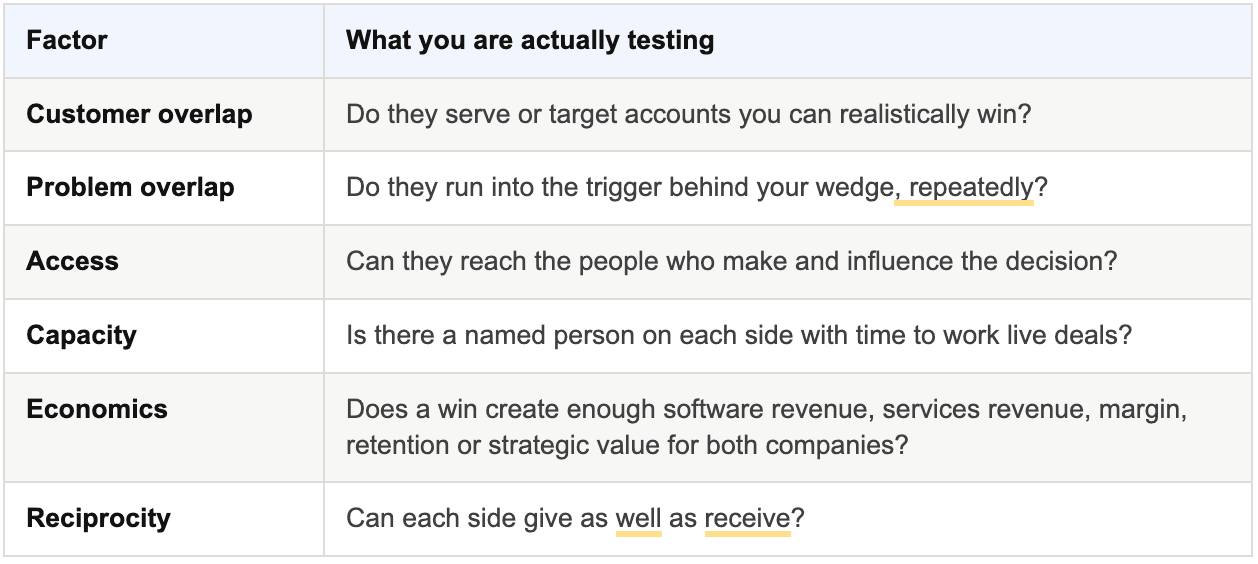
Rate each factor 0, 1 or 2. The total is not a forecast. It exposes the assumption you were about to skip.
Strong overlap with no available sellers is not readiness. Executive enthusiasm with no shared customer problem is not readiness. A company that wants your referrals but will not open its own accounts is not proposing co-selling. It is asking for free distribution.
Start with two or three partners who can run the complete motion. The pilot exists to expose friction while the stakes are still small enough to survive it. Partner discovery helps you find candidates that fit the wedge rather than the org chart, and this guide to recruiting better partners faster covers the sequencing.
Turn account mapping into an action queue
Account mapping finds shared customers, shared prospects and open opportunities where a partner already has a relationship. The value is not in the number of matches. It is in the action attached to each one.
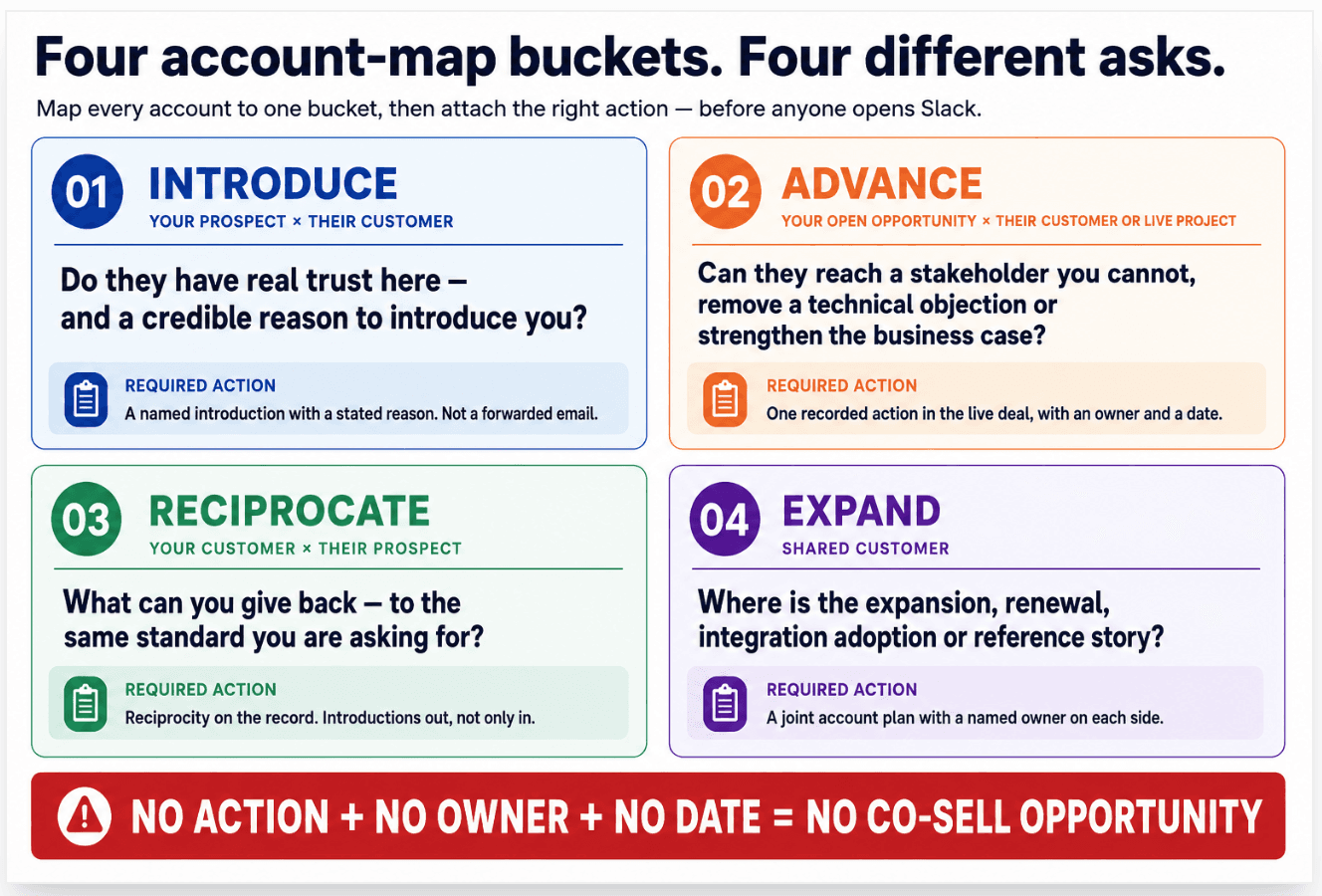
Figure 2. Every mapped account belongs in one of four buckets, and each bucket has a different ask.
Review the buckets with the people who actually own the relationships, not with whoever exported the list.
What to capture for every mapped account
Relationship owner on both sides
Relationship strength, with evidence, not a gut rating
Known project or business trigger
The relevant contact or buying group
The proposed partner action
The action owner
The due date
“Warm introduction” is not an action.
“Priya will ask the ecommerce director whether Thursday’s conversion workshop can include a 20-minute merchandising review” is an action.
Start with 20 to 50 named accounts per partner. Past that, the review stops being a decision meeting and becomes a reading exercise.
Share enough data to act, not every field in the CRM
Agree up front which accounts, stages and details can be exposed. Reveal more only when the opportunity is qualified and the customer has consented to the collaboration.
This protects commercial data and, more usefully, improves the signal. A short list with real relationship context beats a raw CRM export every time.
Write the rules before the first deal arrives
Rules of engagement are not legal decoration. They are the operating contract between two sales teams, and every ambiguity in them gets resolved in favour of whoever is most confident.

Once those decisions exist, they belong in software rather than in a shared document. A partner portal that shows each partner their own registrations, statuses and payouts removes most of the email that programmes mistake for management.
Do not punish direct sellers for using partners
If a seller loses quota credit, control of the account or commission when a partner enters the deal, you have built an anti-co-sell incentive, and no amount of enablement will fix it.
The seller must know how partner involvement affects credit before the first joint call. The partner must know whether it earns a fee, a margin, services work, a marketplace benefit or reciprocal access.
Ambiguous economics create defensive behaviour. Clear economics create cooperation.
Make every rejection useful
A rejected registration should come back with a reason: existing opportunity, duplicate account, poor customer fit, missing contact, no confirmed need, unsupported territory, or missing consent.
Silent rejection teaches good partners to stop sending you deals. Automatic approval fills the pipeline with rubbish and destroys your own forecast. A fast decision with a precise reason improves the next submission.
Referral and lead management in Partner.io gives partners a clear route to submit opportunities, with approval status and CRM context visible to both sides. Partners can submit straight from Slack, which removes the most common excuse for a deal never being registered at all.
Use the Five-Proof Gate to protect the forecast
An account joins the co-sell pipeline only when it passes five tests. Each one has a weak answer that sounds like progress and a real answer a seller can act on.
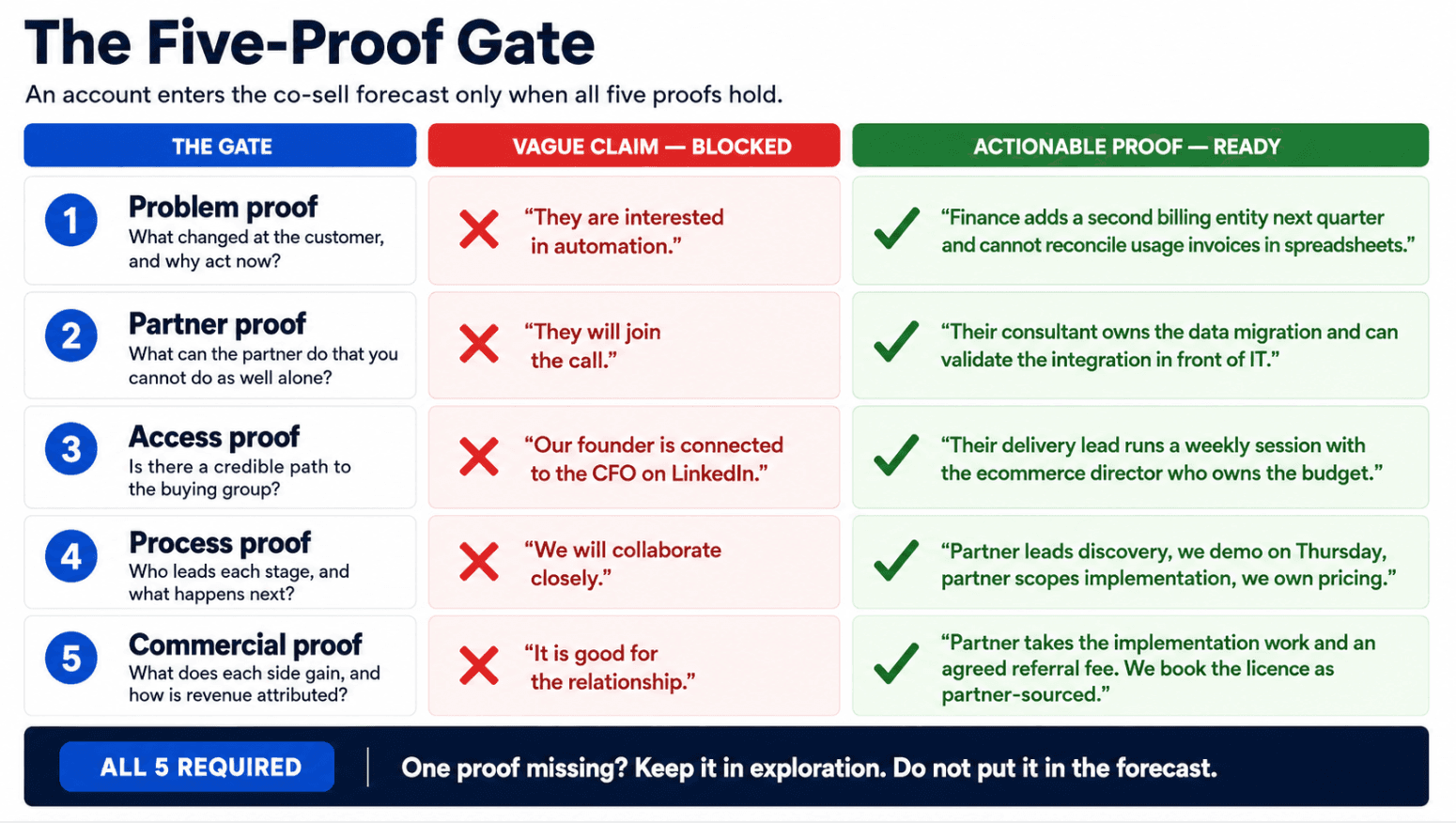
Figure 3. The Five-Proof Gate, with the weak answer and the real answer side by side.
1. Problem proof
What is the customer’s specific problem? What changed? Why act now?
“Interested in automation” proves nothing. “The finance team is adding a second billing entity next quarter and cannot reconcile usage invoices in its current spreadsheet process” is a deal signal.
2. Partner proof
What can the partner do that you cannot do as well alone?
The answer might be access, domain authority, implementation capacity, technical integration, local contracting or marketplace procurement. “Join the call” is not a role.
3. Access proof
Is there a credible path to the buying group?
Name the relationship owner, the contact and the proposed introduction. A LinkedIn connection is weak evidence. An active consulting engagement with the decision-maker is strong evidence.
4. Process proof
Who leads discovery, demonstration, solution design, pricing and follow-up? What is the next customer-facing action, who owns it, and when does it happen?
This is where a promising account becomes an executable deal.
5. Commercial proof
What does each party gain? How will the customer buy? How will revenue be attributed?
For an agency the return may be implementation work. For a reseller, margin and renewal ownership. For an integration partner, adoption and expansion. For a cloud provider, marketplace consumption or workload value.
If one proof is missing, keep the account in an exploration queue. Do not disguise it as pipeline.
The largest co-sell ecosystems enforce this in software
Worth knowing before you decide the gate is overkill for a team your size.
Microsoft’s Partner Center requires a deal name, location, estimated value and estimated close date on every co-sell deal, plus a solution area and solution play for IP and services co-sell. It raises passive warnings on implausible deal values and on close dates inside seven days, gives partners a referral confidence score that points at what is missing, and states that you must obtain the customer’s consent before sharing their contact details, because Microsoft may use them to contact the customer directly. Deal registration adds two more bars: a deal value of at least USD 25,000, and a 72-hour gap between creating the deal and marking it won.
AWS models the same discipline in its data structures. The Partner Central Selling API carries the customer business problem and use case on the project object, a primary-needs-from-AWS field for what the partner specifically wants from the AWS team, and a lifecycle object holding next steps, a timestamped next-steps history and a target close date. Partners in the ACE programme are told to keep those records updated through the opportunity lifecycle to stay visible to AWS sales.
Neither company built those fields for entertainment. Vague submissions waste seller time at scale. A twenty-person revenue team has less seller time to waste, not more.
What a real co-sell opportunity looks like on Tuesday morning
An ecommerce agency and a merchandising software company are reviewing a retailer found through account mapping. At first the entry looks promising for the wrong reason: both companies know the logo.
Then the useful detail appears. The agency is leading a storefront rebuild. Its client is worried the new site will launch without a reliable way to test product placement. The software seller has spoken to a digital analyst but cannot reach the ecommerce director who owns the project.
They do not schedule a vague joint introduction. They split the deal:
The agency leads the business discussion, because it owns the transformation brief.
The software company demonstrates the merchandising workflow using the retailer’s planned site structure.
The agency scopes implementation and ongoing optimisation.
The vendor owns licence pricing.
The agency asks the ecommerce director to join a 30-minute customer workshop on Thursday.
That opportunity passes all five proofs. Eighteen other overlapping logos stay in exploration. Fewer inflated opportunities, more executable ones.

Enable sellers for moments, not meetings
Most partner enablement opens with company history, product architecture and a long demonstration. The seller leaves knowing what the partner does and still not knowing when to involve them.
A useful play answers “when should I bring you in?” in under ten seconds.
Six questions a one-page play has to answer:
Which accounts fit?
What trigger should I listen for?
What does the partner actually contribute?
What should I ask the partner to do?
What do I say to the customer?
When should I keep the partner out?
That last question buys more credibility with sellers than the other five combined.
Three assets that work inside a live deal
A precise partner request. “I am working with [account] on [problem]. We are at [stage]. Your relationship with [person] could help us [specific action]. Can you [ask] by [date]?”
A customer introduction. Two short paragraphs. The shared problem, why the second company belongs in the conversation, and what happens next. No company boilerplate.
A discovery card. Five questions that surface the co-sell trigger, plus the objections each company is best placed to handle.
Then run enablement inside live pipeline reviews. Pick three accounts, apply the Five-Proof Gate, draft the partner asks, book the next actions.
Sellers remember a partner that moved a deal. They forget a 48-slide presentation before lunch.
Sales versus partner playbooks goes deeper into why the two documents cannot be the same document, and an engagement hub is where the working version of the play should live so partners see the same page your sellers do.
Put an operating layer between the partner and the CRM
Co-sell operations break in a predictable order. The partner record sits in a spreadsheet. The opportunity sits in the CRM. The latest status sits in Slack. The commission logic sits in one person’s head, and that person is on holiday when the deal closes.
The clean split
CRM: customer, opportunity value, sales stage, close date, forecast.
Partner platform: partner relationship, account mapping, registration, approval, partner role, enablement, partner-facing status, reward.
Integration: controlled field synchronisation so nobody enters the same update twice.
The fields to connect, at minimum
Partner organisation and partner contact
Opportunity source and partner role
Registration and approval status
Internal opportunity owner
Stage, value, currency and expected close date
Next action, owner and date
Attribution type and supporting evidence
Protection expiry
Closed outcome and loss reason
This is the point where a direct-sales tech stack breaks under partner complexity. A CRM tracks the buyer-facing opportunity. It was never designed to manage partner onboarding, shared visibility, deal protection, enablement and commission calculation.
Partner.io supplies that missing layer: account mapping, referral capture, co-sell deal management, partner enablement and rewards, connected to the revenue they produce. The HubSpot, Salesforce and Pipedrive integrations keep partner context, stages and fields tied to the pipeline your sellers already live in, and webhooks cover whatever else you have wired together.
The goal is not another database. It is to stop a person acting as middleware between disconnected systems. The hidden cost of managing partners in spreadsheets walks through how that operational debt compounds, and what it quietly costs you in partner trust before it ever shows up in the numbers.
Keep the workflow short
Use no more statuses than the team will actually maintain.
Submitted
Needs information
Accepted
Joint action agreed
Active sales cycle
Closed won
Closed lost
Expired or rejected
Do not build seventeen stages to describe every possible conversation. A stage should help somebody decide what happens next. If it does not, delete it.
Try Partner.io free for 7 days
No credit card, no contract. Map your accounts, register a real opportunity and push it through the full workflow before you commit to anything.
Start your free trial See pricing Book a walkthrough
Measure what predicts revenue
Closed revenue matters and arrives far too late to diagnose a new motion. Track the behaviour that produces it.
Participation
Active co-sell partners
Partners with at least one accepted opportunity
Named accounts reviewed
Sellers working partner opportunities
Speed and quality
Median time to accept or reject
Median time from acceptance to first joint action
Share of active deals with a current next action
Stage ageing
Share of submissions that pass the Five-Proof Gate
Top rejection reasons, by partner
Commercial performance
Partner-sourced pipeline and revenue
Partner-influenced pipeline and revenue
Win rate against a comparable non-partner cohort
Sales-cycle length against a comparable cohort
Average contract value
Services attach, marketplace value, margin or commission
Expansion and renewal revenue involving partners
The phrase comparable cohort is doing real work there. Partner deals often sit in larger accounts, later stages or particular industries. Compare them with your entire direct pipeline and you get a flattering number that tells you nothing. Compare similar segments, stages and periods. This cost-per-opportunity comparison of cold outreach and partnerships shows how much the basis you pick changes the answer.
Separate sourced from influenced
Partner-sourced means the opportunity exists because the partner originated it. Partner-influenced means the opportunity already existed and the partner completed a material action that helped it progress. Both are real. They answer different questions.
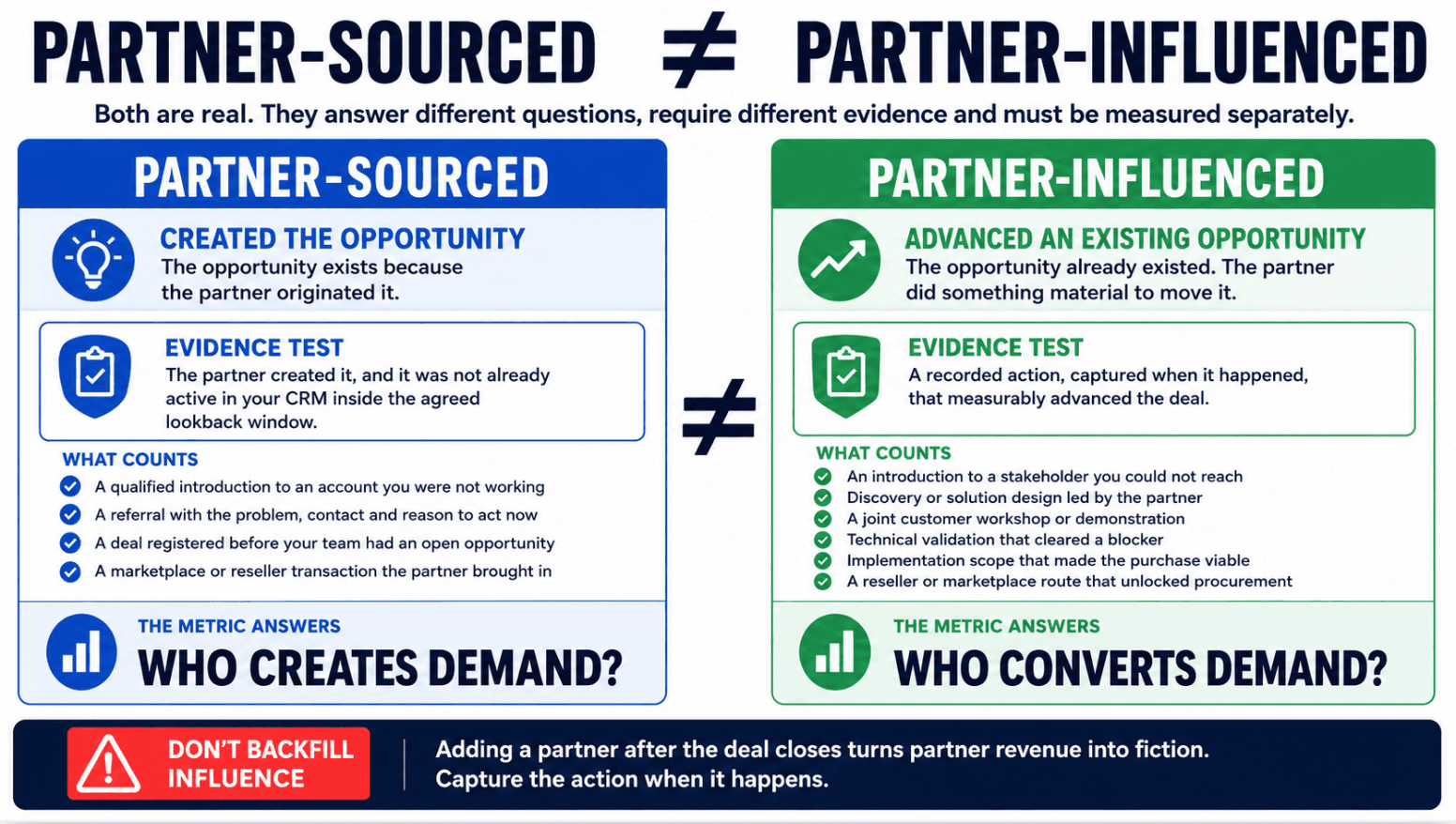
Figure 4. Two different claims, two different evidence bars, two different questions answered.
Do not add a partner’s name after the deal closes and call it influence. Capture the action when it happens, with a date and an owner. Sourced revenue shows who creates demand. Influenced revenue shows who helps convert it. Combine them into one oversized “partner revenue” number and nobody serious will trust it, starting with your own CFO.
Launch your first co-sell motion in 90 days
You do not need a year-long transformation. You need one complete loop from partner selection to a customer action, CRM evidence and revenue you can defend.
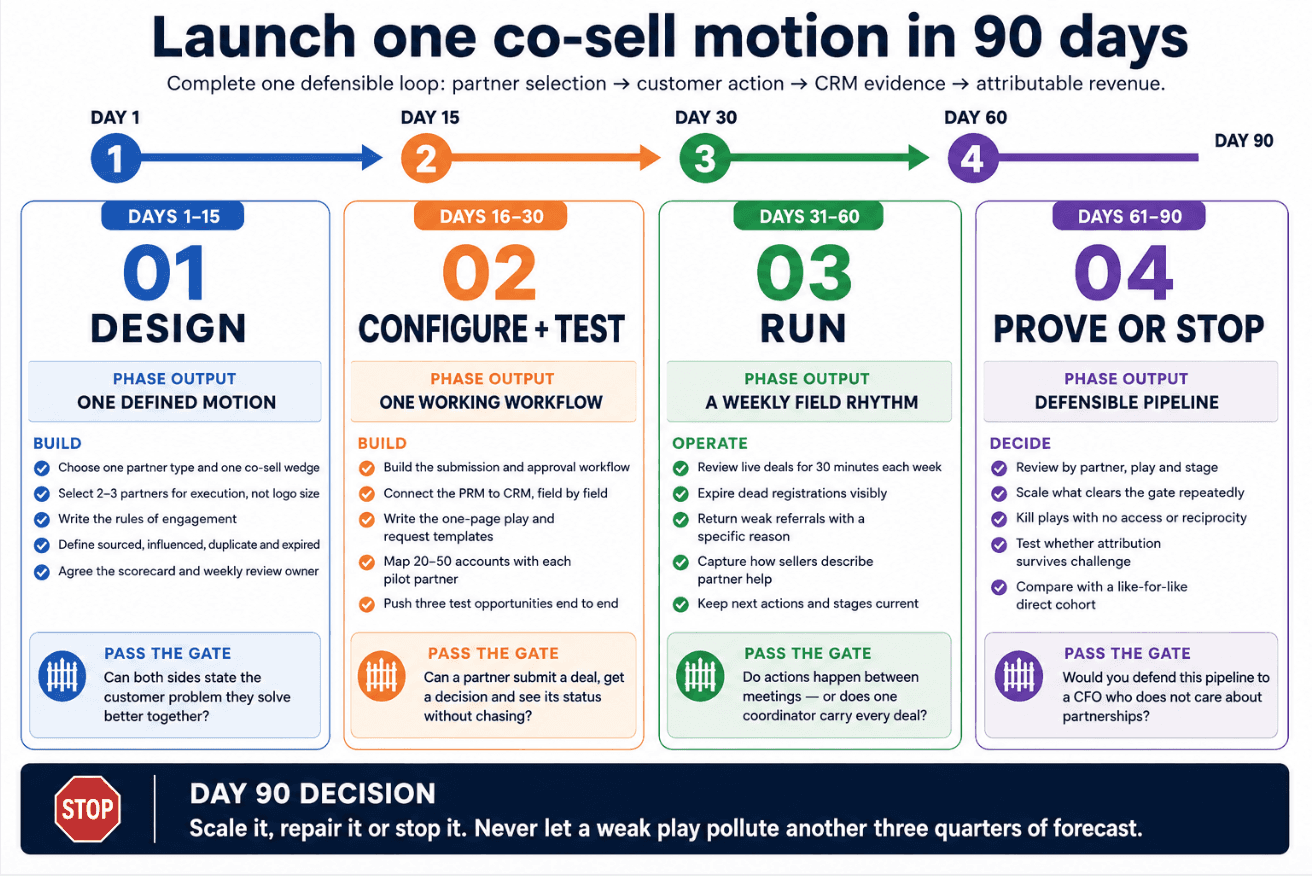
Figure 5. Four phases, four gates. Each gate is a question you have to answer before the next phase starts.
Days 1 to 15: design one motion
Choose one partner type and one co-sell wedge. Select two or three partners using the execution criteria. Write the rules of engagement. Define sourced, influenced, duplicate, accepted and expired. Choose the fields you will connect between the partner platform and the CRM. Agree the scorecard and name the weekly review owner.
Gate: can both sides explain in one sentence which customer problem they solve better together? If not, the motion is still too broad.
Days 16 to 30: configure and test
Build the submission and approval workflow. Connect the partner platform to your CRM. Create the one-page play and the request templates. Train the few sellers involved using live accounts rather than slides. Map 20 to 50 accounts with each pilot partner. Push three test opportunities through the full workflow.
Gate: can a partner submit a deal, receive a decision, see the current status and understand the next action without chasing anyone by email? If not, fix the workflow before adding volume.
Days 31 to 60: run the field rhythm
Hold one 30-minute review each week. Do not recap the partnership. Inspect live opportunities: does the deal still pass the gate, what changed at the customer, what is the next customer-facing action, who owns it, when will it happen, and is the record current?
Expire dead registrations. Return weak referrals with a reason. Capture the exact language sellers use when a partner helps, then put it in the playbook.
Gate: are sellers and partners completing actions between meetings, or is one person carrying every deal? A motion that depends on a permanent coordinator is not ready to scale.
Days 61 to 90: prove, repair or stop
Review the pilot by partner, by play and by stage. Scale when opportunities repeatedly pass the gate, partners reciprocate with access or effort, sellers use the play without heavy prompting, next actions and stages stay current, accepted deals enter genuine sales cycles, and attribution survives scrutiny.
Stop or rebuild when account overlap produces no access, when one side does all the giving, when the joint offer feels forced, or when the economics cannot justify seller time.
Killing a weak play is sensible. Letting it pollute the forecast for another three quarters is not.
When the co-sell motion breaks
Every symptom below has a structural cause. None of them is fixed by another kickoff call.
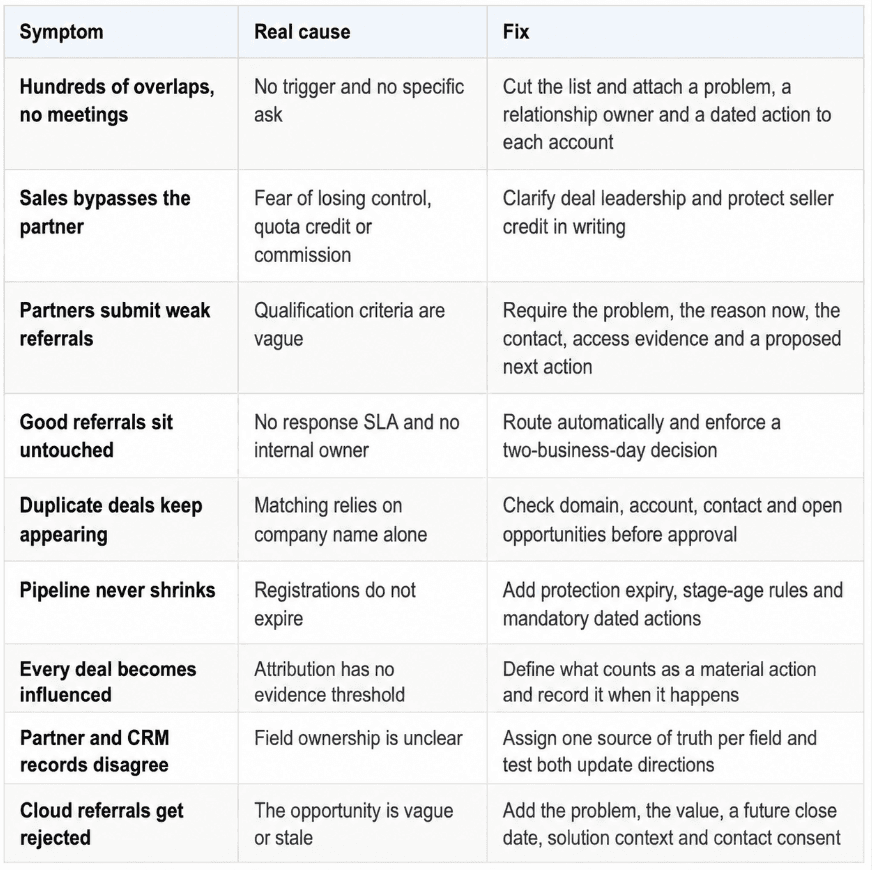

Do not recruit another partner yet
First make one partner useful in one live deal.
Map the account. Confirm the problem. Register the opportunity. Assign each role. Agree the next customer action. Sync the stage. Give the partner visibility. Record the contribution. Tie the outcome back to revenue.
That sequence is the co-sell motion. Everything else is packaging.
Once it works, Partner.io lets you repeat it without multiplying spreadsheets, status emails and attribution disputes. Account mapping, referrals, deal management, partner enablement, CRM visibility and rewards in one system built for partner revenue rather than adapted from direct sales. You can see how other teams got there in the customer case studies.
The companies that win will not have the longest partner page. They will know which partner belongs in which deal, what that partner should do next, and how the resulting revenue gets measured.
Build that system before you add more logos.
Try Partner.io free for 7 days
No credit card. No contract. Build your first co-sell workflow around the opportunities already sitting in your pipeline, and see whether they survive the Five-Proof Gate.
Start your free trial Book a walkthrough Read the docs
KEEP READING