Product
Impartner Alternative for SaaS: Why Partner.io Fits

Teams comparing PRM platforms are really trying to fix four revenue leaks. Here's how to tell whether you need more software or a sharper one.
Most SaaS companies looking for an Impartner alternative do not have a software problem.
They have four revenue leaks: partner leads go unanswered, new partners take too long to activate, sales updates never reach the partner, and commissions end in a spreadsheet dispute.
Buying a larger PRM can put more software around the same leaks.
Impartner makes sense when you need global MDF controls, multi-language portals, distributor hierarchies and hyperscaler workflows. If you need to turn referrals, agencies, integration partners and resellers into measurable pipeline, Partner.io is the sharper fit.
Not because it does everything.
Because it does the work that matters now.
Impartner vs Partner.io: the fast answer
Impartner is a broad ecosystem platform. Its product covers deal registration, onboarding journeys, training, business planning, tiering, compliance, MDF, through-channel marketing, analytics and hyperscaler sales.
Partner.io is built around the commercial loop most SaaS partner programmes need: recruit, onboard, identify accounts, register deals, involve sales, attribute revenue and pay the right partner.
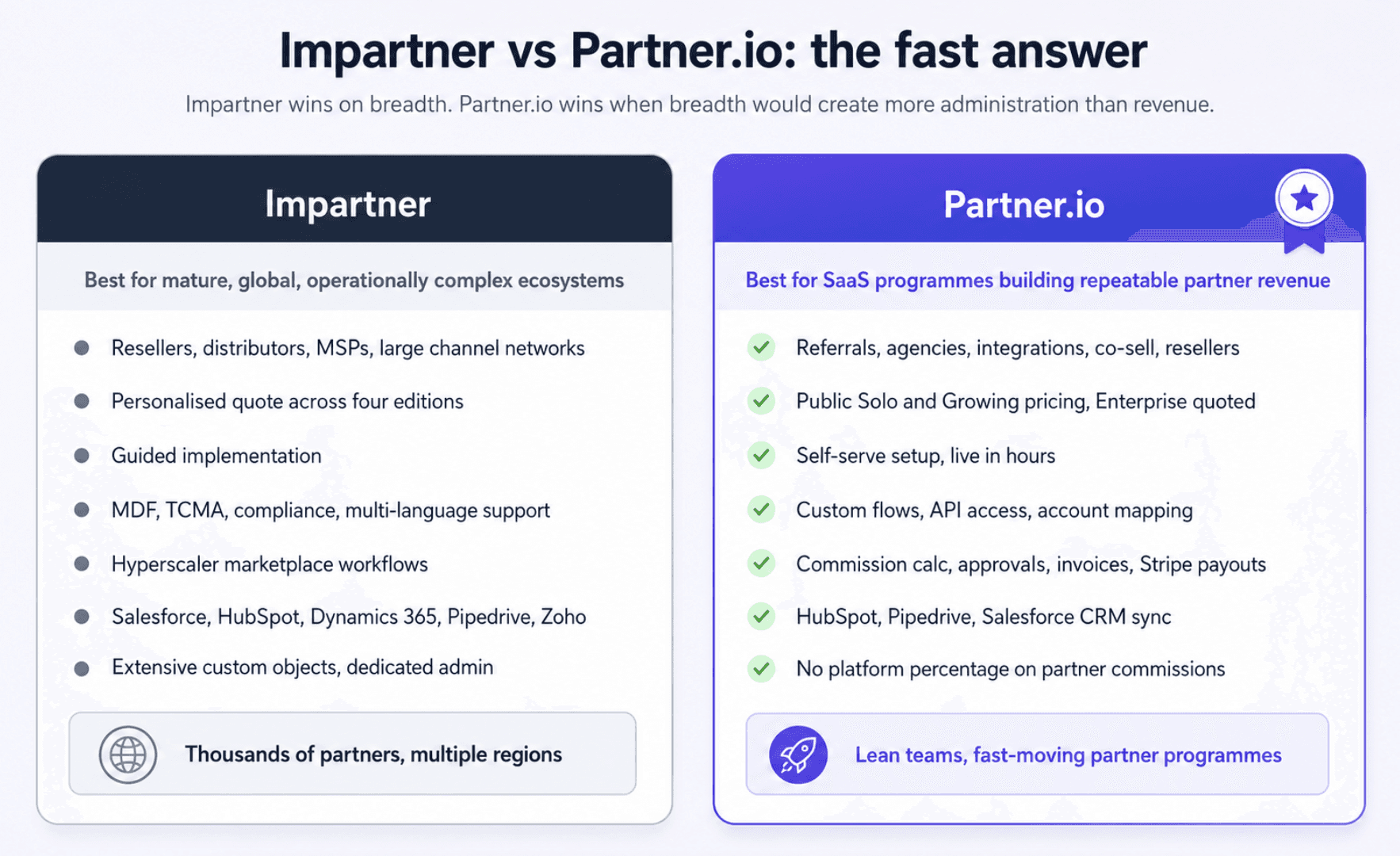
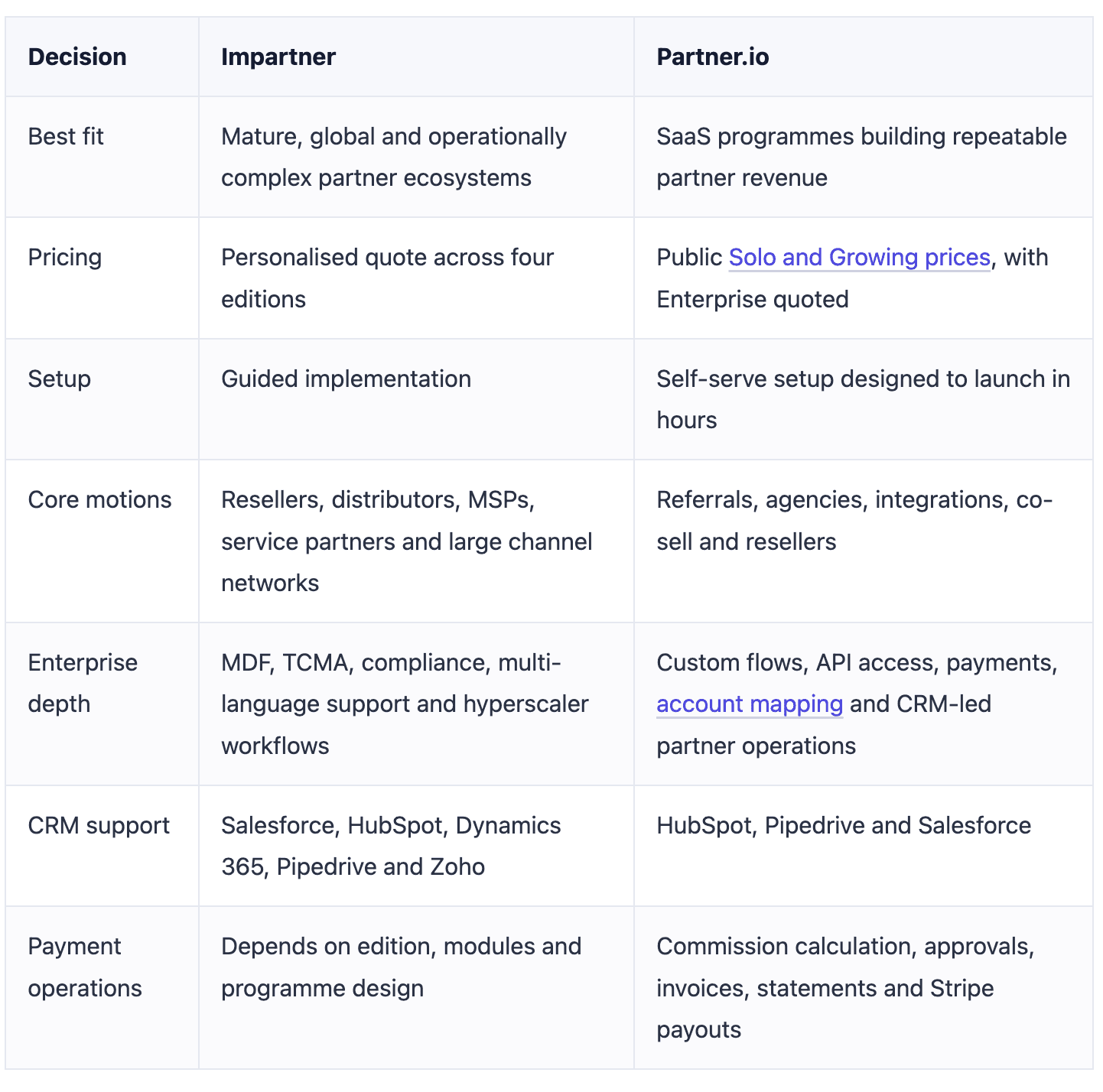
That distinction matters. A company with 60 active agencies and two people running partnerships should not buy software designed around the problems of a multinational distributor network.

Feature count is the wrong way to buy PRM software
PRM comparisons usually begin with a spreadsheet full of ticks.
That rewards the biggest product, not the best fit.
A feature only creates value when somebody uses it to move a partner, account or deal forward. Advanced MDF management is worthless to a programme that has no MDF budget. Ten onboarding journeys add nothing if partners still cannot explain the ideal customer profile. A beautiful portal becomes a document graveyard when sales keeps partner deals in a separate pipeline.
Start with the leaks.
How long does a submitted deal wait for a decision?
How many approved partners produce nothing?
Can sales see which partners know an account?
Can a partner see what happened to an introduction?
Can finance explain every commission without asking for another export?
The best Impartner competitors solve those problems before selling future complexity. Roughly two in three B2B companies now run some form of partner-led growth motion, which is exactly why the software underneath it has to earn its keep rather than just look impressive in a demo.
The Four-Clock Test
Every partner programme runs on four clocks. Slow one down and trust starts to decay.
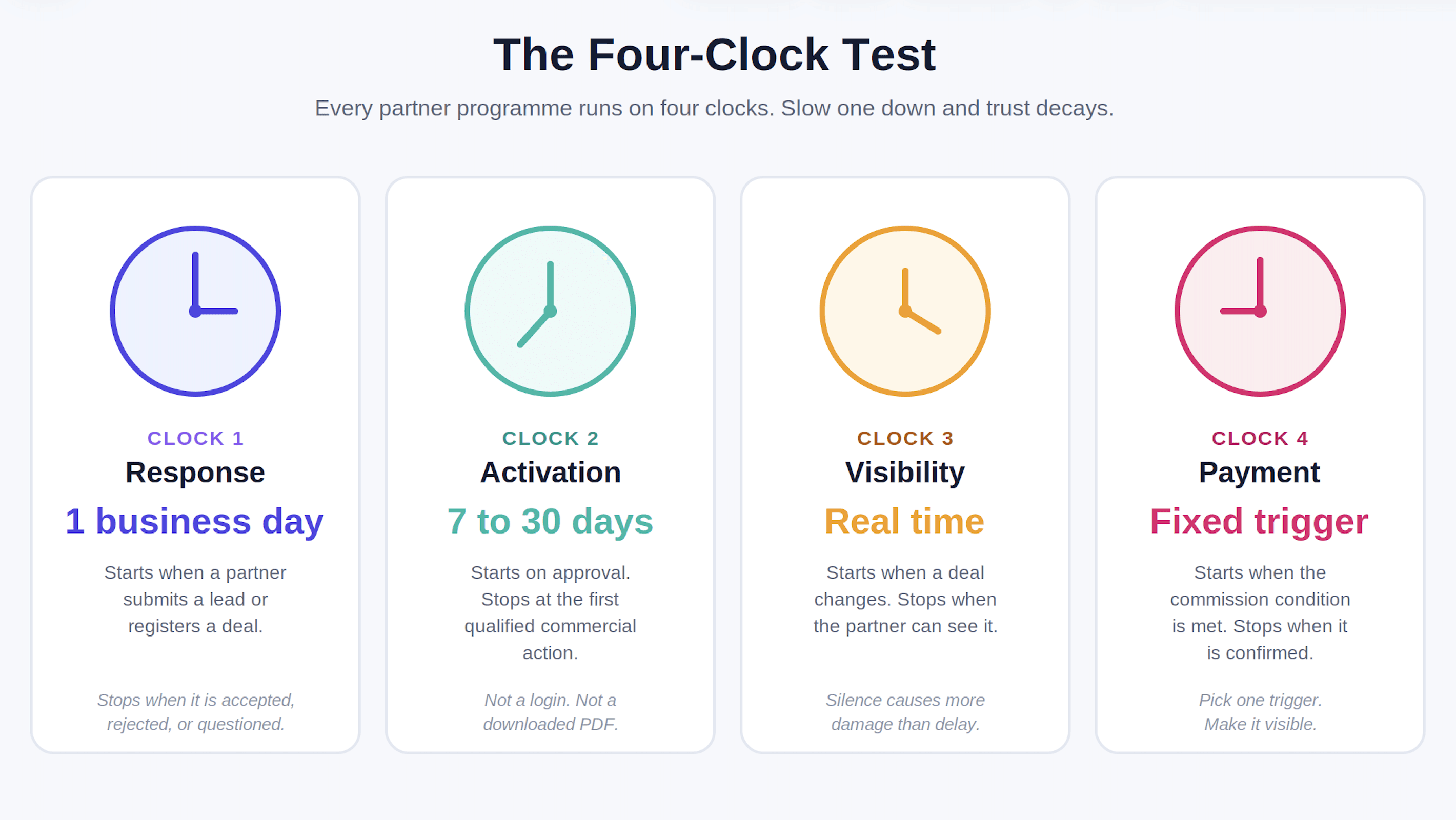
Response, activation, visibility and payment: the four clocks every partner programme runs on.
1. The response clock
This clock starts when a partner submits a lead or registers a deal. It stops when the submission is accepted, rejected or returned with a specific question.
Set a one-business-day target.
A referral is not an ordinary inbound lead. Someone has spent relationship capital to create it. Leaving it untouched for four days tells the partner exactly how much that effort matters.
2. The activation clock
This starts when a partner is approved. It stops at the first qualified commercial action.
Not a login. Not a downloaded PDF. Not a completed profile.
The action depends on the motion:
A referral partner submits a credible introduction.
An agency identifies a client opportunity and books a joint call.
An integration partner agrees a shared-account play.
A reseller completes essential training and registers a qualified deal.
Set different targets. A referral partner can activate in seven days. An agency or reseller may need 30 because the motion requires training, account selection and sales coordination.
3. The visibility clock
This starts when a meaningful deal change happens. It stops when the partner can see it.
Partners should not have to chase for stage, ownership or rejection reasons. A CRM update should feed the partner process, not disappear inside the CRM.
When nothing moves, say so. Silence creates more damage than a slow deal.
4. The payment clock
This starts when the deal meets the agreed commission condition. It stops when the commission is confirmed and queued.
Write the trigger into the programme:
Contract signed
Deal marked closed won
Customer invoice issued
Customer payment received
Those are different events. Pick one and make it visible.
A PRM that cannot shorten these four clocks is a filing cabinet with a login screen.
Why Partner.io is the natural Impartner alternative for SaaS
One system follows the deal from introduction to payment
Weak partner programmes break the revenue journey into separate tools.
The referral sits in a form. The deal lives in HubSpot. The partner update goes through email. Training sits in an LMS. Finance calculates commission in a spreadsheet.
Partner.io connects the sequence.
Referral partners can share tracked links through the referrals workflow. Agencies and resellers can submit opportunities directly from the partner portal. Leads carry status, phase, value, partner, owner, messages, history and payout records. CRM sync keeps the commercial record connected. Training, agreements, documents, deal rooms, events, tiers and rewards support the same motion.
The partner does not care how many systems sit behind the programme. They care whether the introduction was accepted, who owns the next action and when they will be paid.
Account mapping turns relationships into pipeline
Account mapping is available in Partner.io.
It surfaces shared customers, overlapping prospects, open opportunities and accounts where a partner can create a warm route in. Those overlaps become specific plays:
Ask for a warm introduction into a target account.
Bring an integration partner into an open opportunity.
Find shared customers for expansion or a joint case study.
Show sales which strategic accounts already have partner coverage.
Record partner influence before the deal reaches the final stage.
Without account mapping, co-sell often means swapping spreadsheets once a quarter and agreeing to "circle back" on 200 company names.
That is not a motion. It is list exchange.
Partner.io connects overlap data to the rest of the partner workflow. The account can move from identification to action, opportunity, attribution and reporting without becoming another disconnected exercise.
CRM sync protects one commercial truth
A PRM should extend the CRM, not compete with it.
Partner.io syncs partner leads and account data with HubSpot. It also supports Pipedrive, while Salesforce is included in its Enterprise offering.
The integration still needs rules. Decide these before connecting anything:
Which system creates the company, contact and deal?
Which system owns stage, amount, close date and owner?
What happens when the account already exists?
How do you separate partner-sourced from partner-influenced revenue?
Does a rejected lead remain in reporting?
Which event makes commission payable?
Then test a record through its full life: create, duplicate, accept, update, close and pay.
"Two-way sync" means nothing until the field map survives a messy deal.
Onboarding ends with action, not education
Most partner onboarding is too long because nobody has decided what a partner must do first.
The usual result is a welcome email, a 40-slide deck and access to twelve folders. Completion looks busy. Pipeline stays flat.
Partner.io lets each motion follow a shorter route:
Accept the agreement.
Learn the ideal customer profile and rejection rules.
Complete the training needed for the first conversation.
Identify or submit one account.
Book a working session where co-selling is required.
Courses, certifications, tasks, events, documents, messages, tiers and rewards sit in the same partner experience. A referral consultant does not need reseller training. An agency should not study product administration before making an introduction.
Measure time to first accepted opportunity. Course completion is only useful when it shortens that time.
Payment is part of the revenue record
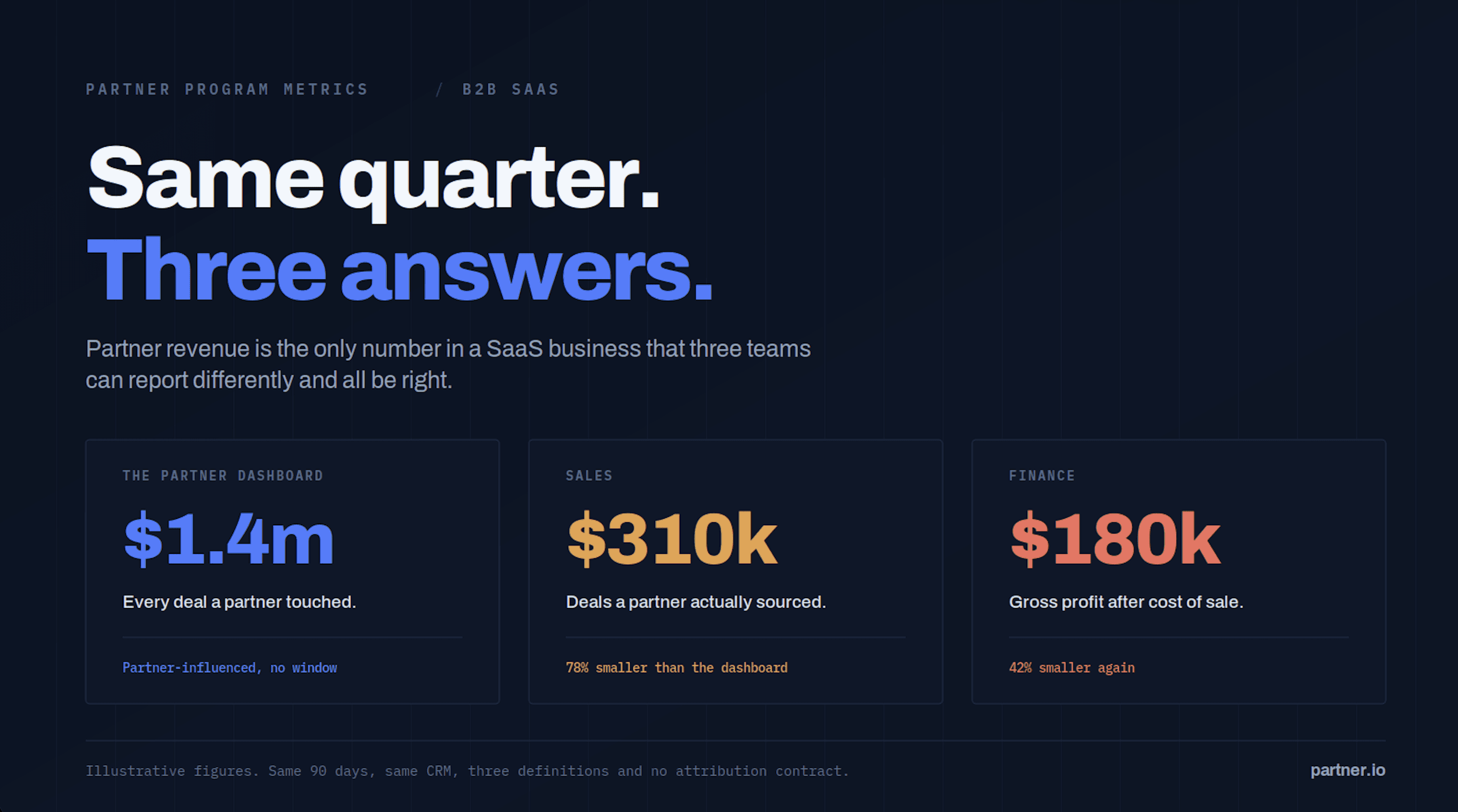
Commission disputes rarely start in finance. They start when the programme leaves words such as "sourced", "influenced" and "eligible" open to interpretation.
Partner.io links commission rules to partner activity and revenue events. It handles calculation, approval, invoices, partner statements and manual or automated Stripe payouts.
Partners can see what is pending, approved and paid. Finance can follow the trail from deal to rule to amount.
Partner.io charges no platform percentage on partner commissions. Stripe's own charges still apply, but programme costs do not rise simply because partners generate more commission.
That is how payment becomes a trust mechanism rather than a monthly argument.
The cost matches the job
At the time of writing, Partner.io pricing lists Solo at $169 per month and Growing at $389 per month. Enterprise pricing is custom.
Impartner publishes Emerge, Ignite, Pro and Enterprise editions but requires a pricing request. The subscription is only part of the comparison.
Price the full three-year job:
Subscription and add-ons
Implementation services
Internal administration
CRM and integration work
Training production
Payment fees
Workflow changes
Parallel spreadsheets kept alive because users distrust the platform
Cheap software can be expensive. So can buying enterprise machinery years before the programme needs it.
Partner.io lets a team test the operating model without making a large implementation the first test of commitment.
What each partner motion needs
One generic journey will not serve four different routes to revenue.
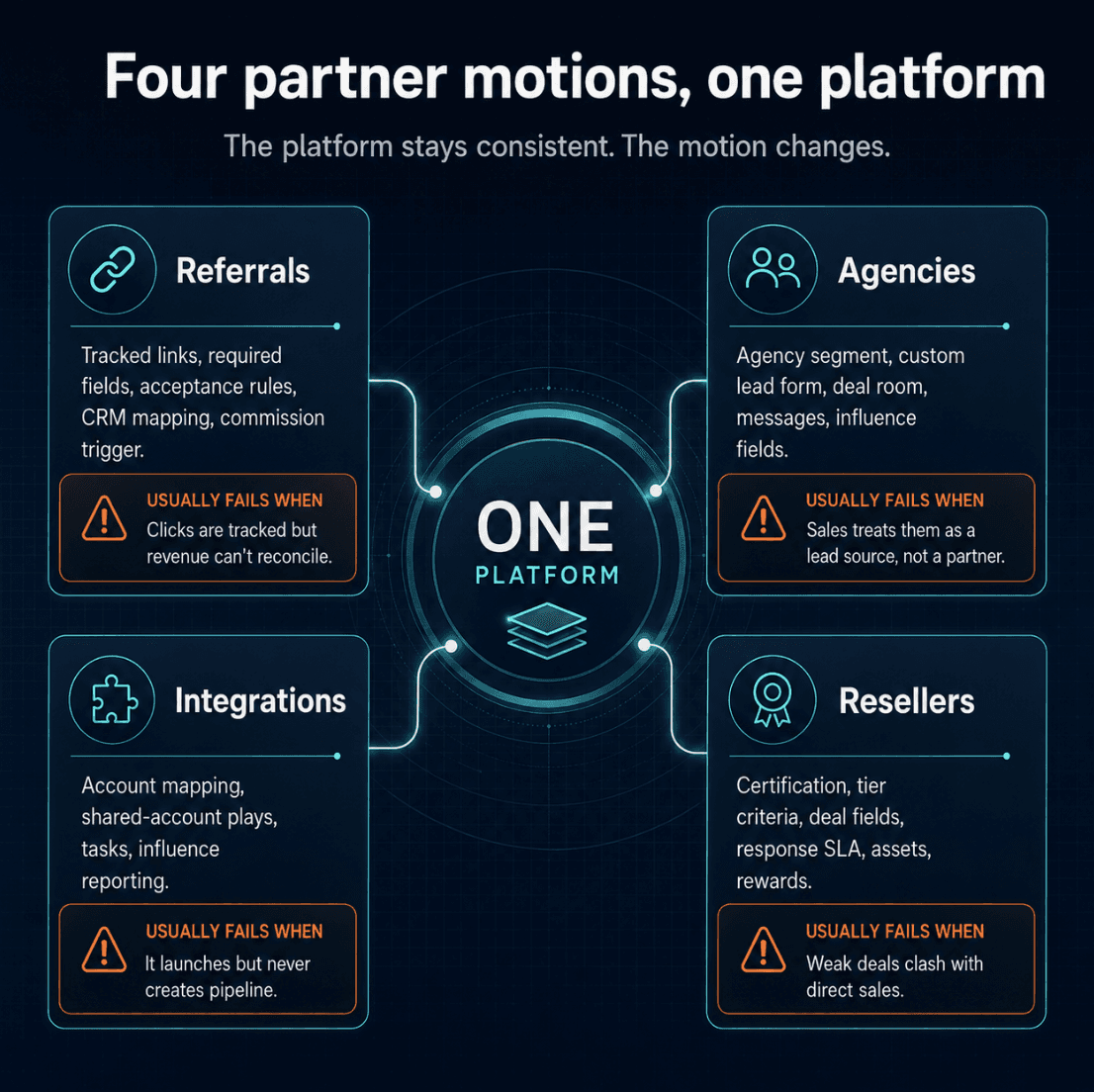
The platform stays consistent. The motion changes.
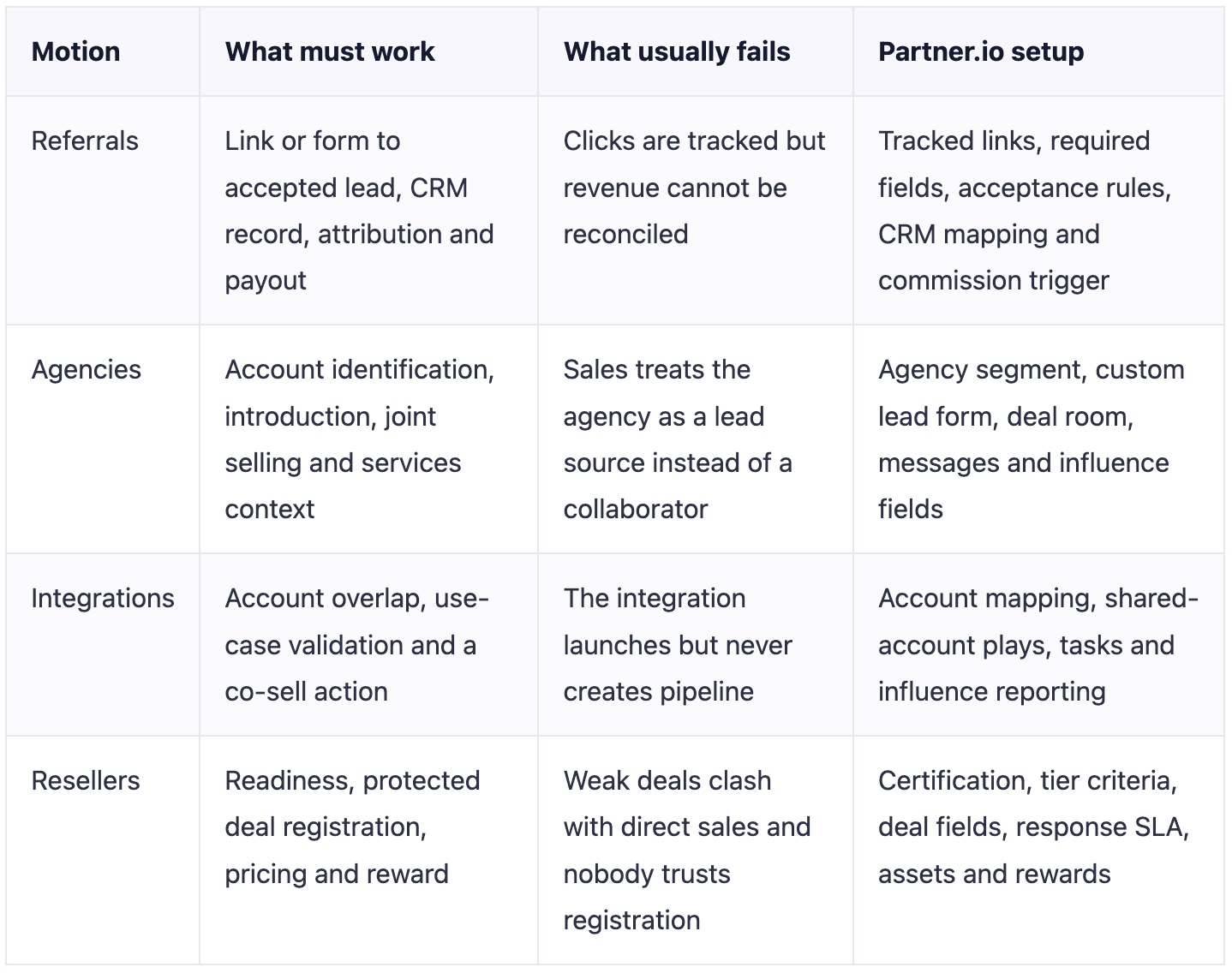
What this looks like in the real world
An agency submits an £18,000 ARR opportunity on Monday morning.
Partner.io creates the pending lead with the customer, contact, expected value, use case and agency attached. CRM sync finds an opportunity that a salesperson opened against the same company two weeks earlier.
This is where weak programmes lose partners.
The easy response is "duplicate". The agency receives a rejection and stops bringing opportunities.
The right response looks at contribution. The agency did not source the account, but it has a relationship with the buying team and has secured the next meeting. The deal becomes partner-influenced. Sales keeps ownership. The agency joins the deal workflow. Both sides can see the next action and the agreed reward.
The software did not make the judgement.
It gave the team enough evidence to make it quickly, record it once and honour it later.
Three months on, finance does not need to reconstruct the story from Slack and email.
When Impartner is the better choice
Choose Impartner when the programme genuinely needs:
Multi-country portals with formal language and currency requirements
Complex dealer, distributor or reseller hierarchies
Mature MDF requests, claims, approvals and ROI controls
Through-channel campaigns and co-branded local assets at scale
Detailed competency, compliance and business-planning structures
Hyperscaler marketplace workflows across AWS, Microsoft Azure or Google Cloud
Extensive custom objects with dedicated platform administration
Thousands of partners split across regions and permission models
Impartner's breadth pays off when the organisation can use and govern it.
Buying Partner.io only because it costs less would be a mistake if those capabilities are mandatory. Buying Impartner because they might matter in three years is the same mistake in reverse.
Buy for the programme that exists and the next stage you can see.
Make every vendor run the same test
Do not buy from screenshots or a polished demo tenant. Put real work through the product.
The ten-case PRM test
Add a referral partner and an agency with different onboarding.
Create a tracked link and submit a real test lead.
Register a deal against an existing CRM account.
Use account mapping to find a genuine overlap and assign an action.
Reject a submission with a reason the partner can see.
Change a deal stage in the CRM and check the partner view.
Complete training and trigger the next step.
Change a tier using a defined condition.
Calculate, approve and display a commission.
Report sourced revenue, influenced revenue and unpaid earnings separately.
Use your fields, stages and rules. Awkward cases reveal the product. Clean demo data hides it.
Ask hard questions:
What can an administrator change without support?
Which integrations are native?
Which objects and fields sync in each direction?
How are duplicates handled?
Can each partner type have different applications, training and lead forms?
Which features require another edition or add-on?
Can historical deals and commissions be imported?
Can finance approve payments without full administration rights?
How is data exported if the contract ends?
If the answer depends on future product work, treat the feature as unavailable.
Move without importing the mess
A PRM migration should remove bad process, not preserve it.
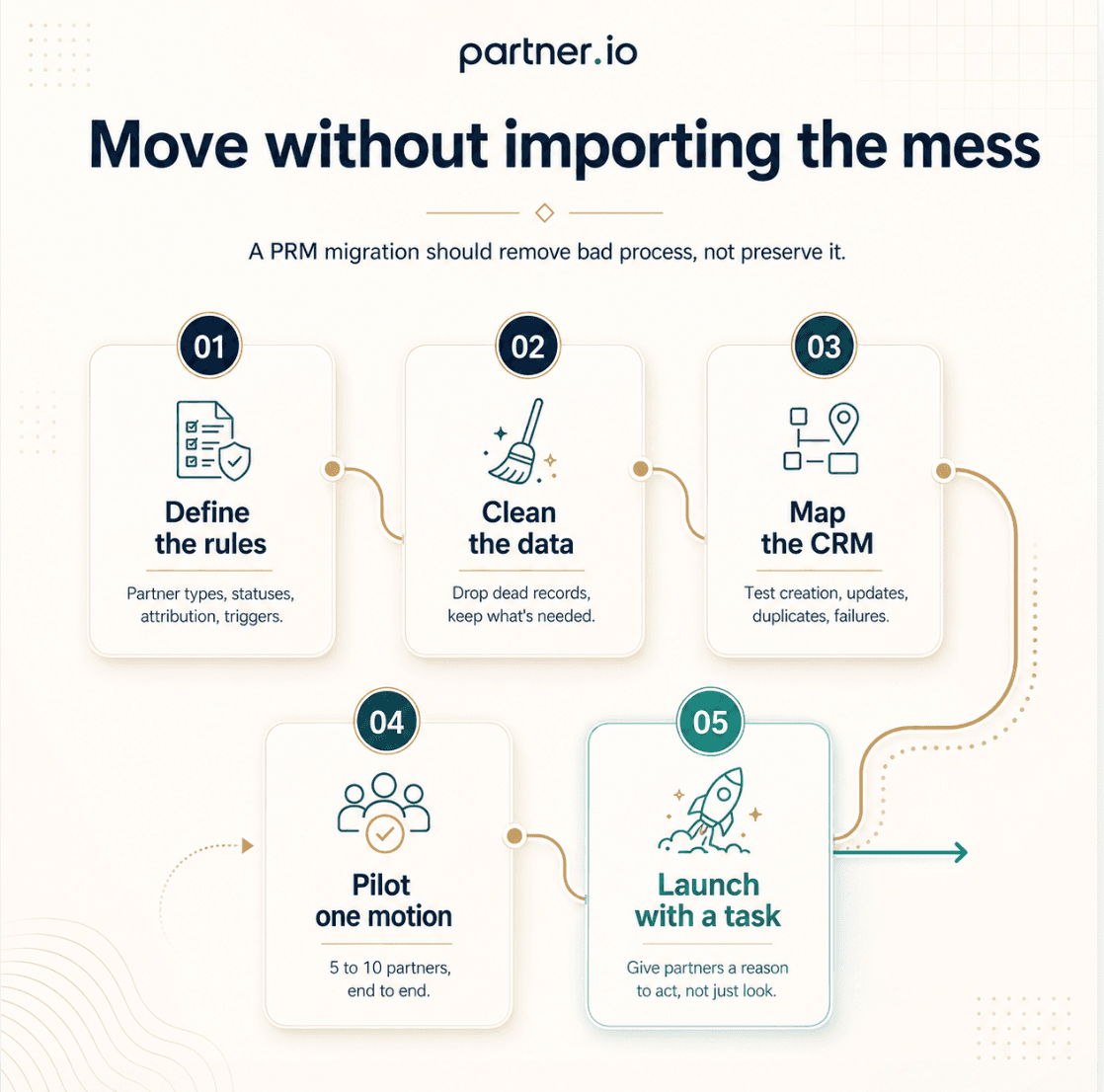
Five steps to move without dragging bad process into the new system.
Define the rules
Document partner types, lead statuses, attribution, ownership, commission triggers and payment timing.
If two people give different answers, stop. The system cannot fix a policy nobody agrees on.
Clean the data
Separate active partners from dead records. Remove duplicate contacts, obsolete assets, abandoned courses and tiers that no longer change behaviour.
Keep the history needed for reporting or payment. Leave the clutter behind.
Map the CRM
Map company, contact, deal, partner, source, influence, value, stage, owner and payout eligibility.
Test creation, updates, duplicates and failures in both directions. Record the expected result. That becomes the runbook.
Pilot one motion
Choose five to ten active partners. Run onboarding, lead submission, CRM updates, account mapping and commission calculation from end to end.
Pick partners who notice problems. Friendly silence is useless during a pilot.
Launch with a task
"The new portal is live" gives partners no reason to care.
"Review these three open deals and confirm the next action by Friday" does.
What to fix when the programme breaks
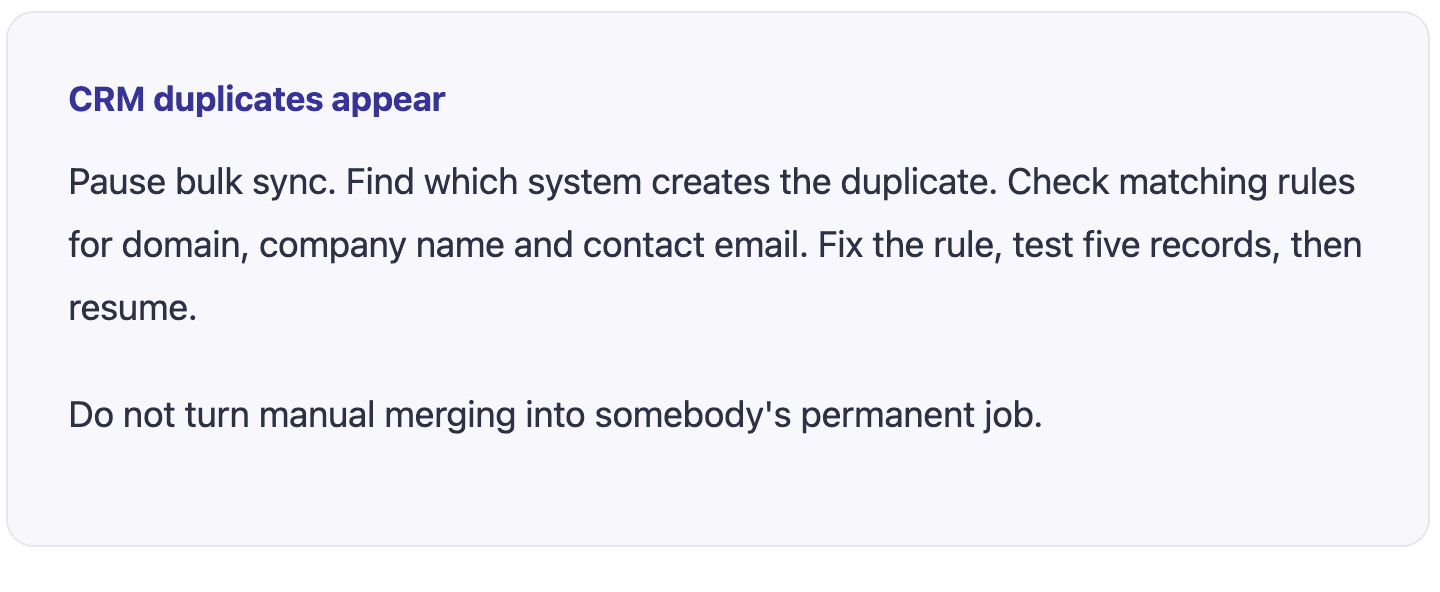
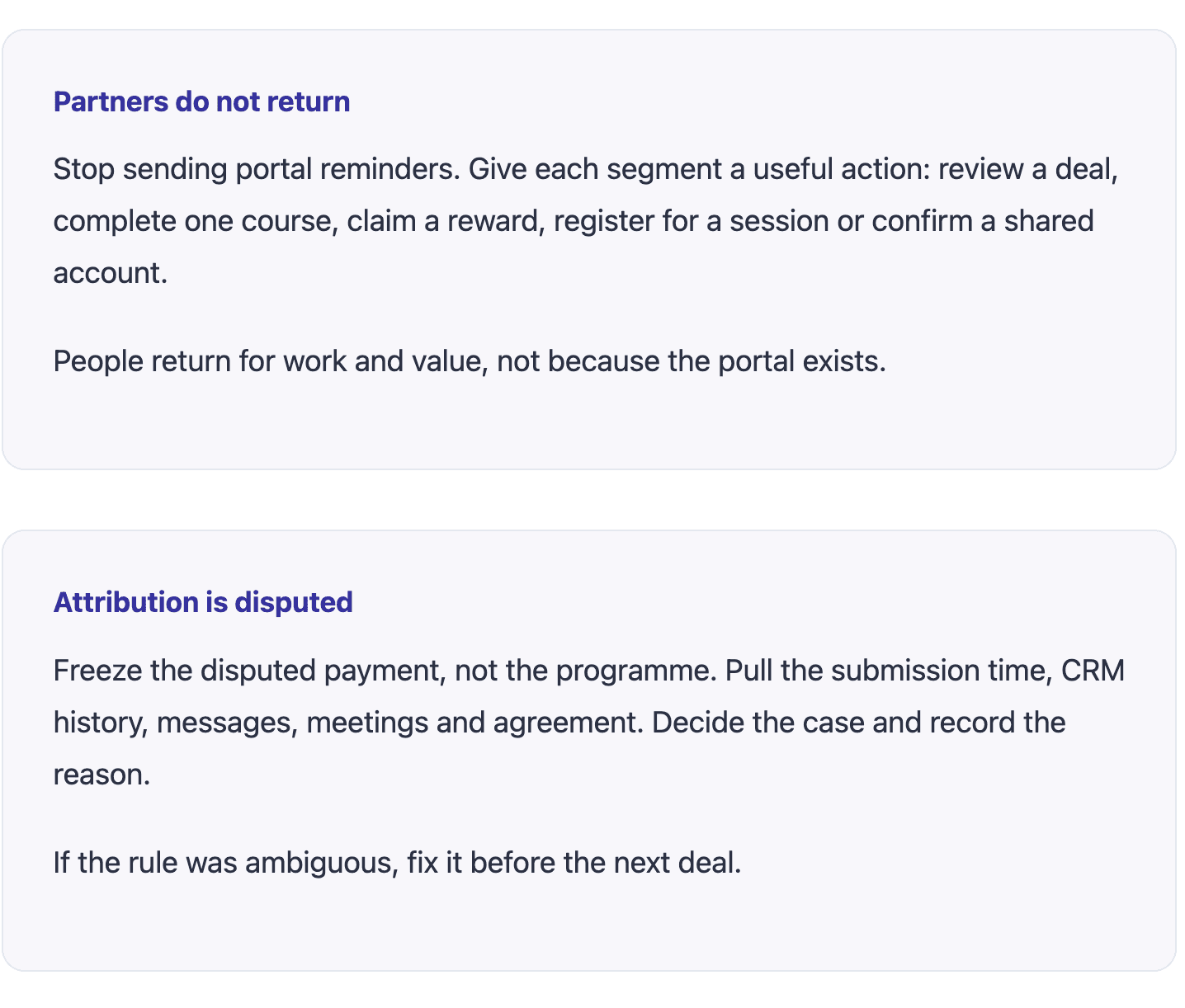
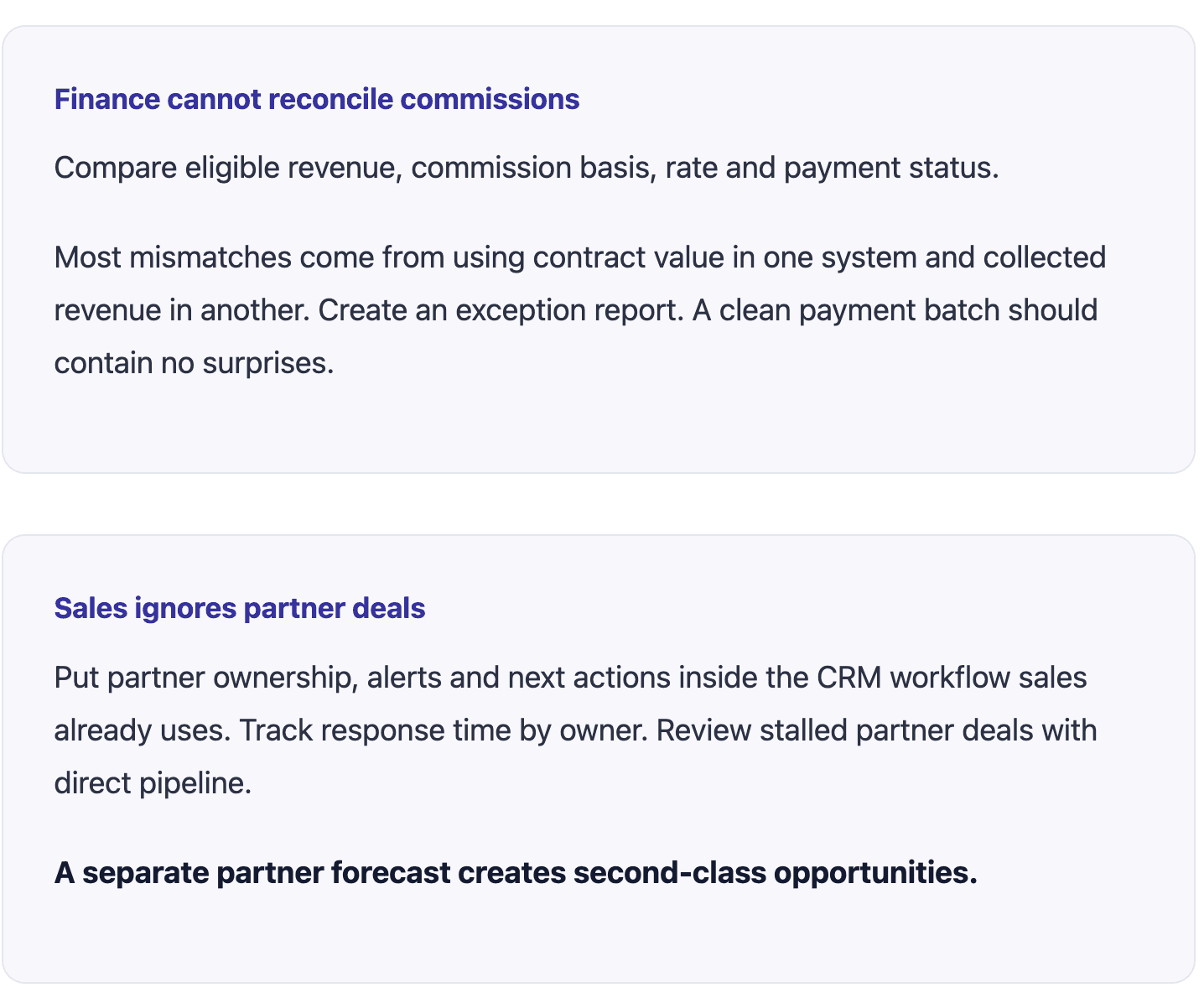
Stop buying for the partner programme you might have
Impartner is built for organisations with mature channel complexity. That is its strength.
It is also why many SaaS programmes should choose Partner.io.
They do not need more modules. They need faster responses, active partners, visible co-sell opportunities, trusted attribution and clean payments. Partner.io connects those jobs without demanding an enterprise operating model first.
Take three real deals. Connect the CRM. Map actual accounts. Run the Four-Clock Test.
If Partner.io shortens the response, activation, visibility and payment clocks, stop comparing feature lists and put the programme into Partner.io.
Take three real deals through Partner.io and see the response, activation, visibility and payment clocks move.
Try Partner.io Free for 14 Days
Frequently asked questions
What is the best Impartner alternative for B2B SaaS?
Partner.io is the strongest fit when the programme needs onboarding, account mapping, referral and deal tracking, CRM sync, training, tiers, events, analytics and payments without a large enterprise rollout.
How does Partner.io compare with Impartner?
Impartner offers deeper enterprise channel management, including MDF, through-channel marketing, compliance, multi-language support and hyperscaler workflows. Partner.io gives SaaS programmes a faster operating system for referrals, agencies, integrations, co-sell, resellers and partner payments.
What does Partner.io cost?
Partner.io currently lists Solo at $169 per month and Growing at $389 per month. Enterprise pricing is available on request. Check the live pricing page for current billing terms and plan contents.
Does Partner.io include account mapping?
Yes. Partner.io account mapping identifies shared customers, prospects and open opportunities so teams can create warm introductions, co-sell plays, expansion campaigns and accurate partner influence records.
When should a company replace spreadsheets with PRM software?
Move when manual work causes slow lead responses, inactive partners, missed updates, disputed attribution or payment errors. Partner count is a poor trigger. Ten productive partners can justify PRM software. Two hundred inactive records cannot.