Product
Crossbeam vs Partner.io: Which One Fits?

Partner programmes do not fail because they lack account data. They fail because nobody owns the next step.
A partner identifies an opportunity. Sales ignores it. The partner chases for an update. Finance cannot confirm the commission. Three spreadsheets disagree. Everyone blames the software.
This is why the Crossbeam vs Partner.io comparison matters. Crossbeam helps companies find partner overlap and use ecosystem data in sales. Partner.io helps companies run the partner programme itself.
They overlap. They are not interchangeable.
Crossbeam tells you who mattered. It does not calculate what they earned.
The Simple Answer
Choose Crossbeam when the main problem is finding shared accounts, identifying warm routes into opportunities and helping sales use partner intelligence.
Choose Partner.io when the problem is managing partners from onboarding through referral, deal progression, enablement, attribution and commission payment.
Crossbeam helps answer:
Which accounts do we share?
Which partner can influence this deal?
Where is there a warm route into a target account?
Which opportunities should sales prioritise?
Partner.io helps answer:
Which partners are active?
Who submitted this opportunity?
Has sales accepted it?
What stage is the deal in?
Which reward applies?
Has the partner been paid?
One reveals opportunity. The other turns opportunity into an operating process.
For most growing B2B SaaS companies building referral, agency, reseller or mixed partner programmes, the second problem causes more damage.

What Crossbeam Is Built For
Crossbeam is an ecosystem intelligence platform. Its strength is account mapping. It connects data between participating companies, finds shared customers and prospects, and surfaces partner context around open opportunities.
That matters when you have:
A large technology ecosystem
Partners with reliable CRM data
A sales team that needs warm introductions
High volumes of target accounts
A mature co-sell process
A team ready to act on partner signals
Crossbeam has also expanded beyond basic overlap reports. Its platform now supports co-sell workflows, pipeline generation, Deal Navigator, CRM experiences and revenue attribution. That makes it useful far beyond the old spreadsheet-style account mapping model.
But its centre of gravity remains the same: partner data, ecosystem signals and sales intelligence. Crossbeam is at its best when the partner programme already works, and the business needs better information to aim it.
What Partner.io Is Built For
Partner.io is PRM software. It manages the operational work behind a partner programme:
Partner applications and onboarding
Referral submission and deal registration
CRM synchronisation
Partner training and certifications
Tiers and rewards
Commission tracking and payments
Programme reporting
Shared partner resources
This is the machinery most partner programmes lack. The business may already have a CRM, a learning platform, a file library, a payment process and several spreadsheets. The problem is that none of them gives the partner a clear experience or gives the business a reliable record.
Partner.io replaces that patchwork with one operating layer. Partners can submit leads, check deal status, access training, view resources and track commission through a single partner portal. Internal teams can manage workflows, monitor performance and keep opportunity data aligned with the CRM.
That is the difference between having partners and running a partner programme.
Start With the Bottleneck, Not the Feature List
Feature tables encourage bad decisions. Every platform can claim reporting, integrations, automation and collaboration. Those words are too broad to help.
A better way to choose is to identify where partner revenue stops moving. Use the MAPS model.
M: Match
Can you identify which partners overlap with target accounts, open opportunities or existing customers? Crossbeam is stronger here. Its network, multi-partner mapping and sales intelligence tools are built for companies that need deep ecosystem visibility. Partner.io includes account mapping, but mapping sits inside a wider PRM workflow.
A: Activate
Can someone turn the signal into a clear action, such as a warm introduction, a partner-assisted sales call, a registered referral, a joint campaign or an integration play? Crossbeam helps sales decide which partner to involve. Partner.io helps the business and partner act together through a managed workflow.
P: Progress
Can everyone see what happens after the opportunity appears? Someone needs to know who owns it, whether sales accepted it, what stage it has reached, and whether it has stalled. This is where Partner.io pulls ahead. A partner programme cannot rely on account executives remembering to send updates.
S: Settle
Can the business prove contribution, calculate the right reward and pay the partner? This is where spreadsheets become dangerous, especially once tiers, split credit, renewals, refunds and clawbacks enter the picture. Crossbeam can support revenue attribution. Partner.io handles the commercial process that follows attribution.
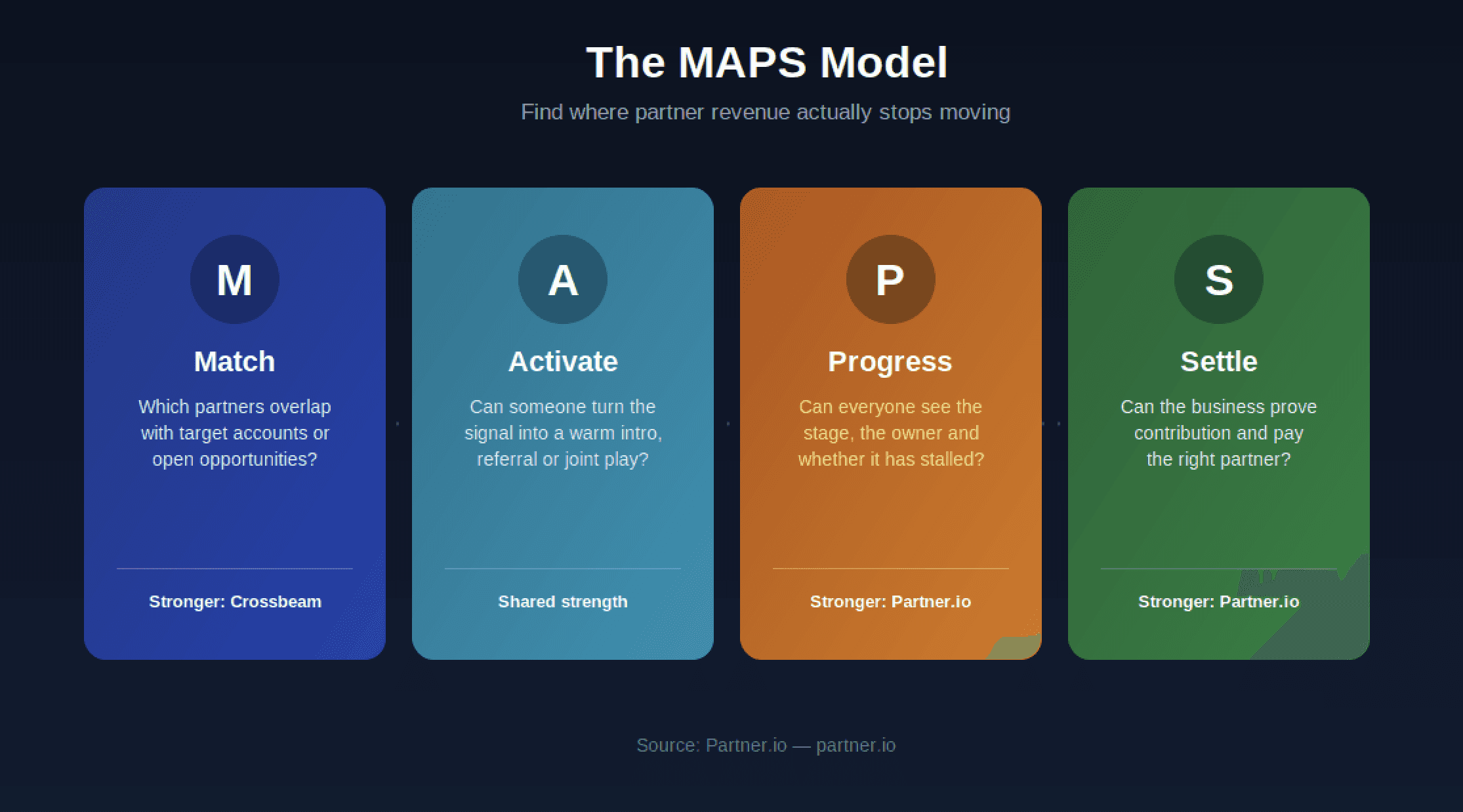
The MAPS model: find where partner revenue actually stops moving.
Knowing a partner influenced a deal is not the same as calculating what they earned.
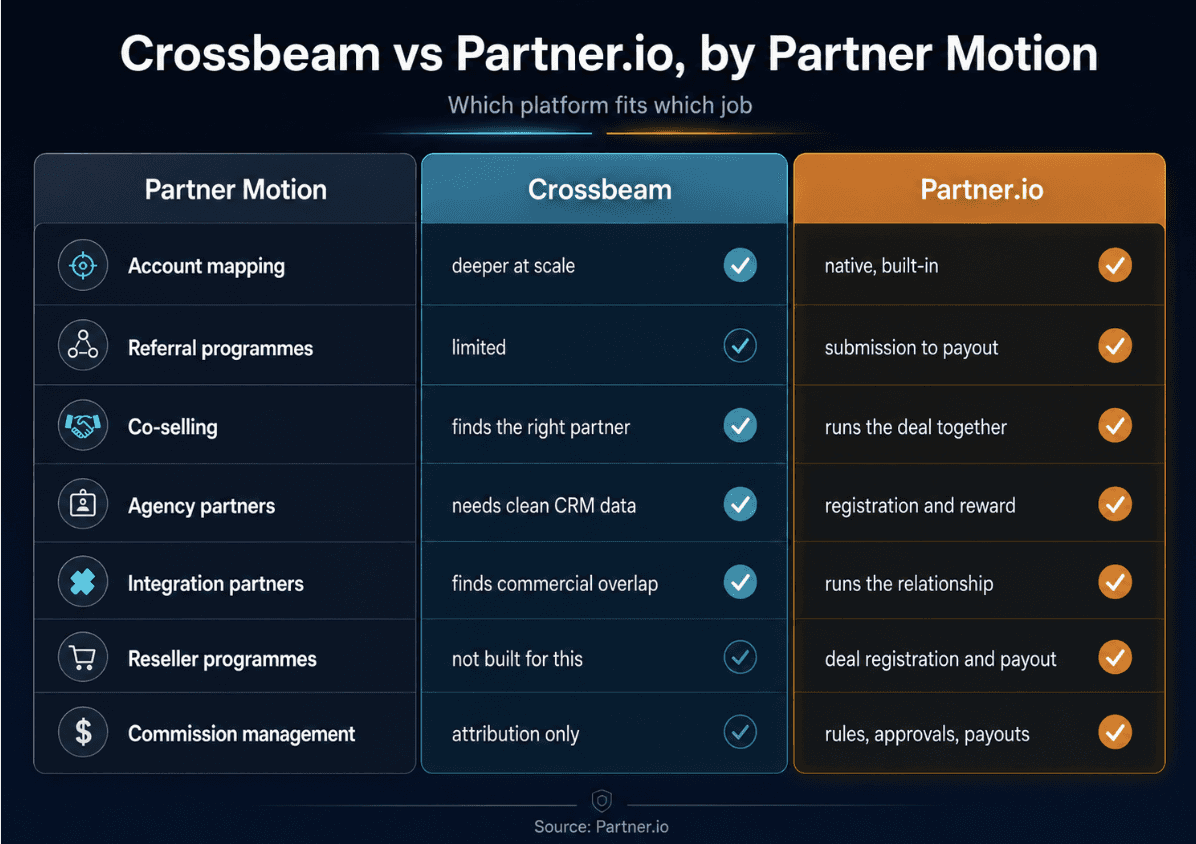
Crossbeam vs Partner.io by Partner Motion
Account mapping — both, different depth
Both platforms do account mapping natively. Crossbeam is built for it first: multi-partner overlap analysis and seller prioritisation across large, data-rich technology ecosystems. Partner.io's account mapping sits inside the same system as your referrals, deal registration and commission tracking, so the overlap moves straight into a tracked action without exporting to a second tool.
Crossbeam gives more depth at the discovery stage for large, multi-partner ecosystems. Partner.io keeps mapping connected to what happens next, which is where most growing programmes actually lose deals.
Referral programmes — best fit: Partner.io
A referral programme needs more than a form. It needs submission rules, lead acceptance, duplicate checks, status updates, attribution and payment tracking. Without those controls, partners lose trust: they submit a lead, hear nothing for three weeks, then discover sales was already speaking to the account.
Partner.io's referral tracking gives partners a clear submission process and lets them track progress without chasing the programme manager. Crossbeam can help uncover warm opportunities. It does not replace the referral operation.
Co-selling - best fit: depends on the failure point
Choose Crossbeam when sales lacks partner context. Choose Partner.io when the co-sell motion needs structure between the business and the partner, including shared updates, tasks, deal stages, ownership and rewards. Crossbeam helps sales find the right partner. Partner.io helps both sides run the deal.
Agency partners - best fit: Partner.io
Agency programmes usually fail through poor operations, not poor account intelligence. Partner.io answers the questions that matter to an agency inside the programme: can we register this client, will the opportunity be protected, what commission applies, and when will we get paid. Crossbeam becomes useful once agencies maintain clean CRM records, but many smaller agencies will not.
Integration partners - best fit: split
Technology partnerships create two jobs. Finding commercial overlap is Crossbeam's strength. Running the relationship (onboarding, training, joint resources, lead exchange, commercial rewards) is Partner.io's strength. Large ecosystems may need both. Smaller teams should resist buying two systems before the volume justifies it.
Reseller programmes - best fit: Partner.io
Resellers need commercial control: who registered the deal, how long protection lasts, which discount applies, when payment is due. Account intelligence can strengthen the motion. It cannot replace the operating process.
Commission management - best fit: Partner.io
This is not a close comparison. Partner.io manages reward rules, approvals, invoices and partner payments. Crossbeam can help show where partners influenced revenue, but it is not designed to run commission operations.
Partner enablement - best fit: Partner.io
Partners fail not because they missed one PDF, but because nobody tells them what to do first, which accounts fit, or how they earn money. Partner.io gives partners access to training, certifications, resources and payments through one portal. Crossbeam can train users to use Crossbeam; it is not the enablement hub for the wider programme.
What This Looks Like in the Real World
A partner manager maps accounts with a major integration partner and finds 146 overlaps. The spreadsheet goes to sales. Three account executives react with a thumbs-up. One asks whether the partner can provide introductions. Nobody assigns owners. Two weeks later, the list is stale.
The problem was not visibility. It was activation.
A working process would split those overlaps into commercial plays: open opportunities where the partner can provide intelligence, target accounts for a warm introduction, shared customers for an integration campaign, existing customers for expansion, and low-value overlaps to ignore. Every accepted account gets an owner, an action and a deadline.
Crossbeam is excellent at finding and prioritising the accounts. Partner.io is the stronger choice when the work must continue through referral submission, deal progression, attribution and reward. The handoff determines whether the data turns into revenue.
Where Implementations Break
Buying the software is the easy part. The damage starts when weak processes enter the system.
Broken CRM definitions
If "customer," "prospect," "open opportunity" and "partner-sourced" mean different things across teams, the data becomes unreliable. Define every lifecycle stage and attribution field before launch, and do not let each department invent its own version.
No response SLA
Partners submit leads and hear nothing, then stop submitting. Set a clear rule: every new referral gets a decision within a defined number of working days. Accepted leads need an owner. Rejected leads need a reason.
Ownership disputes
A partner registers an account that sales was already contacting. Another partner claims it made the first introduction. Decide the rules before the dispute arrives: prior-contact rules, active opportunity windows, deal protection periods and split-credit rules.
Overlap reports with no play
A large overlap number looks impressive in a slide. It means nothing without an action. Every mapping exercise should support a named commercial play, or it should not exist.
Commission rules: finance cannot audit
A programme promises 20 percent commission. Then a customer pays annually, cancels after six months and was influenced by two partners. Nobody knows what to pay. Test commission rules against refunds, renewals, split credit and clawbacks before launch, not after.
A partner portal nobody uses
A portal is not a strategy. Build it around recurring jobs: submit a lead, check deal progress, complete training, download current assets, view commission. Remove everything that does not help the partner act.
Competing systems of record
This appears when the CRM, PRM and account mapping platform all claim the same data. Assign ownership by data type: the CRM owns customers and opportunities, the PRM owns partner operations, the ecosystem intelligence platform owns shared account signals. Document how records move between them.
A portal is not a strategy. Partners log in when they have a reason.
Pricing and Total Cost
Crossbeam lists a free plan, followed by paid plans built around deeper account mapping, co-selling and ecosystem intelligence. Partner.io offers lower-cost entry points and a broader PRM feature set, including partner management, deal registration, enablement, rewards and payouts.
The subscription price does not tell the whole story. Calculate the cost of extra seats, implementation, CRM administration, data cleanup, manual commission work, separate training software, separate partner portals, chasing sales updates, and lost referrals. A platform that looks cheaper but leaves three manual systems in place is not cheaper.
This mirrors what SaaStr has found looking at the largest partner ecosystems in SaaS: Salesforce's biggest source of new revenue is partners and platform, and Shopify grew its partner-driven revenue share from roughly 8 percent to 20 percent of total revenue between 2018 and 2020. That growth came from operational discipline, not just better account data.
Is Partner.io a Crossbeam Alternative?
Yes, when the real need is broader than account mapping. No, when the requirement is deep ecosystem intelligence across a large technology network.
Partner.io is the stronger Crossbeam alternative when a company is searching for account mapping software but actually needs to fix partner onboarding, referral management, deal registration, training, attribution, commission tracking, payments and reporting.
This is the category mistake that wastes budget. Account overlaps are visible and exciting. The operational damage is quieter. It sits inside inboxes, spreadsheets, missed follow-ups and commission disputes. Partner.io addresses the part that creates or destroys trust.
Can Partner.io replace Crossbeam?
For a growing SaaS company that wants account mapping as part of a complete PRM workflow, yes. For a company with hundreds of technology partners and a sales process built around ecosystem data, Crossbeam remains the stronger specialist. The deciding factor is not company size alone. It is whether the bigger problem is finding the opportunity or running it.
Can Crossbeam replace Partner.io?
Not when the business needs a full PRM. Crossbeam can reveal overlaps, support co-selling and show ecosystem influence. It does not replace onboarding, training, deal registration, partner tiers, reward management, commission approvals or partner payouts. Those are not edge features. They are the operating system of the programme.
A Practical Selection Checklist
Choose Crossbeam when:
The partner programme already works
Technology alliances drive meaningful pipeline
Partners maintain reliable CRM data
Sales needs partner context inside its workflow
Multi-partner mapping is a regular requirement
Another system already handles onboarding and payments
Choose Partner.io when:
Partner operations live in spreadsheets and email
Partners need a portal
Referrals need formal tracking
Deal registration matters
Agencies, resellers or mixed partner models are growing
Training and certification are required
Commission work is manual
The business needs one partner system of record
Use both when:
The partner channel already generates meaningful revenue
The technology ecosystem is large and data-rich
Partner operations are mature
RevOps can maintain clear ownership between systems
Do not buy the software stack of a company five times your size. Fix the current constraint.
A 30-Day Implementation Plan
Week 1: Define the motion
Decide which partner types exist, what each should do, what counts as sourced versus influenced, which deal stages partners can see, and when rewards trigger. SaaStr's guidance on early partner programmes makes the same point: treat partner acquisition like a sales funnel, with defined stages logged in the CRM, before anything else.
Week 2: Clean the data
Map CRM fields. Remove duplicates. Fix missing partner identifiers. Test a small import before moving the full programme. Do not import years of bad data because nobody wants to delete the spreadsheet.
Week 3: Launch one workflow
Pick one partner motion, not six. For Partner.io, that might be agency referrals from submission through payment. For Crossbeam, it might be partner-assisted acceleration for open opportunities above a defined value. Train a small internal group and a small partner group. Watch what they do. Ignore what they promised to do in the kickoff call.
Week 4: Inspect failure
Review unaccepted leads, opportunities with no owner, deals with no next action, partners who did not activate, CRM sync errors and rewards that needed manual correction. Fix the workflow before adding more partners. Automating confusion only makes it travel faster.
The Decision
Crossbeam is the right platform when the partner engine works but lacks direction. Partner.io is the right platform when the engine itself is broken.
Most growing SaaS partner programmes do not need another layer of intelligence first. They need control. They need partners to know what to do, sales to know what to own, finance to know what to pay, and leadership to know what produced revenue.
That is why Partner.io is the more natural starting point for referral, agency, reseller and mixed partner programmes.
Run one real partner journey through it. Invite a partner. Submit a referral. Accept the deal. Move it through the pipeline. Trigger the reward. Check the partner experience.
If the process becomes clearer, faster and easier to audit, the decision is already made.
Ready to see it with your own partner data?
Try Partner.io Free for 14 Days