Product
Partner Relationship Management: How to Operationalise Trust in B2B Sales

Your partner does not care what your partnership values slide says.
They care what happens when they hand you a deal.
If the lead vanishes into a shared inbox, sales claims the account and finance debates the commission three months later, the partner learns something: your promises are optional. The next opportunity goes to a competitor.
That is why trust in B2B partner sales cannot depend on goodwill. It has to be operational.
When it is, partners share opportunities earlier. Sales brings partners into deals before they stall. Attribution survives internal politics. Commissions stop becoming investigations.
The partner programme stops running on favours and starts producing repeatable revenue.
Trust is not a feeling your partners have about you. It is a prediction they make about you.
Trust is a process, not a personality trait
Operational trust is simple: a partner can predict what your company will do after they take a commercial risk on you.
They know what earns credit. They know who will respond. They can see the deal move. They understand the reward. If something goes wrong, they know how it will be resolved.
Predictability does not mean saying yes to every claim. A quick rejection with evidence creates more trust than an approval followed by six weeks of silence.
Frances Frei and Anne Morriss make the same point about people, and it transfers cleanly to companies:
“People tend to trust you when they think they are interacting with the real you (authenticity), when they have faith in your judgment and competence (logic), and when they believe that you care about them (empathy).”
Frances X. Frei and Anne Morriss, Begin with Trust, Harvard Business Review, May 2020
A partner programme fails the logic test long before it fails the empathy test. Partners rarely leave because you were unfriendly. They leave because you were unpredictable.
Most partner programmes fail this test because their rules live in the wrong places:
One condition sits in a contract.
Another lives in a spreadsheet.
Commission logic depends on finance remembering an exception.
Deal ownership rests on a Slack conversation nobody can find.
That is personal trust, tied to a few diligent people. It collapses when they get busy or leave. We have written before about the hidden cost of managing partners in spreadsheets, and the cost is almost never the licence fee. It is the promise nobody can find.
Partner relationship management should turn those promises into visible rules, owned actions and auditable records. If your PRM software is only a branded login page, it is not doing the job. If you are still deciding whether you need one at all, start with what a PRM is and whether you need one.
The TRUST operating model for partner relationship management
You can test a partner programme through five controls: Terms, Routing, Updates, Settlement and Traceability.
Each answers a question the partner is already asking.
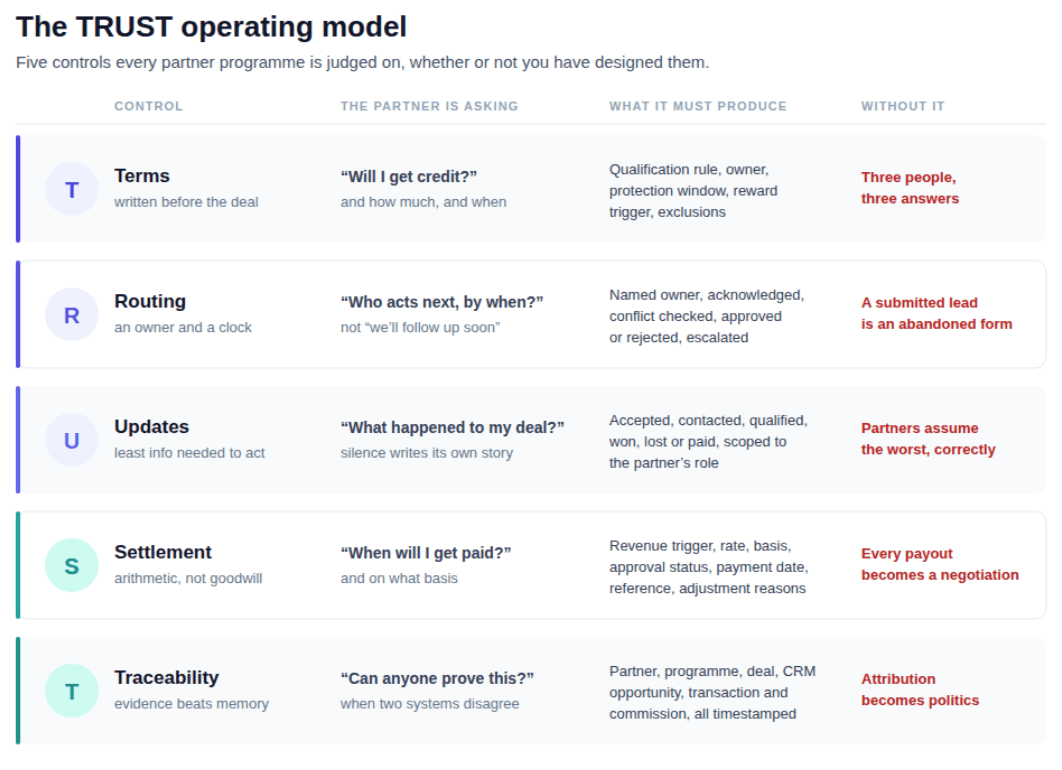
Diagram of the five TRUST controls with the partner question each one answers

Terms: will I get credit?
Write the commercial rules before the opportunity arrives.
For each partner motion, define:
What qualifies
Who owns the deal
How long protection lasts
What evidence is required
Which event triggers a reward
How the reward is calculated
When payment is due
What is excluded
Do not force every partner through one policy.
A referral partner earns credit for a qualified introduction. A reseller may run the sale and need protected margin. An agency can influence product selection, then deliver implementation. A technology partner may create demand without ever introducing a named buyer.
Those contributions are not interchangeable. The rules should not pretend they are.
The three-answer test: give the terms to sales, finance and the partner. Ask each to calculate the reward from the same worked example. If you get three answers, the policy is not ready for automation.
Routing: who acts next, and by when?
A submitted lead without an owner is not pipeline. It is an abandoned form.
Route each referral or registered deal by territory, segment, product, partner type or customer status. Start the clock when it arrives. Tell the partner who owns the review and when to expect a decision.
Separate the service levels:
Submission acknowledged
Conflict checked
Registration approved or rejected
First customer contact attempted
Overdue action escalated
“We will follow up soon” is not a service level. It is cover for a queue nobody owns.
Google’s site reliability engineering team draws a distinction worth stealing for channel partner management:
“An easy way to tell the difference between an SLO and an SLA is to ask ‘what happens if the SLOs aren’t met?’”
Google, Site Reliability Engineering, Chapter 4: Service Level Objectives
Most partner programmes publish objectives and call them agreements. If nothing happens when you miss a 48 hour approval window, you did not promise 48 hours. You expressed a hope.
Deal registration software should enforce the process, not merely capture the form. Partner.io can route submissions, trigger workflows and automate deal registration so the outcome stays visible on both sides. When an owner misses the deadline, the task escalates before the partner has to chase.
Updates: what is happening to my deal?
Silence creates its own story, and it is rarely kind.
A referral partner does not need every CRM note. They do need to know whether the lead was accepted, contacted, qualified, lost, won or paid.
A reseller working the opportunity needs more detail. An integration partner may need account overlap and opportunity signals through account mapping, but not unrelated customer data.
Give each role enough information to make its next decision. No more, no less.
This is where a connected partner portal matters. Partners stay informed while the sales team keeps working inside its CRM, and routine status changes move between systems instead of relying on a partner manager to relay them by hand.
Too little visibility kills confidence. Too much creates privacy and channel conflict risk. If you are sharing customer data across organisations in the UK or EU, the ICO’s data sharing guidance is the practical starting point, not your legal team’s memory of it.
The right level of partner visibility is the minimum information needed for action.
Settlement: when will I get paid?
Commission is where friendly partnership language meets arithmetic.
Define the trigger. Is it a qualified lead, signed contract, collected invoice, subscription payment or renewal? Then deal with the awkward details upfront: discounts, credits, refunds, churn, partial payments and currency conversion.
The partner should be able to see:
The qualifying deal or transaction
The commission rate or fixed reward
The calculation basis
The approval status
The expected payment date
The final payment reference
A payout should not be a pleasant surprise. It should be the expected result of a visible rule.
When a calculation is wrong, preserve the original record and issue an adjustment with a reason. Quietly changing the number destroys the audit trail and turns the next query into an argument.
Partner payments in Partner.io connect commission rules and payment status to both the partner and the underlying revenue event. Finance moves faster because it can verify a calculation without rebuilding the deal from email threads. There is more detail on the mechanics in how Partner.io handles partner rewards.
Traceability: can anyone prove what happened?
Trust depends on memory until two systems disagree. Then it depends on evidence.
Link the partner, programme, registered deal, CRM opportunity, customer transaction and commission. Keep timestamps for submissions, approvals, status changes and overrides. Record who changed what, and why.
A CRM tells you what happened with the customer. A PRM tells you who contributed, under which programme, on what terms and with what obligation attached.
Without that chain, attribution becomes political.
Sales has one number. Finance has another. The partner has screenshots.
See what a predictable partner motion looks like
You do not need a six-month implementation to test this. Set up one referral motion, one owner and one SLA.
Try Partner.io free for 7 days. No credit card required.
Seven ways high-trust partner programmes operate
1. They protect deals without letting partners park accounts
Deal registration asks a partner to expose an opportunity before it is safe to do so. Protection makes that risk worthwhile. Permanent protection lets weak partners squat on your pipeline.
Set an expiry date and renewal criteria. A 90 day protection window, for example, might renew only when the partner records meaningful progress every 30 days. Match the period to your sales cycle, but keep the principle: protection follows evidence of active work.
Publish the rules for existing customers, open opportunities, duplicate submissions and dormant accounts. Check claims using timestamps and customer identifiers. Send genuine ambiguity to one named decision maker with a deadline.
2. They separate source, influence and fulfilment
One partner introduces the buyer. Another shapes the technical decision. An agency implements the product.
If your system has one “partner sourced” checkbox, somebody gets erased.
Track three contributions:
Source: created the opportunity
Influence: helped the opportunity progress
Fulfilment: resold, implemented or serviced the solution

Diagram showing partner contribution split into source, influence and fulfilment, and how each maps to a different reward rule
Tracking a contribution does not mean paying for it. Attribution records what happened. Compensation applies the programme rules to that record. Collapsing the two is why most channel attribution arguments never end.
This distinction also cleans up reporting. Partner sourced pipeline, partner influenced win rate and partner delivered revenue answer different questions. Combining them produces a flattering number that nobody trusts, which is one of the reasons partnerships collapse without internal alignment.
3. They design the handoff before recruiting partners
Weak programmes recruit first and discover the sales process later.
The first referral lands with an account executive who lacks context, has no incentive to prioritise it and does not know what the partner was promised. The problem is not partner engagement. The handoff was never designed.
Build backwards from the first customer conversation. Capture the company, contact, business problem, partner context, consent, timing and requested support. Put that information inside the CRM record where the seller already works.
For a co-sell deal, assign the roles before the call:
Who opens the relationship
Who runs discovery
Who demonstrates the product
Who handles commercials
Who follows up
Who owns implementation
The buyer should meet one joined up team, not watch two companies negotiate ownership in front of them. Done well, this is a large part of why partner sourced deals close faster in B2B SaaS.
4. They give each partner type a different path
A reseller needing certification, pricing and protected margin should not receive the same onboarding as a consultant making three introductions a year.
Segment by intended behaviour, not by impressive sounding tier names.
Partner type | What they actually need |
|---|---|
Referral partners | Short submission path, clear qualification rule, payment visibility |
Agency partners | Implementation training, co-selling material, directory exposure, shared account planning |
Technology partners | Integration documentation, launch ownership, support rules, a route for joint opportunities |
Reseller partners | Deal protection, commercial assets, tier logic, renewal handling |
A partner portal should remove work. If it is a branded cupboard full of PDFs, partners will ignore it.
Partner.io supports multiple partner types in one programme while giving each the relevant rooms, resources, training and enablement, tiers and workflows. Consistency does not mean forcing everyone through the same journey.
5. They put partner context inside the sales workflow
If a salesperson must open another system to discover whether a partner is involved, adoption will fail.
Sync approved partner data into the CRM. Show the attached partner, contribution type, registration status, next action and programme owner on the account or opportunity record. Send alerts where the team already responds.
Keep the CRM as the customer revenue record. Use the PRM to run programme terms, partner access, enablement, deal registration and commissions. Before enabling two way sync, decide which system owns every critical field. If you are working in HubSpot, the vendor’s own guidance on how deal records are created and associated is worth reading before you map anything.
Partner.io syncs into HubSpot, Salesforce, Pipedrive and Slack through native integrations and webhooks.
When an integration breaks, stop adding fields. Map the data flow. For each field, name the system of record, accepted values, update direction, duplicate rule and failure alert.
Most integration problems are ownership problems wearing technical clothes.
6. They measure responsiveness before revenue
Revenue is a late result. By the time it falls, the behaviour that caused the decline may be months old.
Track the signals that reveal whether you are keeping your promises:
Time to acknowledge a submission
Time to approve or reject a registration
Accepted leads contacted within the agreed window
Active deals updated in the last 30 days
Commission adjustments and disputes
Days from qualifying payment to partner payout
Partner activation by programme type
Partner sourced and partner influenced pipeline
Break the results down by partner type, region and internal owner. A healthy average can hide a territory where leads go to die.
7. They treat exceptions as product feedback
Every manual workaround tells you where the operating model is weak.
Review rejected registrations, duplicate conflicts, ownership overrides, missed service levels, incorrect commissions and failed syncs every month. Ask one question: was the failure caused by the policy, the workflow, the data or the person?
Then act. Change the rule, fix the automation, require better information or train the owner.
Some exceptions should stay manual. If a case appears twice a year and requires judgement, automating it may cost more and produce worse decisions. Document the route and keep the audit trail.
What operational trust looks like in a live deal
An agency registers a £24,000 annual software opportunity after a client asks for a recommendation. The contact already exists in the CRM, but there is no open opportunity.
In the usual broken process: the submission reaches a shared inbox. Three days pass. Sales creates an opportunity without attaching the agency. Six weeks later the deal closes, and the agency has to prove it made the introduction.
Now run the same deal through Partner.io:
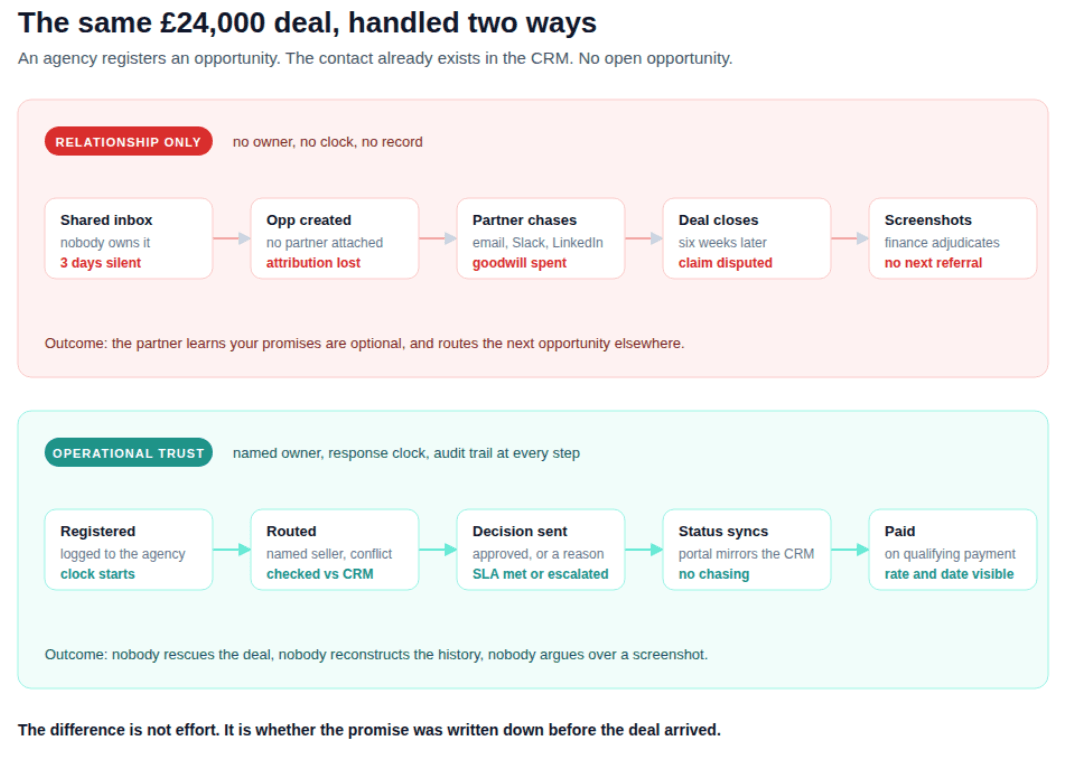
Timeline comparing a broken partner deal handoff with an operational one, showing owners, SLA clocks and audit points at each stage
The submission is recorded against the agency and routed to the right seller.
The team checks the connected CRM for an existing contact before creating or associating the opportunity.
The agency receives confirmation and a response deadline.
The seller sees the partner context inside the CRM.
Status changes flow back to the partner portal.
When the customer’s qualifying payment lands, the agreed commission is recorded and shown with its payment status.
Nobody rescues the deal. Nobody reconstructs the history. Nobody argues over a screenshot.
That is operational trust.
What changes once partners can predict your behaviour
Partners share earlier, because registration protects rather than threatens their position.
Sales involves partners more often, because the context, ownership and next action are already in the workflow.
Forecasts improve, because registered interest, qualified pipeline, sourced revenue and influenced revenue stop being bundled into one dubious figure.
Strong partners give you more attention. They have limited time and plenty of vendors asking for it. They favour the company that responds, collaborates and pays without drama. That is the real engine behind partner-led growth, and it is also why most teams fail at it.
The uncomfortable change is visibility. Slow approvals, ignored leads, inactive partners, disputed rules and sync failures can no longer hide behind relationship talk.
Good. Hidden failure cannot be fixed.
Build your first trusted workflow in 30 days
Do not begin by redesigning the whole partner ecosystem. Choose one revenue motion and make it reliable.
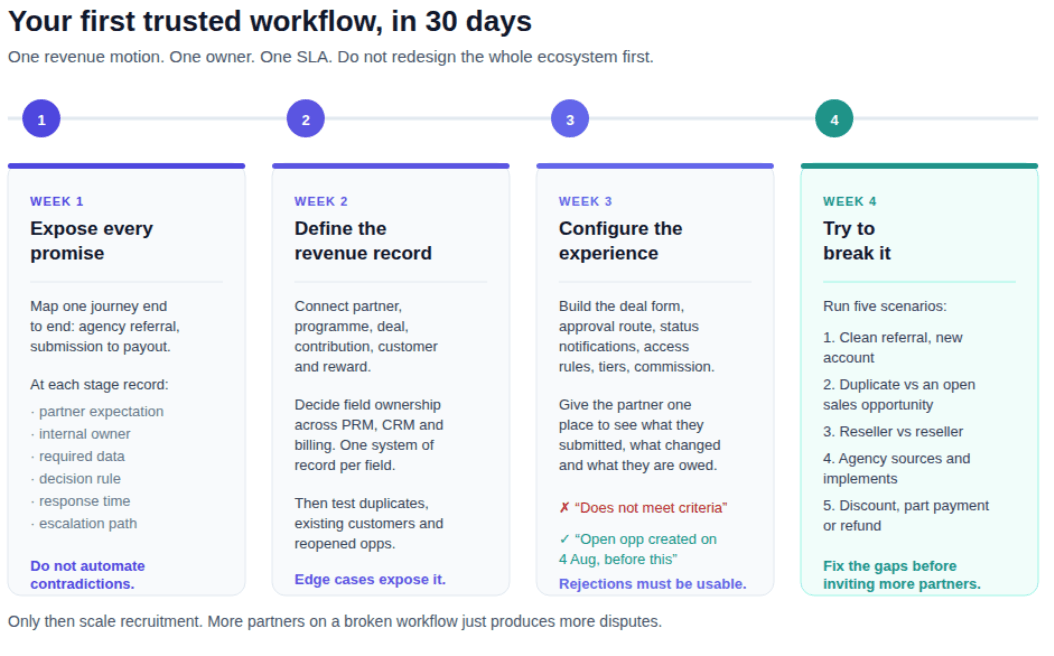
Four week plan to launch one trusted partner workflow, from mapping promises to breaking the process with edge cases
Week 1: expose every promise
Map one journey, such as an agency referral, from submission to payout.
At each stage, record the partner expectation, internal owner, required data, decision rule, response time, notification and escalation path.
Do not automate contradictions. Find them first.
Week 2: define the revenue record
Connect the partner, programme, deal, contribution, customer and reward. Decide field ownership between Partner.io, the CRM and the billing system.
Test duplicates, existing customers, multiple partners and reopened opportunities. Clean deals prove almost nothing. Edge cases expose the design.
Week 3: configure the experience
Build the deal form, approval route, status notifications, access rules, tier logic and commission calculation. Give the partner one place to see what they submitted, what changed and what they are owed.
Use rejection reasons a partner can act on:
❌ “Does not meet criteria” explains nothing.
✅ “An open opportunity was created on 4 August, before this registration” closes the loop.
Week 4: try to break it
Run five scenarios:
A clean referral for a new account.
A duplicate against an open sales opportunity.
A reseller registering an account held by another reseller.
An agency that sources the deal and delivers implementation.
A won deal with a discount, partial payment or refund.
Check what the partner, sales and finance teams each see. Inspect the audit trail. Fix the gaps before inviting more partners.
The operational trust test
Your partner programme is ready to scale only if you can answer yes to these questions:
☐ Can a partner understand the commercial rules without asking for an interpretation?
☐ Does every submission get an owner and a response deadline?
☐ Are duplicate and channel conflict rules written down?
☐ Can source, influence and fulfilment be recorded separately?
☐ Does partner context appear inside the CRM?
☐ Can partners see meaningful deal and commission status?
☐ Are rewards tied to a defined revenue event?
☐ Can finance trace a payout back to the transaction?
☐ Are overrides logged with a reason?
☐ Do overdue actions escalate automatically?
☐ Are results reported by partner type?
☐ Do exceptions improve the system?
If several answers are no, more recruitment will make the problem bigger. It will not create partner-led growth. That is precisely the difference between having partners and running a partner programme.
Frequently asked questions
What is partner relationship management?
Partner relationship management is the practice, and the software category, for running a partner programme as a defined process rather than a set of relationships. A PRM holds the commercial terms, partner records, deal registration, enablement content, tier logic and commission rules, and connects them to the CRM record for the same customer.
Is a PRM the same as a CRM?
No. A CRM is the system of record for the customer and the revenue. A PRM is the system of record for who contributed to that revenue, under which programme, on what terms, and with what obligation attached. Running a partner programme inside CRM custom fields works until two partners claim the same account.
What does deal registration software actually need to do?
Capture the opportunity, check it against existing customers and open opportunities, route it to a named owner, start a response clock, return an approval or a specific rejection reason, protect the deal for a defined period against defined renewal criteria, and link the outcome to a commission record.
How do I stop channel conflict between partners and my direct sales team?
Publish the rules before the conflict, not during it. Define what counts as an existing opportunity, how long registration protects a deal, what evidence settles a duplicate claim, and who makes the final call with what deadline. Most channel partner management disputes are not disagreements about fairness. They are disagreements about facts nobody recorded.
Stop asking partners to trust the process
If partners have to trust your process, they probably cannot see it.
Give them the rules. Show them the status. Protect their contribution. Pay what you promised. Keep the evidence.
That is the job of a serious PRM, and it is why Partner.io exists. It connects partner management, deal registration and revenue tracking, referrals, CRM data, workflows, training, account mapping and commissions so the promise made at recruitment survives the reality of a live deal.
Start with the next referral. Put the rules into Partner.io before it arrives, assign the owner, set the clock and connect the reward to revenue.
Then earn the next deal.
Try Partner.io free for 7 days
Set up your first deal registration workflow today. No credit card. No contracts. Cancel anytime.
Start your free trial
Prefer a walkthrough first? Book a demo or see pricing.