Product
Affiliate Software, Referral Tools or PRM? How to Pick Partner Tech That Survives a Real Deal

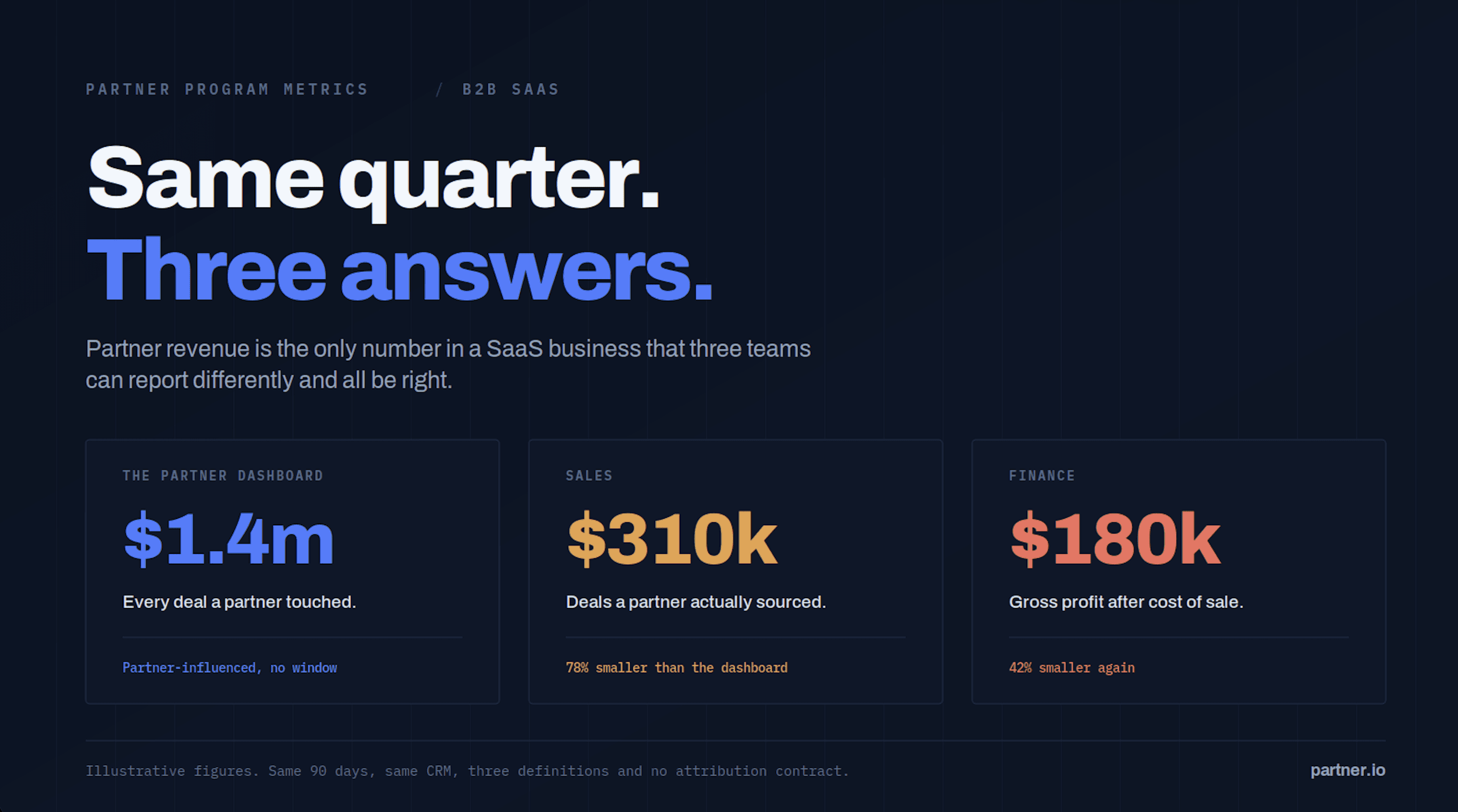
The referral was tracked. The deal closed. And your partner still had to chase you for the money.
Your dashboard logged that as a win.
Your partner logged it as a reason to go and talk to a competitor.
I've seen that exact sequence more times than I'd like. It's rarely a tracking problem. A link can tell you where a buyer came from. It can't settle an ownership argument, run a joint sales call, or explain why commission has been sitting in "pending" for six weeks.
So here's the rule I'd apply before you look at a single pricing page.
Choose your partner technology around the work that happens after the introduction.
If partners send traffic and people buy online without talking to anyone, affiliate software will do the job. Fine. But the moment partners are introducing named accounts, helping you sell, delivering implementations or working opportunities alongside your reps, you need something that supports those responsibilities.
That's the job partner relationship management software is built for.
A tracking link tells you where a buyer came from. It won't tell you who deserves the credit, or who's supposed to do something next. |
Affiliate software vs referral tools vs PRM: what each one is actually for
The three categories overlap, but they have different centres of gravity.
Affiliate software attributes conversions and manages rewards for promoters. Links, cookies, subscription events, payouts.
Referral software captures recommendations from customers or contacts and rewards the ones that qualify.
PRM software manages the working relationship. Onboarding, opportunities, resources, training, communication and commissions, in one place.
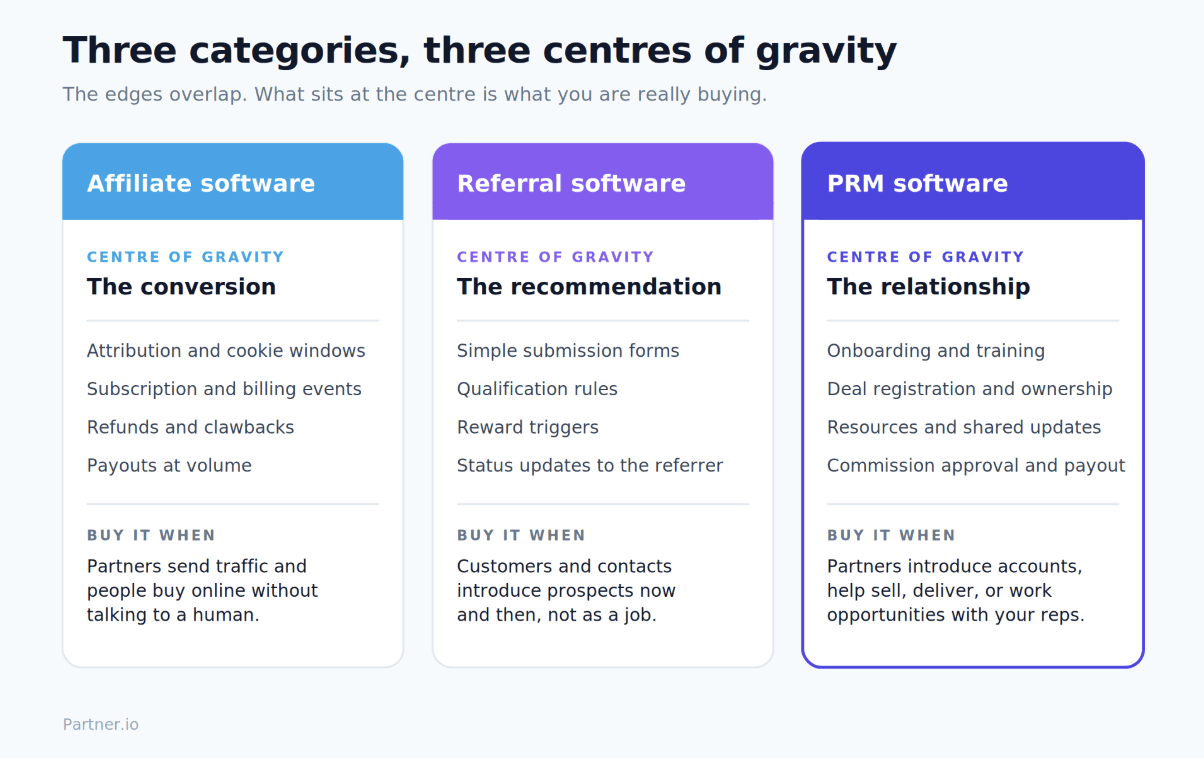
Now, the honest caveat. The edges are blurry.
Plenty of affiliate tools handle billing events and refunds properly. Plenty of referral tools can fire a reward off a CRM stage change. Some of them ship a portal.
And none of that tells you how much of your programme the product can actually carry.
So don't buy off the longest feature list. Take one recent partner deal, a real one, and ask whether the product could have run it end to end. From the moment the partner submitted it, to the moment the money left your account.
Include the awkward parts. Especially the awkward parts.
Start with how partners create business, not what you call them
"Agency partner" is close to meaningless as a buying input.
It could mean a business that drops an affiliate link in a newsletter. It could mean one that introduces its own clients. It could mean one that resells your software inside a managed service and never lets you near the customer.
Same label. Three completely different workflows.
Map the motion instead.
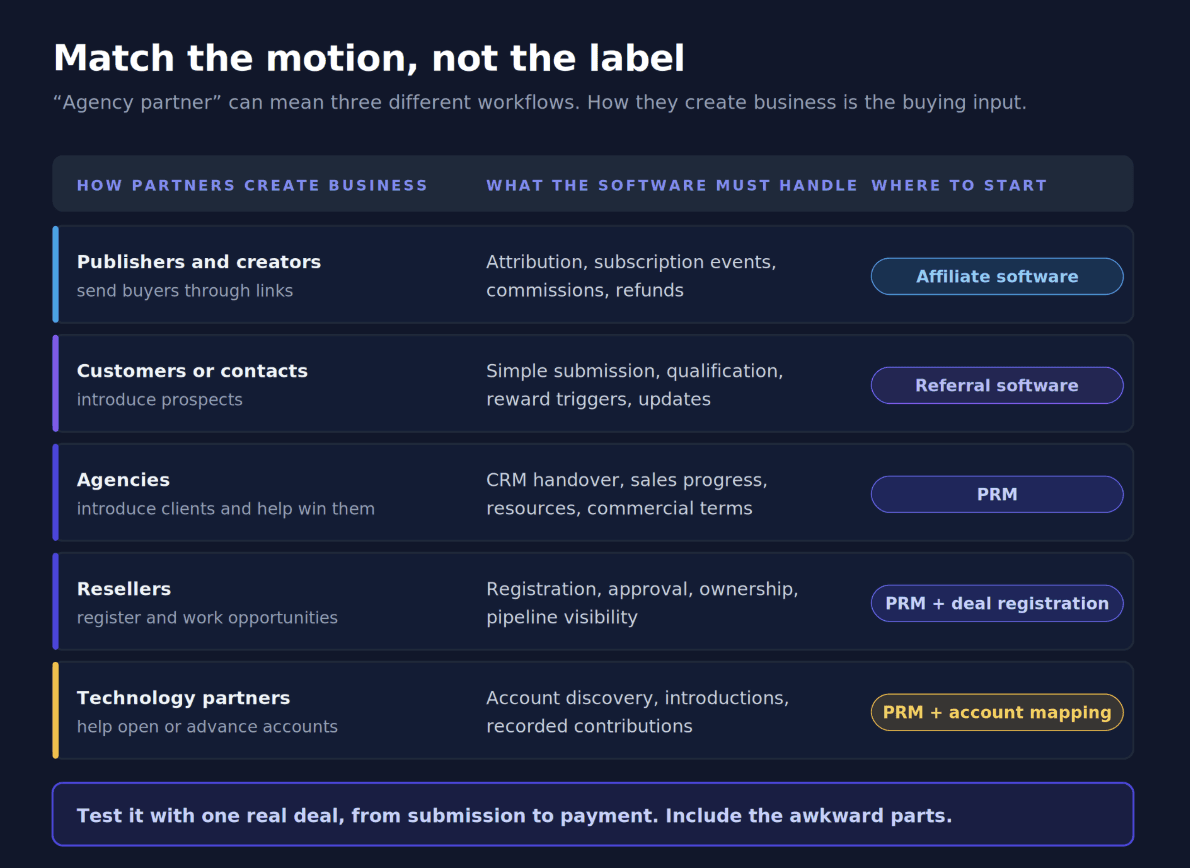

How partners generate business | What the software has to handle | Where to start |
Publishers and creators send buyers through links | Attribution, subscription events, commissions, refunds | Affiliate software |
Customers or contacts introduce prospects | Simple submission, qualification, reward triggers, updates | Referral software |
Agencies introduce clients and help win them | CRM handover, sales progress, resources, commercial terms | PRM |
Resellers register and work opportunities | Registration, approval, ownership, pipeline visibility | PRM with deal registration |
Technology partners help open or advance accounts | Account discovery, introductions, recorded contributions | PRM with account mapping |
When a tracking link genuinely is enough
A specialist newsletter recommends your product. A reader clicks, subscribes, pays online. The affiliate earns their percentage. Done.
Every question you have here is about attribution, renewals, refunds and payouts. Focused affiliate software is the right call. Don't overbuy.
Now change one thing about that sale.
An employee clicks the link. A colleague books the demo. Procurement signs three months later. An agency scopes the implementation.
Suddenly you're trying to connect a person, an account, an opportunity and three separate contributions. A cookie window can't referee that.
When referrals quietly turn into a relationship
An occasional customer referral needs a submission form and a clear reward. That's it.
An agency sending you clients every month needs a lot more. Which prospects qualify. Whether the introduction was accepted. Who's following up. What happened after the demo.
And if every one of those updates comes back as an email to your partner manager, congratulations. Your team is now the API between your partner and your CRM.
If your partner manager is the integration layer, you don't have a partner programme. You have a bottleneck with a job title. |
A partner portal gives that relationship somewhere to live that isn't your inbox.
When partners sell or deliver the product
A reseller needs to register an opportunity, see its status, and work under agreed commercial terms.
An implementation partner needs current product material, training and a clean handover from sales.
Before you evaluate anything, settle four questions. Who sells, who contracts, who invoices, who owns the renewal.
Reseller margin and referral commission are not the same arrangement. And a commission engine doesn't magically replace quoting, billing or provisioning. Sorry.
When partners co-sell
Account mapping shows you the customers and prospects you share with a partner. Useful. But the commercial value shows up in what happens next, which is an introduction, a joint discovery call, or a technical validation that gets the buyer over the line.
A shared account is a reason to go and look. It isn't an opportunity yet, and it definitely isn't proof that a partner influenced anything.
Someone still has to own the next action.
The four-handover test (steal this)
Most software comparisons obsess over features and miss the four moments where responsibility changes hands. Those moments are where programmes break.
So test them directly. Take one representative deal and push it through capture, acceptance, progress and settlement. At each stage, demand a visible result you can point at.
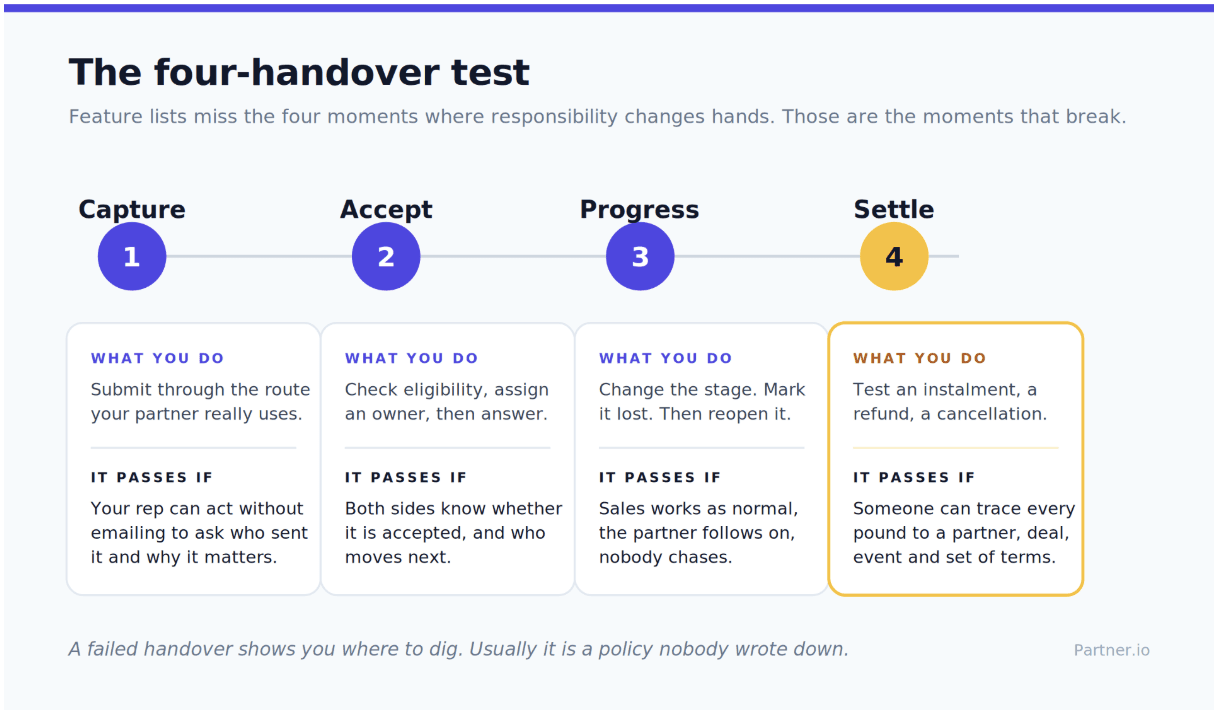
1. Capture: can someone actually act on this introduction?
Submit it through the route your partner will really use. Tracking link, referral form or deal registration.
For a named-account referral, capture the partner, the customer, the contact and the reason for the introduction. Ask enough to explain the buying situation. Don't make the partner complete your discovery call for you.
The test: can your rep act on it without emailing anyone to ask who sent this and why the prospect should care?
2. Accept: does the partner get an answer?
Submission and acceptance are two different events. A lot of programmes quietly merge them and then wonder why partners go cold.
Check eligibility. Look at existing opportunities. Assign an owner. Then give the partner an acceptance, a rejection with a reason, or a visible "under review" status.
For registered deals, spell out what acceptance protects. A specific opportunity, a product, an account. And for how long.
The test: do both sides know whether it's been accepted, and who moves next?
3. Progress: does the information survive contact with a real sales cycle?
Change the deal stage and value in your CRM. Mark it lost. Then reopen it.
Now go and look at what came back to the partner system, and what the partner can see. Shared updates must not leak internal notes or another partner's information. Check that properly. The HubSpot sync or Salesforce sync is where this usually falls over.
The test: can sales work in their normal system while the partner follows progress without chasing?
4. Settle: can you explain every pound you owe?
Apply the agreed reward to the event that makes it eligible. Follow the amount through approval and payment.
Then break it. Test an instalment. Test a refund. Test an early cancellation.
The test: can someone trace a payment back to the partner, the deal, the qualifying event and the terms that applied?
A failed handover tells you where to dig. The gap might be a missing capability. It might be a configuration problem. Very often it's a policy nobody has bothered to write down.
Software can apply a decision. It can't rescue one you've been avoiding for eight months. |
Seven rules worth building into the programme
1. Give different partner motions different paths
An occasional referrer should never have to complete reseller onboarding. And an agency responsible for implementation needs more than a link and a percentage.
Start with one repeatable route to revenue. Add a second only when you can explain how its sales involvement, acceptance rules and economics differ from the first.
Keep the reporting consistent. Let the working experience differ.
2. Make acceptance a commitment, not a vibe
Decide what qualifies, who reviews it, and when the partner should expect an answer.
Two working days is a target a team can actually operate against. Pick something you can hit, then track whether you're hitting it.
An existing CRM contact should trigger a review, not an automatic rejection. A webinar registration from last year and a live sales opportunity are not equivalent claims on an account. Treating them the same is how you teach good partners to stop bothering.
For deal registration, define expiry and the evidence needed to keep protection. Otherwise your process rewards account parking rather than selling.
3. Separate credit, commission and payment
These are three separate decisions and people constantly collapse them into one.
Decision | The question it answers |
Attribution | What contribution gets credit? |
Commission eligibility | What event earns the reward? |
Payment | When and how does the approved amount get paid? |
Here's an illustrative example. A £24,000 annual contract paying 10% commission on eligible cash received.
If the customer pays £2,000 a month, each payment generates £200 of eligible commission. Three payments in, the partner has earned £600.
That is a completely different agreement from paying £2,400 at signature. Both are defensible. Only one is what your partner thinks they agreed to.
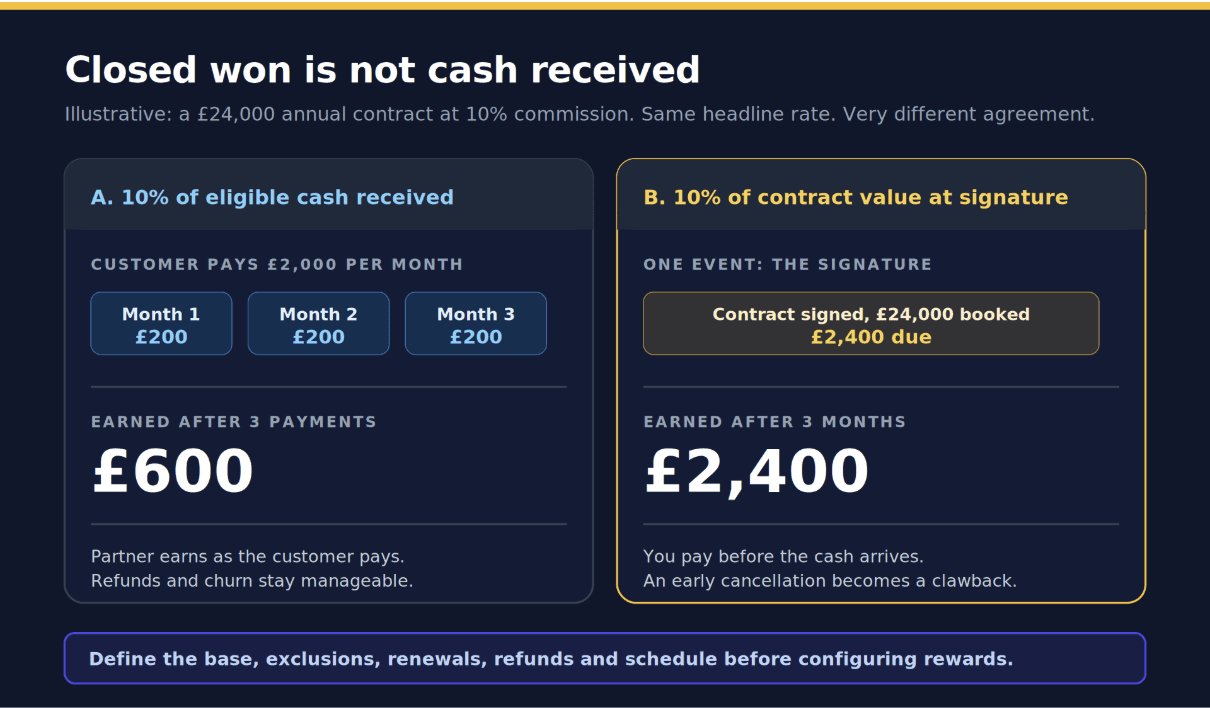
Same 10% headline rate. £600 or £2,400 after three months. Worth finding out which one your partner thinks they agreed to. |
Define the calculation base, the exclusions, renewals, refunds and the payment schedule before you configure a single reward rule.
Closed won does not mean cash received.
Want the accounting view of why those two diverge? IFRS 15 is the standard that governs revenue recognition. And Stripe's subscription docs are a readable walk through what a billing system is actually doing in between.
4. Decide which system owns each fact
"Two-way sync" tells you nothing about which system wins when two records disagree.
A sensible starting point:
Information | Who owns it |
Sales owner, opportunity stage, forecast value | CRM |
Partner identity, terms, onboarding | PRM |
Customer payments and refunds | Billing or accounting system |
Commission calculation and approval | Partner platform, using agreed evidence |
Document the mappings and the update directions. Then test a missing field, a changed stage and a failed sync.
A retry must not create a duplicate opportunity or a duplicate reward. Ask the vendor how failures surface and how records get recovered. Watch whether they have an answer ready or start improvising.
5. Make the portal worth coming back to
Partners want to complete a task. They're not there to admire your dashboard.
Let referrers submit and check progress. Give resellers current material and opportunity access. Put the training in front of the partners who actually deliver the product.
And if partners keep emailing you for updates, go and look at what they can see before you send another reminder to log in. Nine times out of ten the portal is just empty.
Portal adoption isn't a communications problem. It's an information problem. |
6. Count the contribution without double-counting the revenue
Define partner-sourced and partner-influenced, then stick to it.
Sourced means the opportunity came from an accepted partner introduction under your rules. Influenced means there's a documented contribution, like a joint meeting or a technical validation.
A deal can be both. Count it once in combined revenue.
Track acceptance time, time to first accepted referral, and repeat participation alongside the revenue number. Those measures show you where partners stall long before the revenue report does. We went deeper on that in why partner-sourced deals close faster.
7. Design the exceptions before you switch on automation
Clean records make every system look brilliant. The exceptions are where you find out what you bought.
What breaks | What to check | What the process needs |
Two partners claim the same opportunity | Submission evidence, existing activity | Precedence rules and a named decision owner |
A referral matches an old contact | Whether a live opportunity exists | A written definition of existing business |
Commission looks wrong | Calculation base, trigger, terms | Reconciliation and controlled correction |
Customer signs but doesn't pay | The agreed eligibility event | Separate sales and payment states |
CRM updates stop | Failed records, field mappings | Failure visibility and safe recovery |
An active partner gets an onboarding reminder | Conditions and timing | Tests for each workflow branch |
Keep disputed rewards out of automatic payment until the evidence is settled. And preserve the reason for every correction.
Otherwise automation just makes the argument happen faster.
The deal that exposes the gap
Let me walk you through an illustrative scenario. You'll recognise it.
An agency introduces a retailer. Sales rejects the referral because there's already a contact in the CRM.
The agency pushes back, and they've got a point. They arranged the buying conversation. That old contact came from a webinar eight months ago. There's no active opportunity attached to it.
Then a technology partner helps validate an integration. The customer signs. Both partners now expect recognition.
With clear rules, this is boring. The agency gets sourcing credit because its introduction qualifies. The technology partner's contribution is recorded separately. Rewards follow the relevant agreements. The sale is counted once.
Without those rules, your team spends a fortnight searching inboxes, negotiates after the fact, and teaches both partners a grim lesson: credit goes to whoever complains loudest.
That's the work a tracking link cannot do. It needs an operating process, and a system built to hold it. Which is roughly the same argument we made in the hidden cost of managing partners in spreadsheets.
Where Partner.io fits
Partner.io puts the partner relationship and its commercial activity in one system. Onboarding, a branded portal on your own domain, training, resources, referrals and opportunity visibility.
That matters when the same partner needs to submit a lead, help push it forward, and understand what they've earned from it.
The capabilities map onto the four handovers:
Capture and acceptance. Referral forms, tracking links, CRM sync and deal registration. For reseller programmes, ask the team to switch deal registration on for your account.
Progress. Automated emails and tasks drive follow-up, with approval rules for records that qualify. Test those conditions against the messy situations your programme actually produces, not the clean ones.
Settlement. Tier-based rewards, commission approval, invoicing and Stripe payouts, plus a way to record payments made outside that route. Validate your billing cadence and your exceptions during setup, not after the first dispute.
The value is in the joins. Your team spends less time ferrying information between systems, and partners get a clearer view of what they've sent you.
Price the admin, not just the subscription
Partner.io is $79 per internal seat per month. Unlimited partners and partner reps. No setup fee, and no Partner.io platform fee on payouts. There's a 7-day trial and it doesn't ask for a card.
Now compare that against the full cost of whatever you're doing today. Subscriptions, configuration, separate payment processing charges, and the hours your team burns chasing, reconciling and correcting.
Use your own numbers. Count the time it takes to answer one commission query, or to establish who introduced an account nine months ago.
Cheap software stops being cheap the moment someone has to finish its job every week.
So when is it time for a PRM?
Partner count is the wrong threshold. Everyone uses it anyway.
Hundreds of affiliates can run happily on a link-and-reward model. A handful of active agencies or resellers can demand approvals, training, shared selling and different payment terms.
The better signal is recurring work happening outside your existing tool:
Partners ask for updates your team has to go and fetch by hand
Sales receives introductions with no context and no clear owner
Commission depends on a spreadsheet somebody maintains privately
Different partner types are being forced down the same workflow
Nobody can reconstruct a disputed deal without searching Slack and email
A CRM can hold partner fields and track opportunities perfectly well. What it doesn't do is give partners the access, resources and actions they need while connecting all of that to your internal process. That's the gap we wrote about in your tech stack was built for direct sales.
That's the case for a PRM. Not a bigger database. A programme that runs without one person remembering every promise they made.
Bring us your most awkward deal
Don't evaluate partner software with a perfect referral that converts on time and pays cleanly. That test proves nothing.
Use the deal with the stale CRM record, the second partner, the changed value and the late payment. Run it through capture, acceptance, progress and settlement. Then check two things: what your team can explain, and what the partner can see.
That's the buying test. Everything else is a demo.
If the work ends at conversion, buy software that handles conversion well. If the work carries on through sales, delivery and commission, give it a system built for the relationship.
Start your free 7-day Partner.io trial
No card required. Bring the deal your current tools couldn't handle, and make that the last time you rebuild the story from your inbox.