Product
How to Turn Strategic Alliances into a Repeatable Sales Channel

Most partnerships generate enthusiasm, not revenue. The difference between the two comes down to one thing: whether you're running a relationship or a system.
A partnership gets announced. Teams exchange decks. A few introductions happen. Someone adds a logo to a partner page. Six months later, nobody can point to meaningful pipeline contribution. The problem is not partner quality. It is execution.
Strategic alliances fail when they depend on relationships. They succeed when they operate like a sales channel. The difference is simple: a sales channel has process, accountability, visibility, and measurement. Partnerships that produce revenue are not built on goodwill. They are built on systems.

Stop Treating Alliances Like Relationships
Relationships open doors. They do not create predictable revenue. A repeatable sales channel has defined partner motions, qualification criteria, opportunity workflows, shared accountability, revenue attribution, and performance reporting. Without those foundations, partnerships become networking with quarterly business reviews.
The strongest partner-led companies understand something most SaaS firms miss. They do not ask, "Who should we partner with?" They ask, "How does revenue move through this partnership?" That question changes everything.

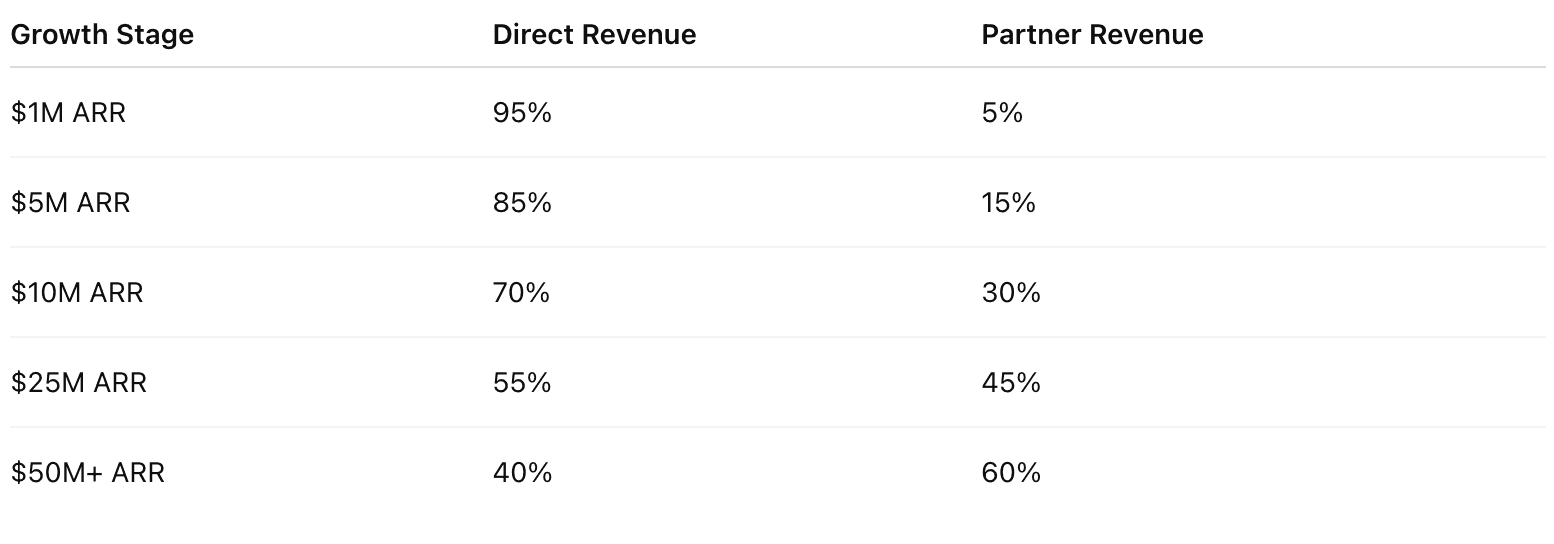
Most SaaS companies don't struggle because they lack partners. They struggle because they can't operationalise them. The moment partner revenue becomes material, spreadsheets break, attribution becomes political, commissions become messy, and sales loses visibility. That's when partnerships stop being a strategy discussion and become an operational challenge. That's where a PRM becomes infrastructure rather than software.
The Five Alliance Models That Actually Generate Revenue
Not all partnerships are created equal. The highest-performing programs focus on specific motions rather than broad partnership strategies. Here is where the real revenue lives.
Referral Partners
Referral partnerships work because trust already exists. Consultants, agencies, advisors, and customers hear problems long before software vendors do. The challenge is consistency.
Partners stop referring opportunities when leads disappear, feedback never arrives, commission becomes unclear, or sales ignores introductions. Strong referral programs create confidence. Partners know how to submit opportunities, what qualifies, where deals sit, and when they will be paid. The easier you make participation, the more referrals arrive.
Learn how Partner.io's referral management tools eliminate the black hole problem for good.
Co-Sell Partners
Co-selling is often misunderstood. Many teams treat co-selling as asking for introductions. That is not co-selling. The best co-sell partners influence decisions already happening inside target accounts. They provide credibility, context, technical validation, access to stakeholders, and implementation confidence.
A warm introduction helps. A trusted partner helping shape a buying decision is far more valuable. The difference between those two things is often worth six figures in ARR.
Agency Partners
Agencies sit closer to customer problems than most vendors. They see operational friction, technology gaps, and growth challenges every day. That position creates influence. Yet most SaaS companies enable agencies badly: they hand over a slide deck and hope for referrals.
Effective agency programs focus on commercial outcomes. The agency must see how your product helps them retain clients, expand engagements, deliver results, and generate services revenue. If the agency cannot win alongside you, engagement fades quickly.
Integration Partners
Most integration partnerships are little more than marketplace listings. Customers rarely buy software because an integration exists. They buy because the integration removes friction.
The question is not whether two products connect. The question is whether the connection solves an expensive problem. The strongest integration partnerships create clear buying triggers: eliminating manual data entry, automating reporting, simplifying commission management, or reducing implementation effort. When those outcomes become part of a joint sales motion, integrations start creating pipeline.
Resellers
Resellers can unlock markets, accelerate expansion, and shorten procurement cycles. They can also create chaos. Most reseller problems stem from weak operational design.
Unclear ownership creates channel conflict. Poor deal registration creates disputes. Vague commission structures destroy trust. Strong reseller programs remove ambiguity before the first opportunity arrives.
The Partner Revenue Engine: Five Stages That Actually Work
Most partnership programs fail because they focus on recruitment. The real challenge begins after recruitment. The strongest programs operate using five stages.

Stage 1: Find - Look for Commercial Overlap, Not Audience Overlap
A partner should provide at least one of three things: access, influence, or capability. Without one of those, there is no channel. There is only a relationship.
Stage 2: Align - Before Launching Anything, Agree on Everything
Alignment is not paperwork. It is risk reduction. Before a single referral is submitted, agree on target accounts, customer profile, partner motion, commercial structure, opportunity ownership, and success metrics. Many partnerships fail because these conversations happen too late.
Stage 3: Activate - Give Partners Something Specific to Execute
Specificity drives action. Vagueness kills momentum. Here is the difference:
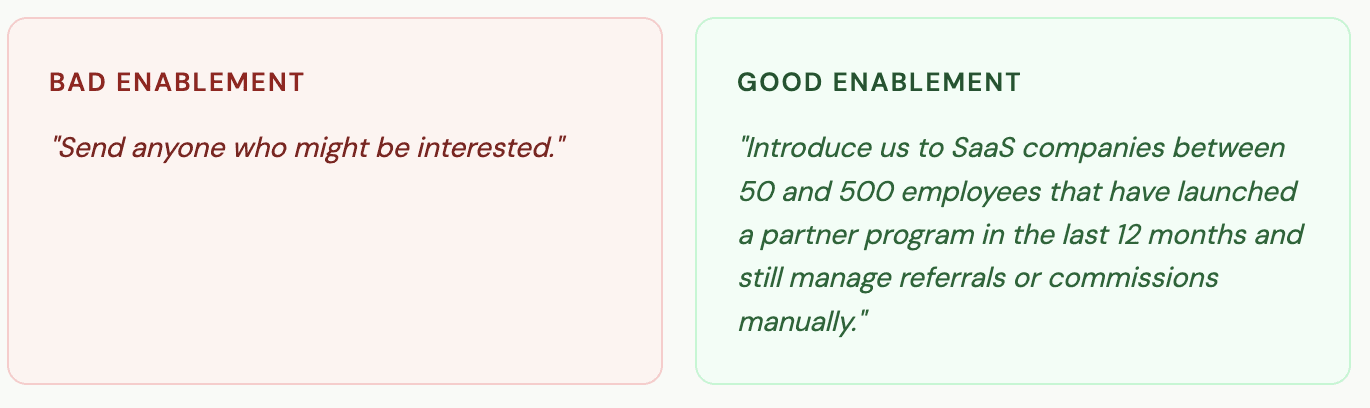
Enable partners around buying signals, not product features. Teach them what to listen for and show them the moments where your solution becomes relevant. Gartner research consistently shows that partners who receive outcome-based enablement produce three times more qualified pipeline than those who receive product-only training.
Stage 4: Attach - Where Most Programs Break
Partner activity lives outside the revenue process. Deals arrive through email. Updates sit in Slack. Partner managers chase sales for status. Nobody knows who owns the next step.
If partner activity is invisible to your revenue process, it becomes irrelevant to your revenue results. This is the single most common failure point in partner programs at growth-stage companies.
Partnerships become scalable when partner activity becomes part of the same operational system as direct sales. Opportunities, account mapping, deal registration, commissions, approvals, and reporting should all connect. Partner.io's CRM integrations keep sales and partnerships in the same system, eliminating the visibility gap.
Stage 5: Measure - Track Contribution, Not Count
Most companies measure partner recruitment. They should measure partner contribution. The metrics that matter:
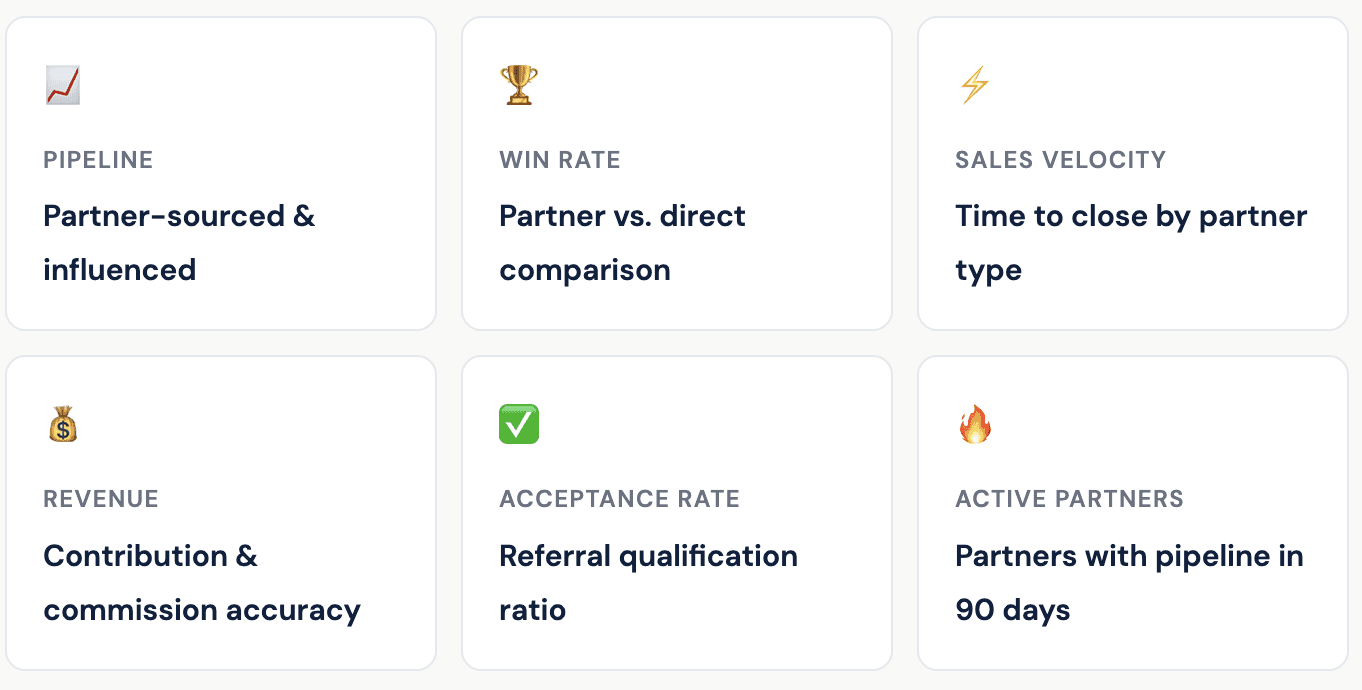
The goal is not more partners. The goal is more revenue.
What This Looks Like in Practice
A SaaS company partners with a digital agency serving ecommerce brands. The agency already sees operational challenges that the SaaS platform solves. The old approach would be familiar: a kickoff call, a shared deck, a promise to stay in touch. Nothing happens.
The better approach starts with a shared account list: 30 target companies, 8 active agency clients, 3 live opportunities. Everything visible. Everything tracked.
The agency receives a defined sales play, qualification criteria, and a dedicated space to collaborate. Two referrals arrive. One qualifies. The opportunity enters a structured deal workflow. The agency can see progress. Sales can see partner involvement. Commission eligibility is tracked automatically. Nobody chases updates. Nobody relies on memory. The process scales because the system supports it.
This is precisely what Partner.io's partner rooms and deal rooms are built to enable.
Why Most Partner Programs Stall (And How to Fix Them)
Partnership teams often respond to slow results by recruiting more partners. That usually makes things worse. The issue is rarely volume. It is activation.
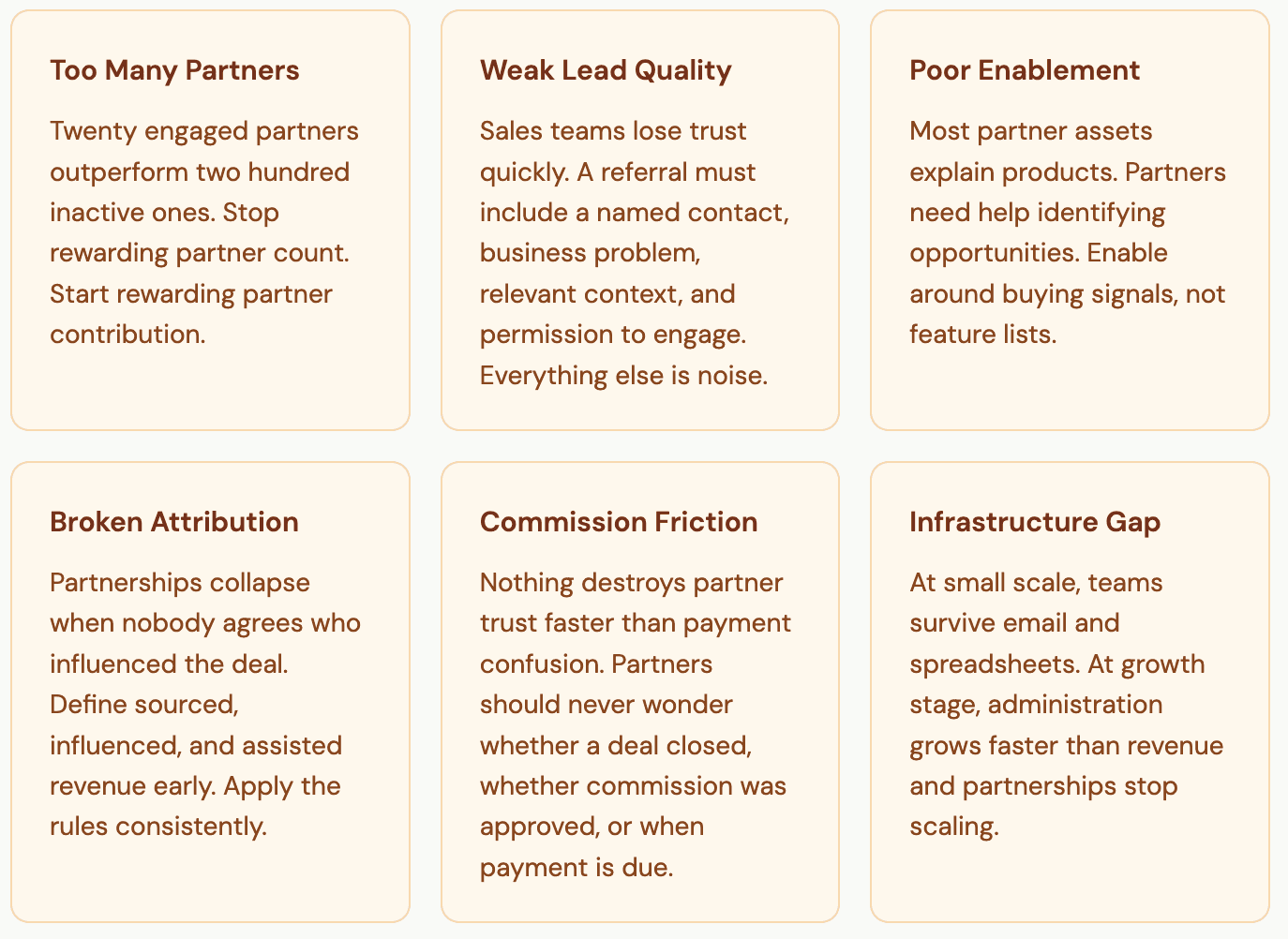
For a broader view of how partner program infrastructure affects revenue growth, McKinsey's research on partner ecosystems and Forrester's Partner Relationship Management Wave are worth reading.
The Operational Gap Most SaaS Companies Ignore
Most SaaS firms do not have a partnership strategy problem. They have an infrastructure problem. The ingredients already exist: the partners are there, the customer overlap is obvious, and the opportunities are real. The system is missing.
That gap shows up everywhere:
Opportunities managed through email threads
Deal registration living in spreadsheets
Commission calculations done manually every quarter
Partner updates scattered across Slack channels
No visibility into which partners influenced which deals
No reporting anyone actually trusts or acts on
At small scale, teams survive this. At growth stage, it becomes a bottleneck. Partnerships stop scaling because administration grows faster than revenue.
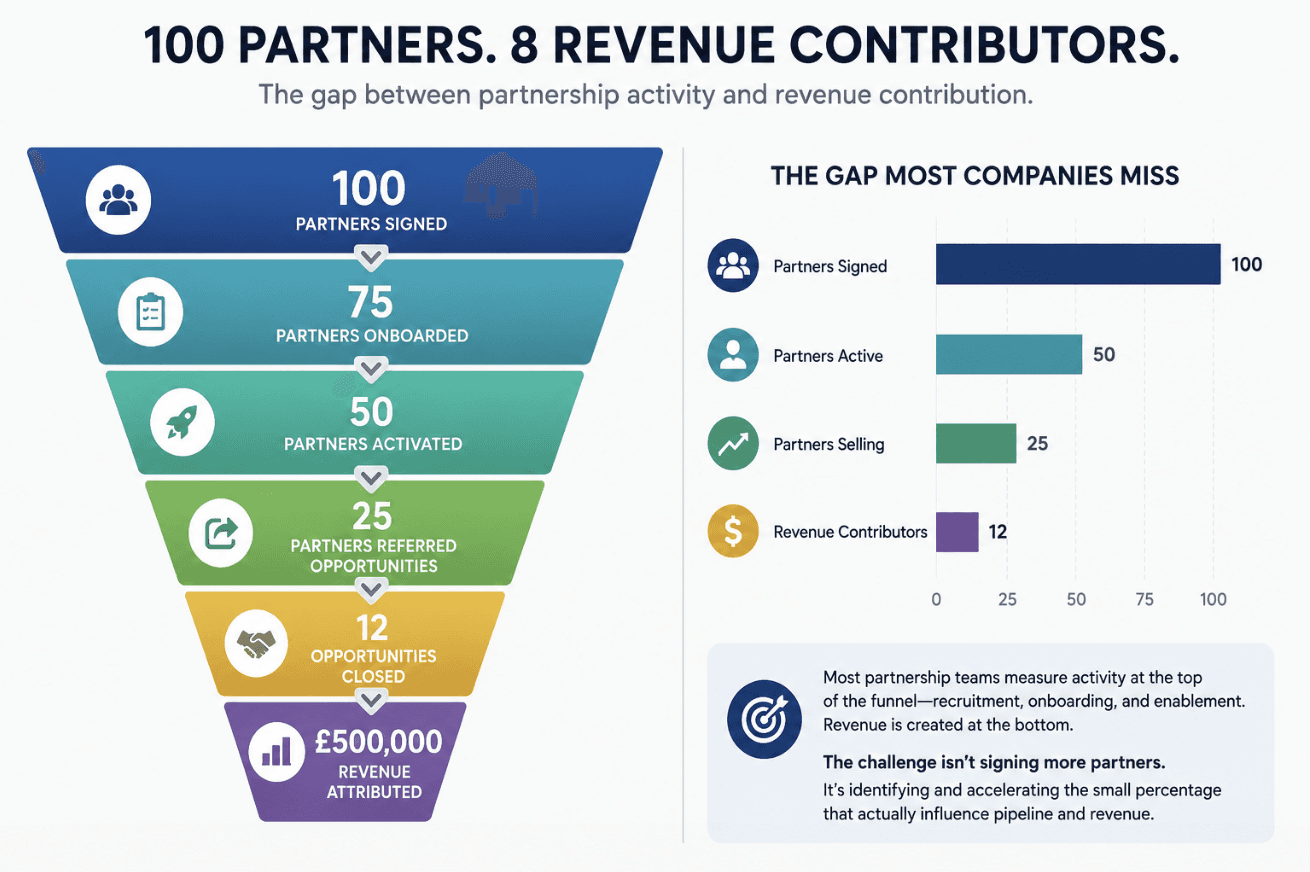
"Strategic alliances become a sales channel when every introduction, opportunity, influence point, and commission payment moves through a repeatable system."
Ready to Build a Partner Channel That Actually Produces Revenue?
Partner.io gives partner-led teams the infrastructure to close the gap between partnership strategy and partnership execution — where most revenue is currently being lost.