Product
How to start a SaaS partner program that actually produces revenue

Partner programs do not die in public. They look busy first. A few agency calls. A handful of referral links. A partner page. Maybe a launch post with friendly comments underneath.
Then nothing happens. No qualified referrals. No registered deals. No co-sell momentum. No partner-sourced pipeline anyone trusts. No clear answer when someone asks: "What revenue has this produced?"
That is the real problem. Companies do not struggle because partners are hard to find. They struggle because they recruit partners before they know what those partners are supposed to do.
A partner program is not a logo list. It is not a commission table. It is not a portal full of stale PDFs. A proper SaaS partner program is a revenue system: one that recruits the right partners, activates them fast, gives sales a reason to care, tracks partner impact, protects deals, and pays people without an argument.
If your current plan is "let's sign up some partners and see what happens," stop. That is not a strategy. That is expensive admin……

Start with the motion, not the programme
The first question is not: "How do we launch a partner programme?" The first question is: "What can a partner do that creates revenue, adoption, trust, or access faster than we can do alone?"
That question cuts through a lot of nonsense. Because not all partners do the same job:
A referral partner spots a problem and makes an introduction
An agency partner packages your product into client work
An integration partner improves the customer workflow
A co-sell partner helps open or move a named account
A reseller takes on part of the commercial process
Those motions need different recruitment, enablement, tracking, incentives, and rules. Treat them the same and the programme starts to rot.
The partner motion stack
Before you build tiers, badges, commission plans, onboarding flows, or a partner portal, run every partner motion through this stack.
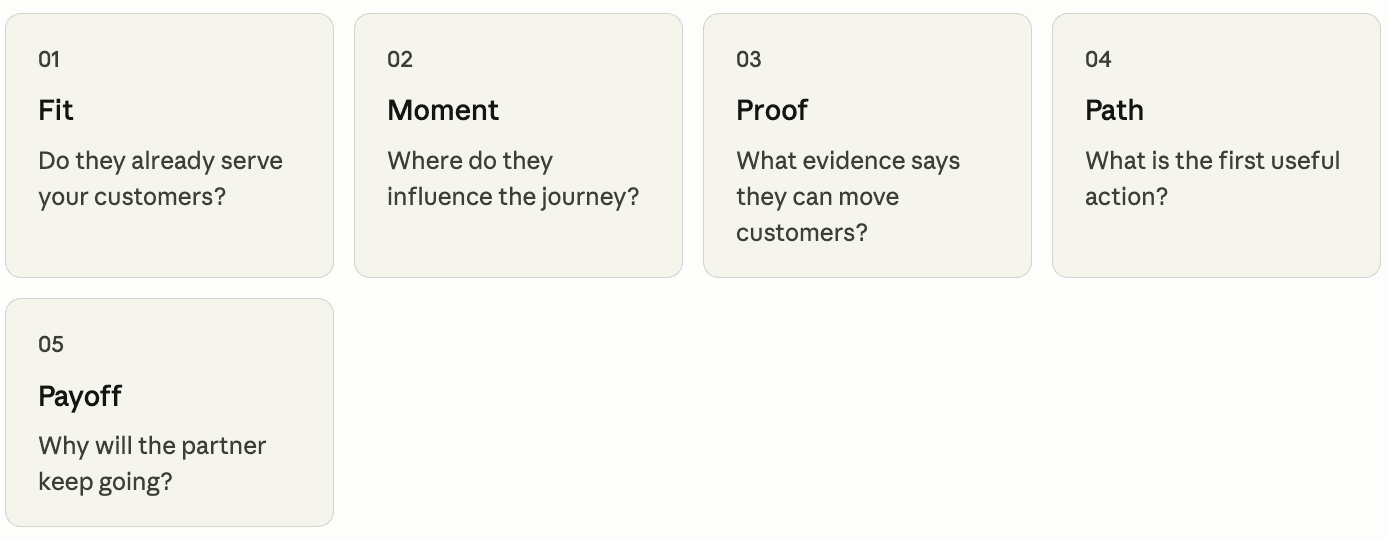
Fit: do they already serve your customers?
Real fit means the partner has access to your ideal customer, trust with that customer, and a reason to bring you into the conversation, not "they work in SaaS" or "they know our market." A HubSpot agency serving scaling B2B SaaS companies might fit a customer onboarding tool. A Shopify consultancy might be a good fit for an ecommerce retention platform.
A random consultant with a LinkedIn audience and no repeatable client base is probably noise. Fit comes before enthusiasm. Enthusiasm does not create pipeline.
Moment: where do they influence the customer journey?
If you do not define the moment, the partner becomes a vague supporter of growth. That sounds nice. It is useless in a pipeline review. A referral partner might influence awareness. An agency might influence selection, onboarding, and retention. The moment decides the playbook.
Proof: what evidence says this partner can move customers?
Account mapping is often the fastest filter. If there is no overlap, no customer pull, and no practical route to action, the partnership is probably theatre. Look for shared customers, overlapping target accounts, existing relationships with your buyer, or marketplace traction before you recruit.
Path: what is the first useful action?
Not "log in and look around." Not "we'll send you some resources." A real path is: submit one qualified referral, register one target account, review ten shared accounts, or complete one product training path. The longer partners sit idle, the less likely they are ever to produce anything.
Payoff: why will the partner keep going?
Commission matters but it is rarely the whole reason. A referral partner wants speed, trust, visibility, and payout. An agency wants client value and a repeatable service offer. A reseller wants margin, control, and commercial clarity. Match the payoff to the partner type; if the payoff is vague, activation dies quietly.
Pick one partner motion first
Do not launch referral, agency, reseller, integration, and co-sell motions at the same time. That is how you build something that looks sophisticated and behaves like a spreadsheet with anxiety. Pick one primary motion. Get it working. Then add the next one.
Referral partners: the cleanest first motion
Referral is usually the cleanest first motion for an early SaaS partner programme. The partner does not need to sell the product deeply. They need to recognise the right problem, make a trusted introduction, and know the lead will not vanish into a black hole.
Good referral partners include existing customers, consultants, fractional operators, niche communities, agencies with adjacent services, and category specialists with trusted audiences. The rules must be simple. Define:
What counts as a qualified referral
How long the referral is protected
What commission is paid and when
What happens if the lead already exists in CRM
How the partner can see progress
Who owns the next step internally
Referral programmes fail when partners feel ignored. A partner sends a warm intro. Sales takes six weeks to follow up. Nobody updates the partner. Then the company wonders why referrals dry up. That is not a partner problem; that is an operating problem.
Partner.io's deal registration and referral tracking tools keep both sides informed and remove the chasing.
Agency partners: high potential, high dependency on your support
Agencies sit close to customer pain. They advise, implement, and influence decisions before vendors even know an opportunity exists. But agencies need a real reason to care; a referral link is not enough.
Most agencies want better client outcomes, service revenue, product training, certification, implementation playbooks, co-branded assets, clear support access, and visibility when they influence a deal. If you want an agency to bring you into client conversations, make the partnership useful to their business. Help them package the offer. Help them sell it. Help them deliver it.
Co-sell partners: two teams, named accounts, clear rules
Co-sell is not two companies promising to "collaborate more closely." That phrase should be banned from partner calls. Co-sell means two teams work together on named accounts because each side adds something the other lacks: relationship access, product context, implementation credibility, regional knowledge, or influence with a blocked stakeholder.
A proper co-sell motion needs shared account lists, account mapping, clear account ownership, deal registration, sales handoff rules, partner notes inside CRM, and follow-up after each customer conversation.
Integration partners: only build when demand is visible
Tech partnerships sound strategic, which is exactly why they get overbuilt. An integration is only useful if customers want the workflow, sales can explain the value, and both sides can point to accounts where it matters. Before building, prove that shared customers exist, that shared prospects care, and that the workflow solves a real problem sales can articulate.
Do not let the roadmap become a hiding place for weak partner strategy. If nobody can name the accounts, use case, buyer pain, and sales play, slow down.
Resellers: not a beginner motion
Resellers are not a beginner motion unless your product, pricing, onboarding, and support model are already clean. Before recruiting resellers, confirm they can quote accurately, explain pricing, handle procurement, access sales support, register and protect deals, and get paid without chasing. If not, start with referral or co-sell. Resellers magnify operational mess. They do not fix it.
Build an ideal partner profile that actually says no
A weak Ideal Partner Profile describes who you hope will join. A strong one helps you reject bad fits. A launch partner should have:
Access to your ideal customer and trust with that customer
A clear reason to introduce, influence, sell, or implement
A commercial model that benefits from the partnership
A named owner and a repeatable route to market
Willingness to use your process and share account context
A first useful action that can happen within 30 days
If they cannot pass that test, do not put them in the first cohort.
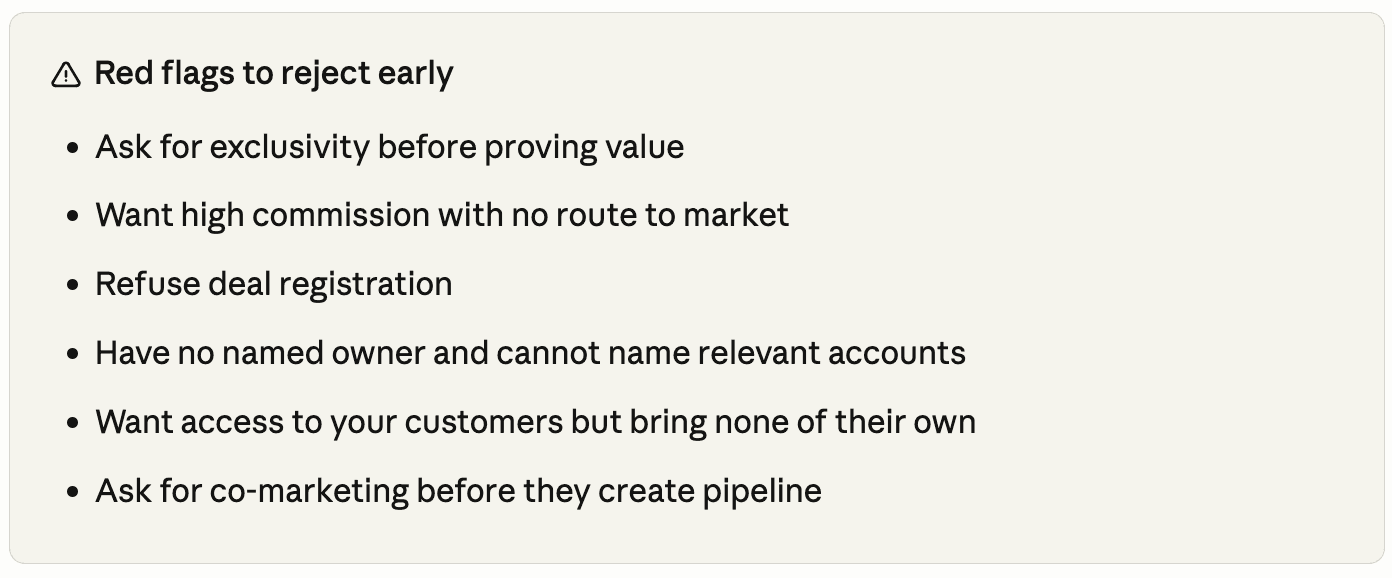
Bad-fit partners are not missed revenue. They are future admin.
Activation is the programme
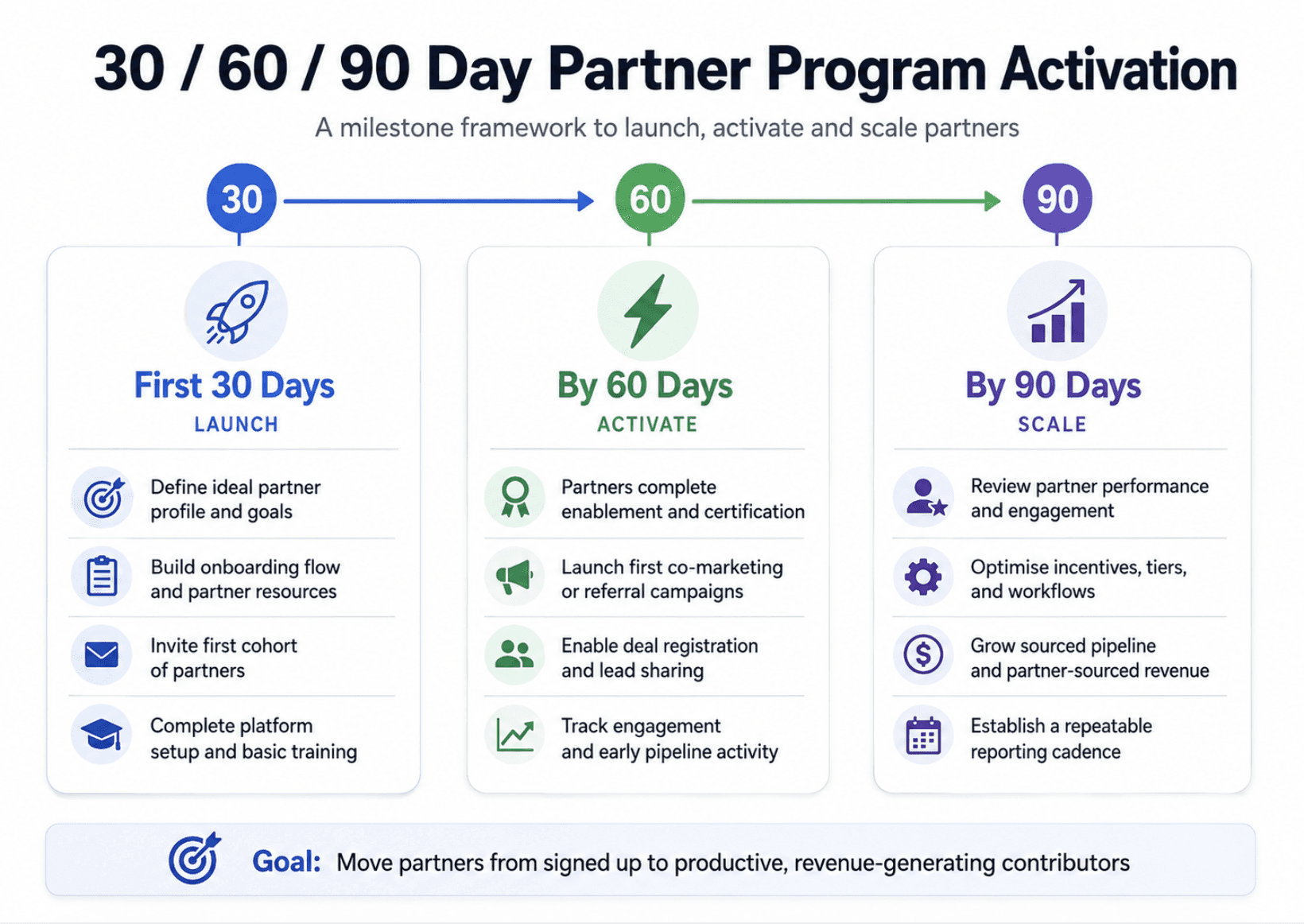
Partner.io helps partner-led teams run the programme in one place instead of stitching together spreadsheets, forms, CRM fields, Slack messages, and payout notes. If those pieces live in different places, trust breaks; partners cannot see what is happening, sales cannot see why the partner matters, finance cannot see what needs paying.
Software does not replace partner strategy. It exposes whether you have one. If your motion is clear, Partner.io gives it the structure to scale.
Launch checklist: use this before you recruit
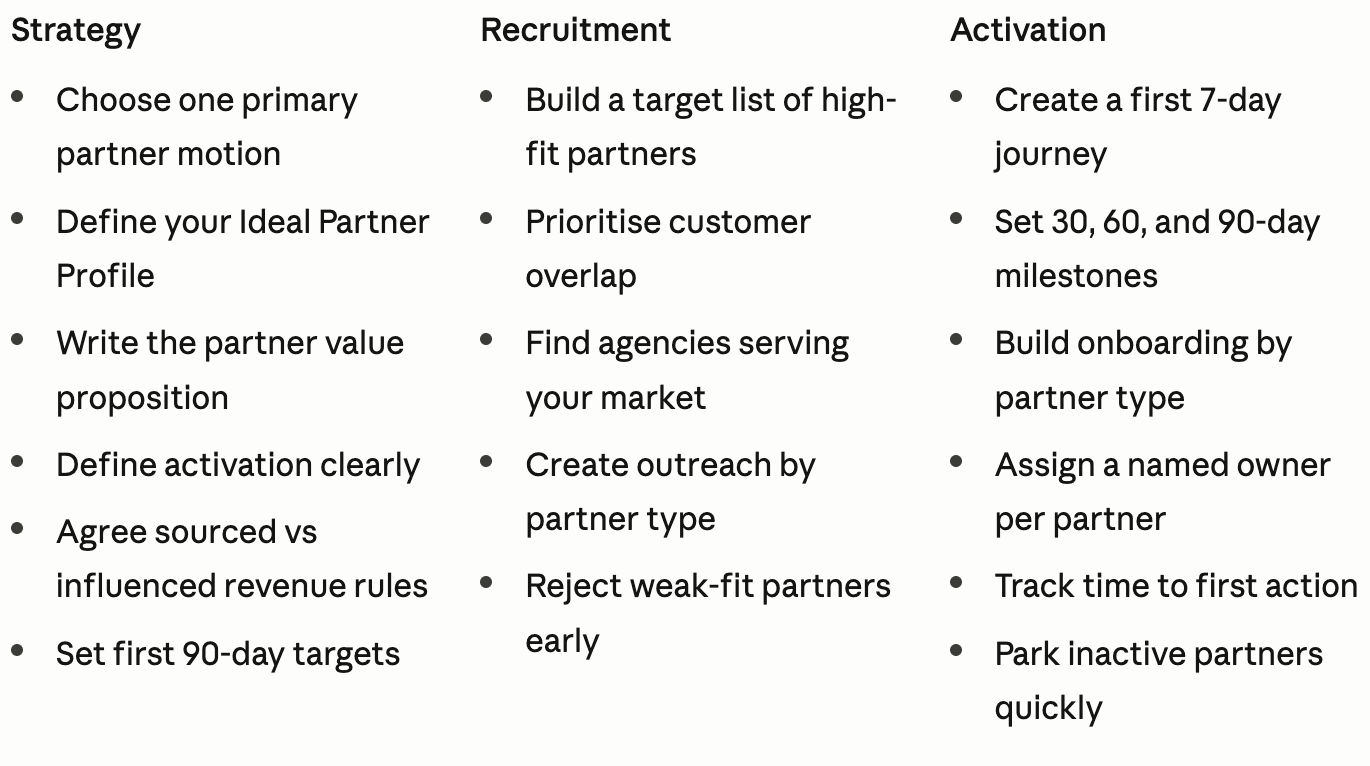
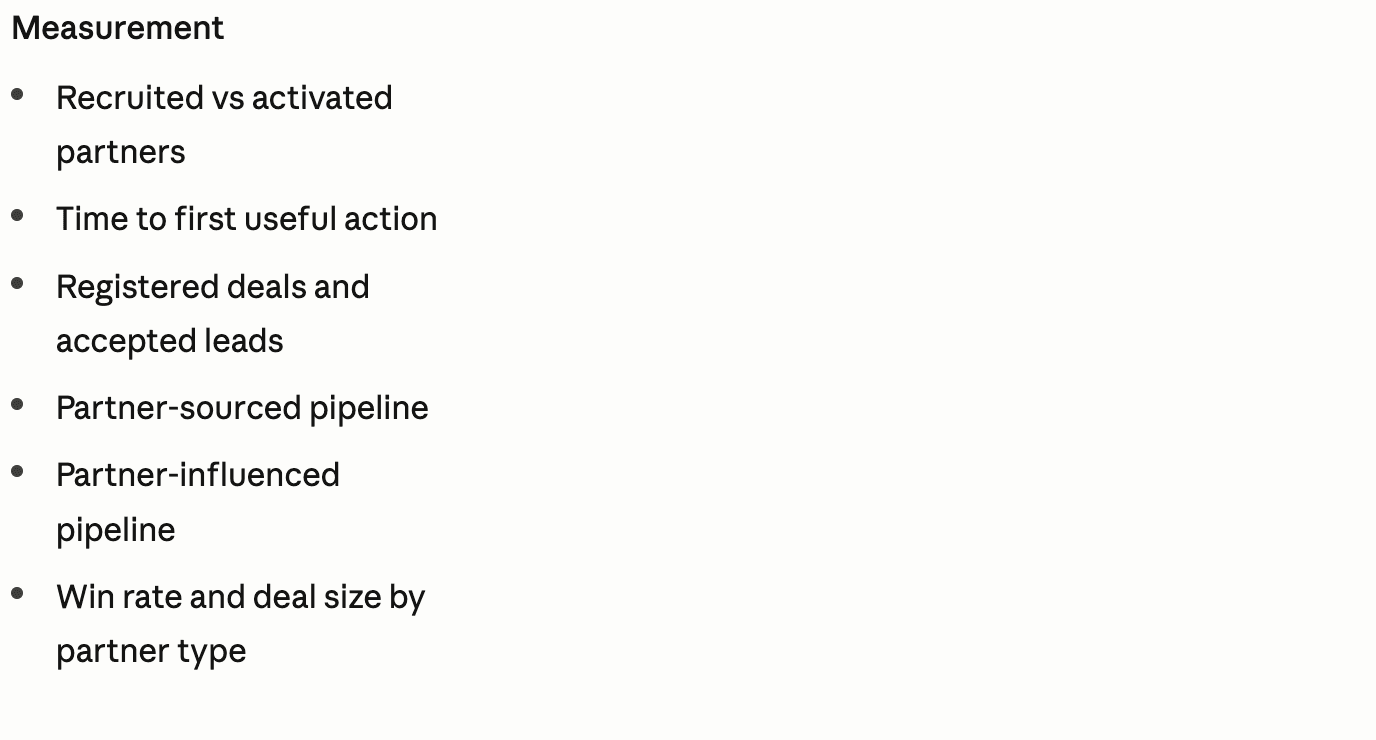
The first 90 days should look small
A strong launch does not need hundreds of partners. It needs proof. A sensible first 90 days might aim for 10 to 15 high-fit partners recruited, 3 to 5 properly activated, first accepted referrals or registered deals, one account mapping exercise, one partner-assisted customer story, and commission and attribution rules tested.
That is enough. Once the motion works, scale it. More partners will not fix a weak programme. They will expose it.
Build the system before you chase the logos
Partner-led growth works when the operating system is clean. The partner knows what to do. Sales knows why the partner matters. Finance knows what to pay. Leadership knows what revenue came from partners and what revenue partners helped influence.
That is the bar. Not sign-ups. Not portal logins. Not a busy partner page. A real programme recruits the right partners, activates them fast, tracks the work, protects the deal, and pays people properly.
Start with the motion. Define the rules. Cut the dead weight. Then put Partner.io underneath it, so the programme can run like a revenue channel instead of a spreadsheet circus.
Ready to build a partner programme that actually produces revenue?
Partner.io gives you deal registration, referral tracking, account mapping, commission management, and partner portals in one place without the complexity of enterprise PRM tools.
Try Partner.io free for 14 days