Product
Crossbeam Alternative for Mid-Market SaaS

In this article
What Crossbeam does well
Partner.io's angle: account mapping plus the operating layer
The uncomfortable truth: overlap is not pipeline
The Overlap to Revenue Loop
Crossbeam vs Partner.io: the practical comparison
Why mid-market SaaS teams hit the wall
The partner motions that need more than mapping
The buying checklist for a Crossbeam alternative
A 30-day plan for moving beyond account mapping
When Crossbeam makes sense
When Partner.io makes more sense
Crossbeam is not the villain here. The mistake is thinking account mapping alone will fix a partner program.
It won't.
You can find every shared account, every mutual customer, every open opportunity and every warm path into a target account. But if nobody knows what happens next, you have not created partner revenue. You have created a better spreadsheet.
That is the real problem.
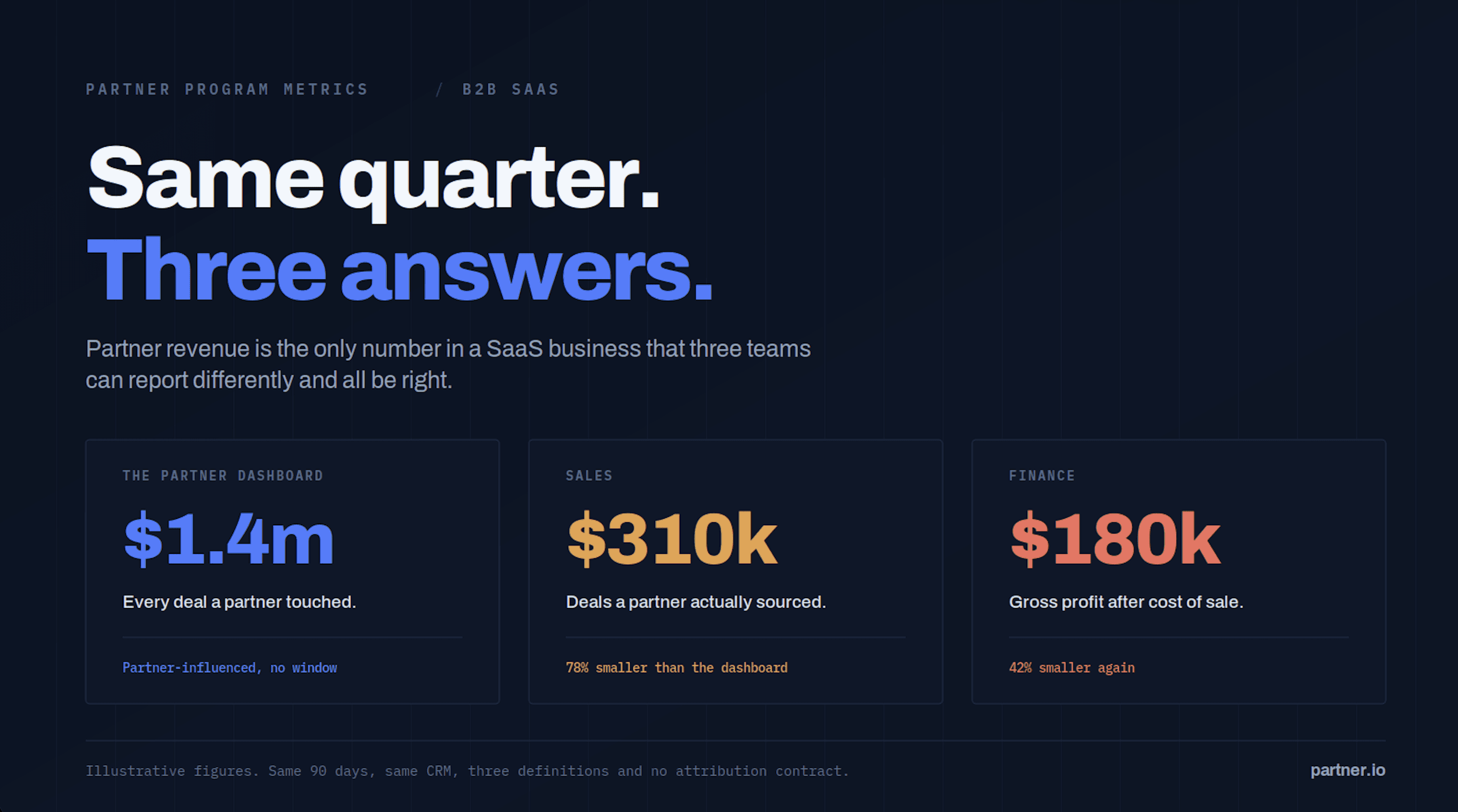
Most growing SaaS companies do not fail at partnerships because they cannot imagine which partners might help. They fail because the workflow after that discovery is weak. Sales does not act. Partners do not get updates. Deal registration is inconsistent. Commission rules live in someone's head. Attribution gets argued about after the deal closes.
That is why the Crossbeam alternative conversation needs to be sharper.
This is not "account mapping versus PRM." Partner.io has account mapping too.
The better question is: Do you need a tool that helps you see partner overlap, or do you need a system that helps you turn that overlap into tracked partner revenue?
For most mid-market SaaS teams, the answer is the second one.

What Crossbeam Does Well
Crossbeam has earned its place in the because account mapping matters.
When it works, it helps you see where your customers, prospects and opportunities overlap with your partners. That can uncover warm introductions, co-selling opportunities, expansion paths, integration stories and partner-sourced pipeline that would otherwise stay hidden.
The strongest Crossbeam use case is ecosystem intelligence.
You connect data. Your partners connect data. You define what gets shared. The platform shows where accounts overlap and where partner signals could help sales prioritise the right accounts.
That can be powerful, especially when your partner ecosystem is mature and your sales team is already trained to work partner signals.
The issue is not that Crossbeam is weak. The issue is that many teams looking for a Crossbeam alternative are not just trying to find overlap. They are trying to build a partner revenue motion that holds up under pressure.
That means referrals. Agencies. Resellers. Integration partners. Co-sell partners. Partner onboarding. Deal registration. Partner portals. Commission rules. Payouts. CRM sync. Attribution. Reporting.
Account mapping helps start the conversation. It does not run the whole program.
Partner.io's Angle: Account Mapping Plus the Operating Layer

Partner.io should not be positioned as the product you buy when you do not need account mapping. That is wrong.
Partner.io includes account mapping as part of the platform. It helps teams uncover overlap across customers, prospects, partner customers, partner opportunities and open deals. It also supports secure data syncing from Salesforce, HubSpot and CSV, with automated matching, deduplication and controlled sharing through defined Populations.
That matters because the first job is still the same: find the overlap.
The difference is what happens after.
Partner.io is built as a PRM (Partner Relationship Management) platform, so account mapping sits inside a broader partner workflow. Once an overlap is found, you can connect it to the actions that actually matter:
A partner submits a referral
A sales team accepts or rejects the lead
A reseller registers a deal
A co-sell motion gets attached to an opportunity
A partner sees progress without chasing
Commission logic is tied to closed revenue
Partner performance is reported in one place
The CRM reflects what happened
That is the practical difference.
Crossbeam helps surface partner intelligence helps surface partner intelligence and then operationalise it through PRM workflows.
The Uncomfortable Truth: Overlap Is Not Pipeline
Partner teams love overlap because it looks like progress.
You run the mapping exercise. You see 400 shared accounts. You get a nice chart. You send it to sales. Everyone gets excited for about eleven minutes.
Then the questions begin.
Who owns the account?
Which partner has the strongest relationship?
Is this a referral, co-sell assist or reseller opportunity?
Does the partner get paid?
Can sales contact the account directly?
What happens if two partners claim influence?
What does the partner see after the lead is submitted?
Where does this show up in the CRM?
How do we report it at the end of the quarter?
This is where partner-led growth either becomes a revenue system or dies in a Slack thread.
The value is not in knowing that an overlap exists. The value is in creating a clean path from overlap to action, then from action to revenue. That path needs process.
The Overlap to Revenue Loop
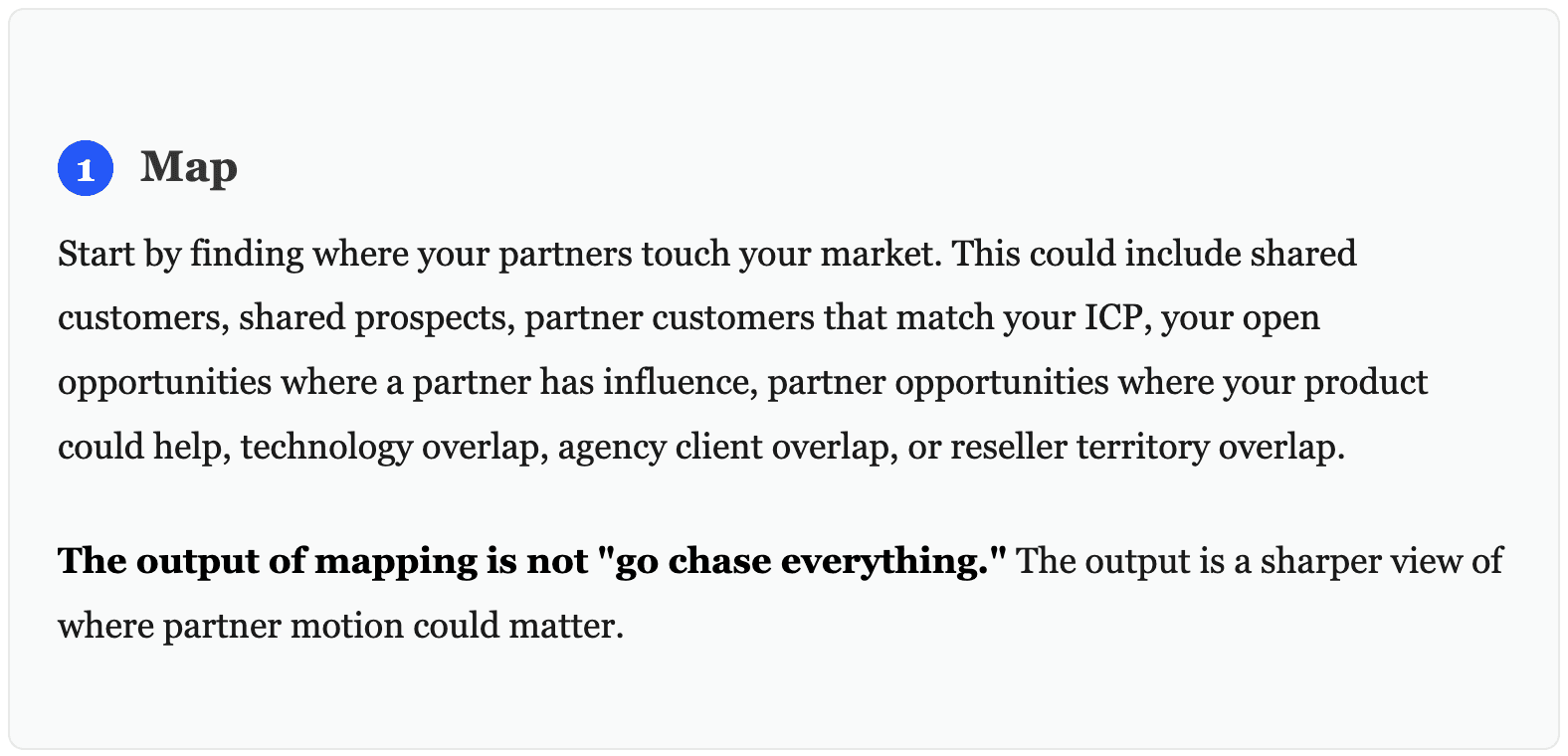
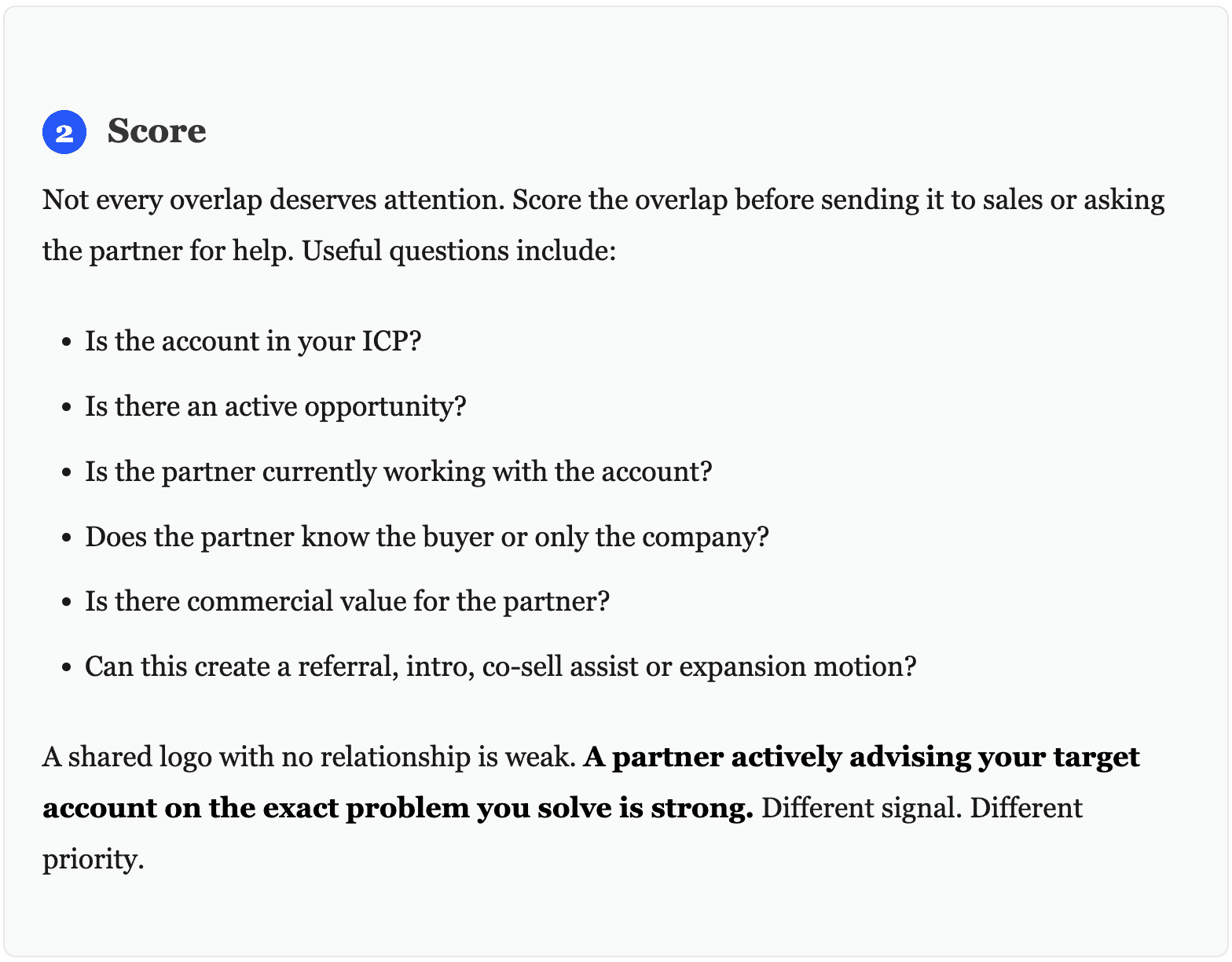
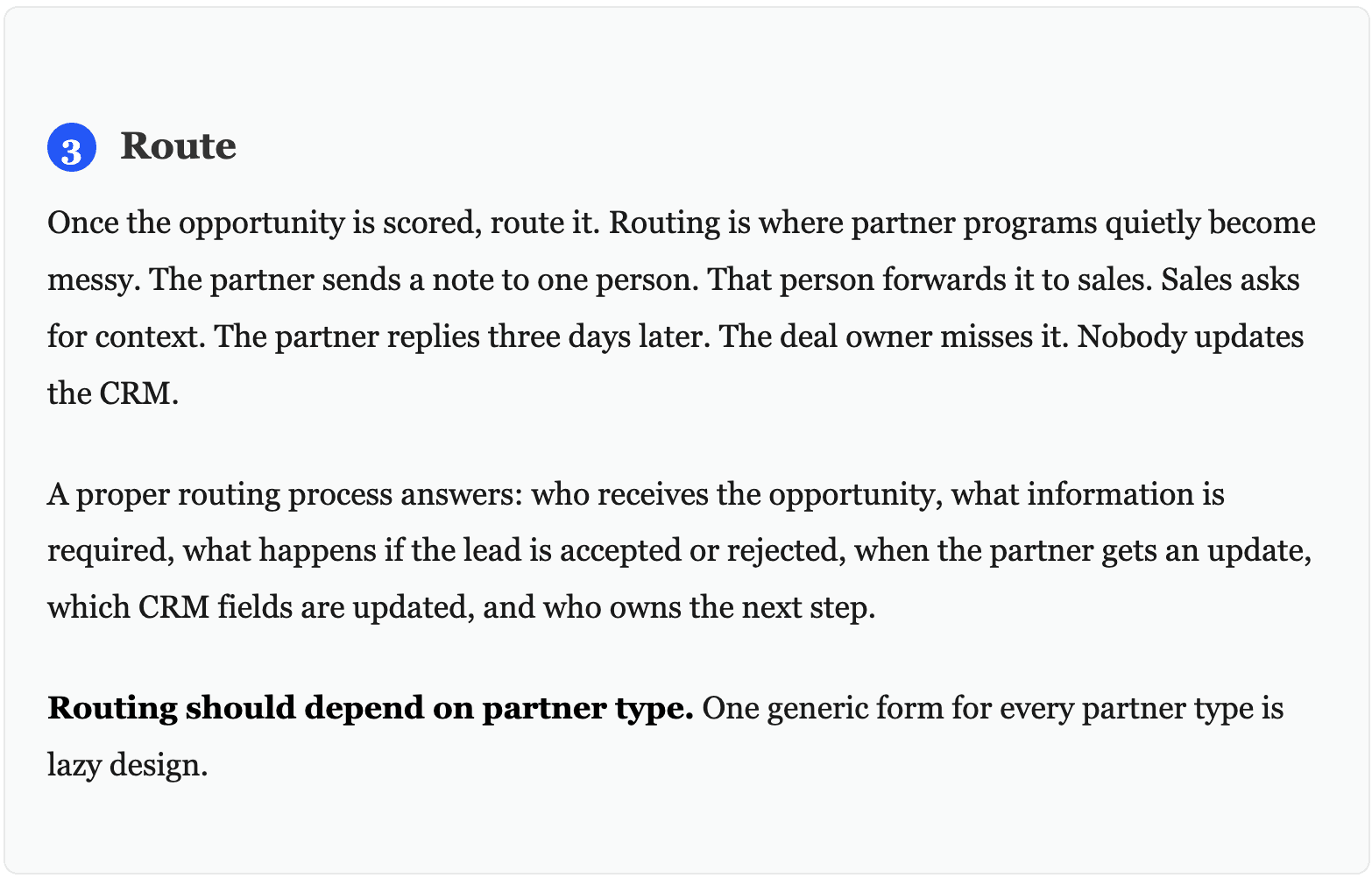
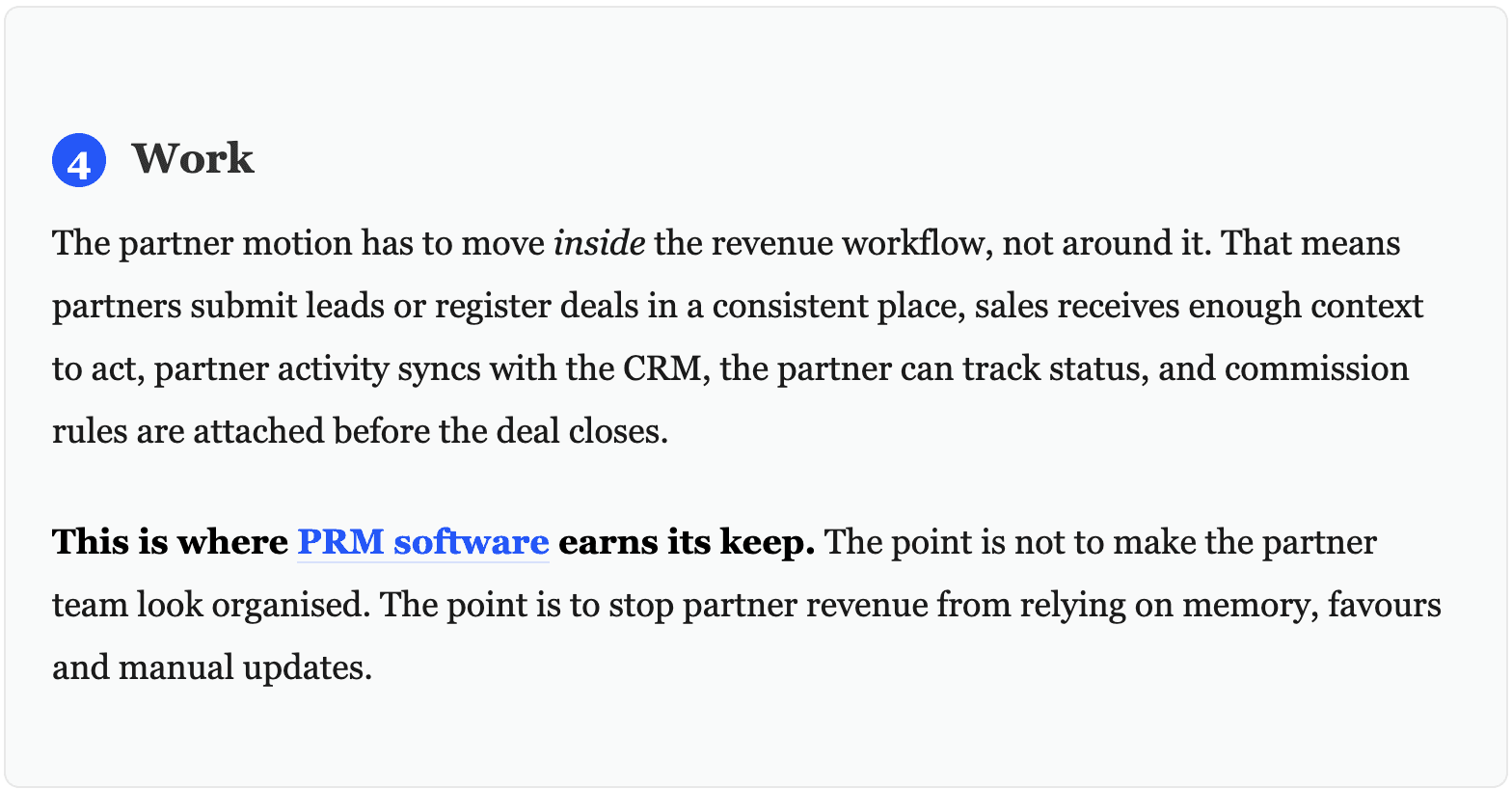
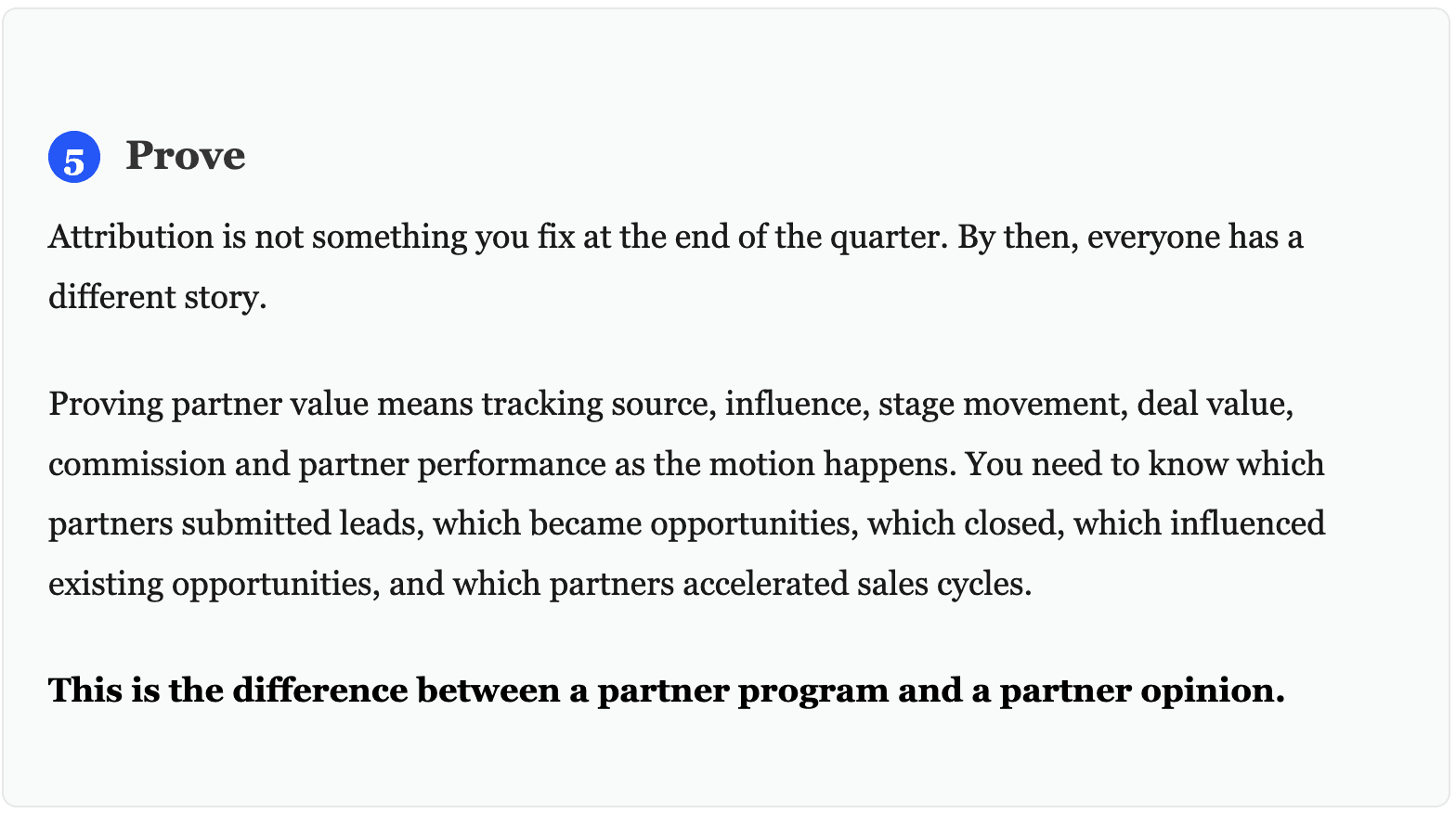
Here is a simple operating model for turning partner overlap into revenue. Call it the Overlap to Revenue Loop. It has five parts.
It sounds basic. That is the point. Most partner programs break because they skip one of these steps.

See the full Overlap to Revenue Loop inside Partner.io
Start Your Free 14-Day Trial →
Crossbeam vs Partner.io: The Practical Comparison
The wrong comparison is "Crossbeam has account mapping, Partner.io has PRM." Partner.io has account mapping as part of the platform.
The right comparison is this:
Crossbeam is strongest when ecosystem intelligence is the centre of the problem.
Partner.io is strongest when partner execution is the centre of the problem.
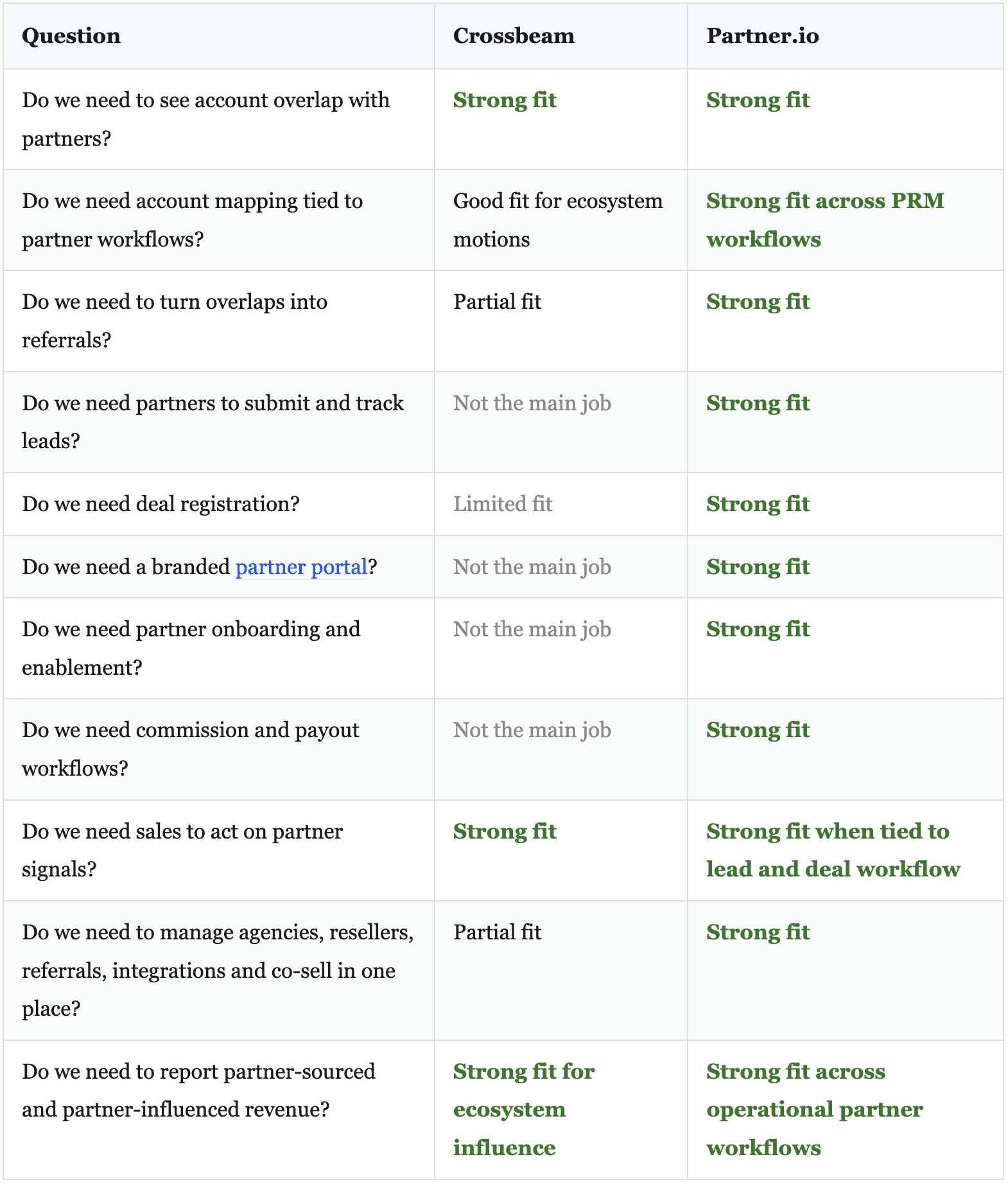
This is not a polite feature checklist. It is an operating choice.
If your biggest problem is seeing where your partners overlap with your accounts, Crossbeam makes sense. If your biggest problem is turning partner activity into a repeatable revenue process, Partner.io is the stronger fit.
Why Mid-Market SaaS Teams Hit the Wall

The first version of a partner program is usually held together by a few capable people. They know the partners. They remember who introduced whom. They manually chase sales. They update partners by email. They calculate commission in spreadsheets.
That works for a while. Then partner volume grows.
Five partners become thirty. A few friendly referrals become agencies, integration partners, consultants and resellers. Sales starts asking for clearer rules. Finance starts asking who gets paid. Leadership starts asking whether partnerships is actually contributing revenue.
Suddenly the charming manual process becomes a liability.
The cracks usually show up in the same places:
Leads go missing
A partner submits a lead by email. Sales is busy. The CRM is not updated. Two months later, the deal closes and nobody knows whether the partner should get credit.
Sales does not trust partner leads
Some partners send poor-fit leads. Others send brilliant leads with no context. Sales starts treating all partner leads the same, which usually means slowly.
Partner visibility is poor
Partners ask for updates because they cannot see what happened. The partner team becomes a helpdesk for deal status.
Commission gets political
If reward rules are unclear, every closed deal becomes a negotiation.
Partner reporting is thin
The team can show partner count, but not partner contribution. Partner count is not a serious metric. It is inventory. Revenue, accepted pipeline, influenced deals, partner conversion and partner activation are serious metrics.
If you recognise any of these symptoms, read our guide on how to build partnerships that last and how to fix each one systematically.
The Partner Motions That Need More Than Mapping
Account mapping is useful across several partner types, but each one needs a different workflow after the overlap is found.
Referral Partners
Referral partners need speed. They need to submit a lead, know whether it was accepted, see progress and get paid if it closes. A good referral workflow includes simple lead submission, required qualification fields, partner-specific tracking, CRM sync, acceptance or rejection workflow, automated partner updates, commission logic and clear payout status.
Where it breaks: The lead arrives in an inbox. Sales forgets to tag it. Nobody updates the partner. The deal closes and the reward becomes awkward.
What to do: Move every referral into one workflow. Require enough context for sales to act. Track lead acceptance rate by partner. If a partner sends ten leads and sales accepts none, you do not have a sales adoption issue. You have a partner quality issue.
Co-Sell Partners
Co-selling needs context. The partner is not just handing over a lead. They may be helping you understand the account, reach a stakeholder, validate the problem, unblock procurement or strengthen the business case.
Where it breaks: Someone says "this partner knows the account." Sales asks for an intro with no context. The partner does not understand the ask. The moment passes.
Tie every co-sell request to a specific deal action. Bad ask: "Can you help with Acme?" Better ask: "Acme is in evaluation for our workflow product. Your team implemented their CRM last year. Can you introduce us to Priya in RevOps or share context on who owns the process? We are trying to confirm the buying committee before proposal."
Agencies and Consultants
Agencies care about reputation. They will not throw clients into a vendor process they do not trust. If your partner experience is clunky, they will protect the client and avoid the referral.
Where it breaks: You recruit agencies, send them a PDF, do one onboarding call and expect referrals. Nothing happens. Then the team says "agency partnerships don't work."
Design an activation path. An agency agreement is not activation. It is paperwork.
Integration Partners
Integration partners often influence revenue indirectly through shared customers, marketplace visibility, co-marketing, implementation partners, product usage or expansion plays.
Where it breaks: The integration launches. Both companies post on LinkedIn. Everyone feels productive. Six months later nobody can show what it did for pipeline.
Build the revenue motion before launch. The launch is not the strategy. The workflow after launch is the strategy. For more on this, see how keep partners engaged.
Resellers
Resellers need rules. They need pricing clarity, deal registration, account protection, territory logic, enablement and margin or commission terms that do not change every five minutes.
Where it breaks: The reseller registers an opportunity. Direct sales is already working it. Nobody knows who owns the deal. The reseller loses trust and stops bringing serious opportunities.
Define channel conflict rules before the conflict. The first serious reseller dispute is always more painful than expected. Partner.io's deal registration workflow handles this automatically with configurable ownership and conflict-resolution rules.
The Buying Checklist for a Crossbeam Alternative
Before choosing a platform, answer these six questions.
1. What is the primary partner motion?
Pick one primary motion first: referral, co-sell, agency, integration, reseller, affiliate, or mixed. Mixed is allowed. Vague is not. If you say "all of them" but cannot explain how each one works, you are not ready to scale. You are ready to create a confusing portal nobody uses.
2. Where does partner revenue leak today?
Find the operational leak. Look for leads submitted outside the CRM, partner source fields missing or unused, sales rejecting leads without feedback, partner updates handled manually, deal registration done by email, commission calculated in spreadsheets, no distinction between sourced and influenced revenue, or reporting that shows activity but not commercial impact. Buy the system that fixes the leak, not the system with the nicest category label.
3. What happens after an overlap is found?
This question exposes weak partner operations. When account mapping shows a promising overlap, what happens next? If the answer is "someone follows up manually," you have found the risk. Manual follow-up does not scale. It also does not report cleanly.
4. What should partners be able to see?
Partner visibility is a design decision. Too little visibility creates constant chasing. Too much visibility creates risk and confusion. One visibility model for every partner type will probably annoy everyone.
5. How will you handle attribution?
Separate sourced and influenced. Sourced means the partner created or submitted the opportunity. Influenced means the partner helped an existing opportunity move forward. Both matter. They should not always be rewarded in the same way. Write the attribution rules before money is involved in your partner agreement.
6. What will leadership trust?
Reporting needs to survive scrutiny. Weak reporting says: "We have 120 partners." Strong reporting says: "Seventeen active partners created £420k in accepted pipeline last quarter, with agency referrals converting at 28 percent and reseller registrations producing the highest average deal size." One of those gets budget. The other gets polite nods.
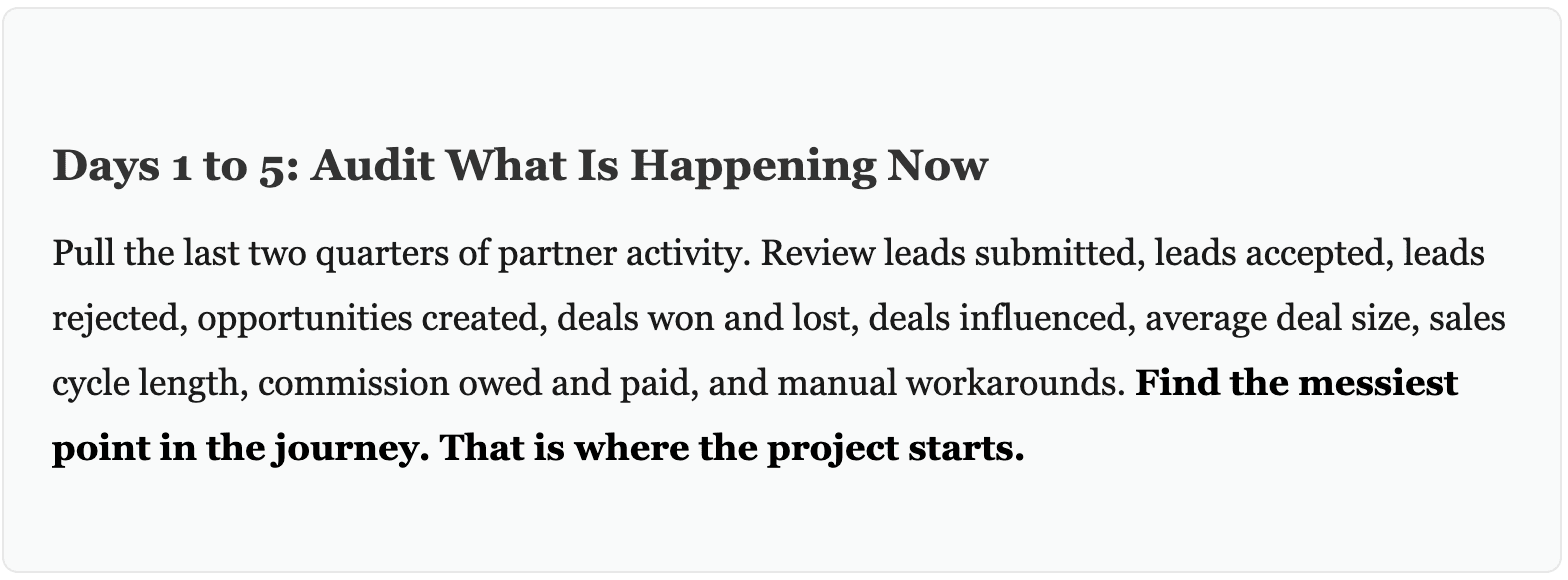
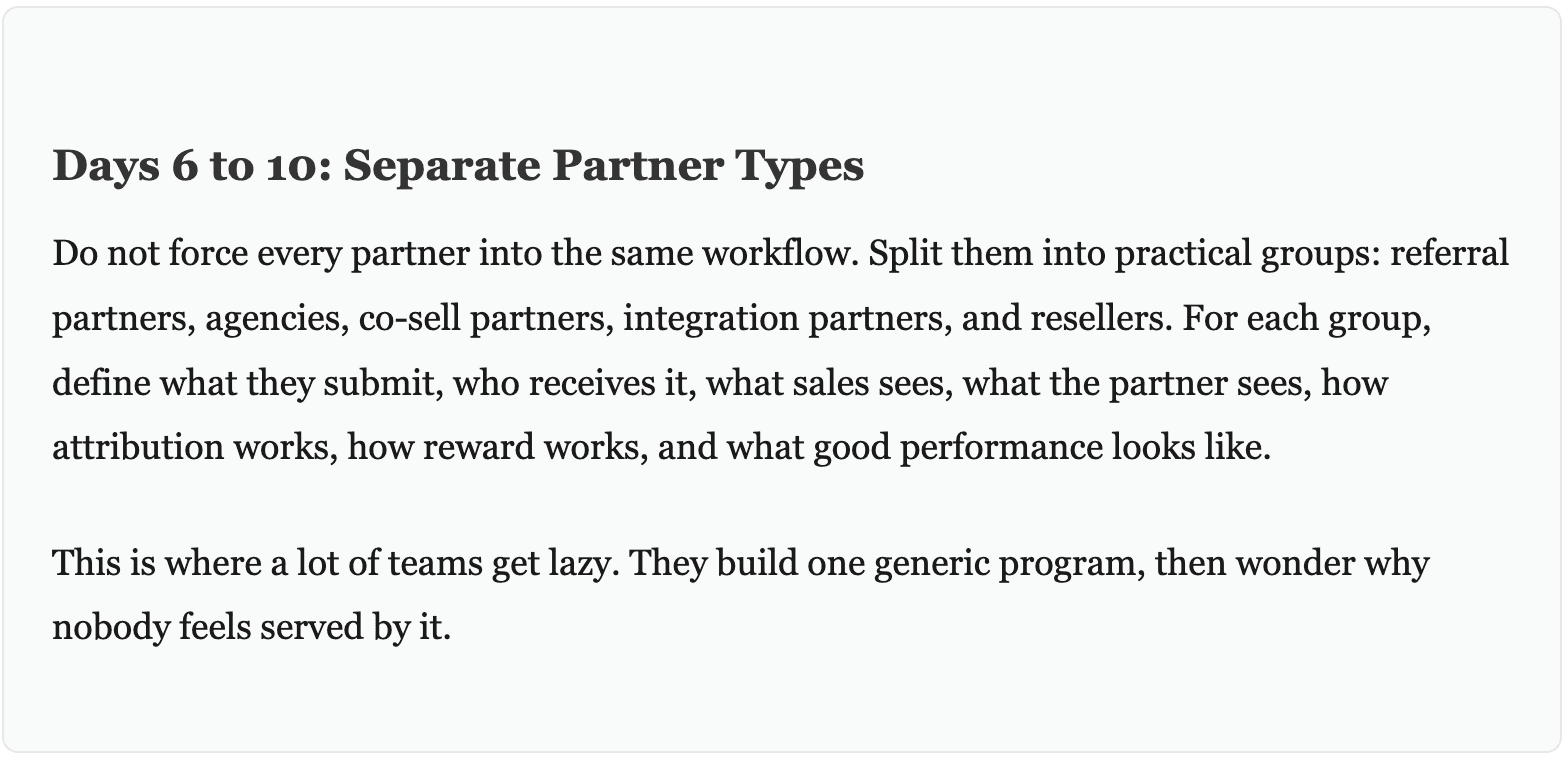
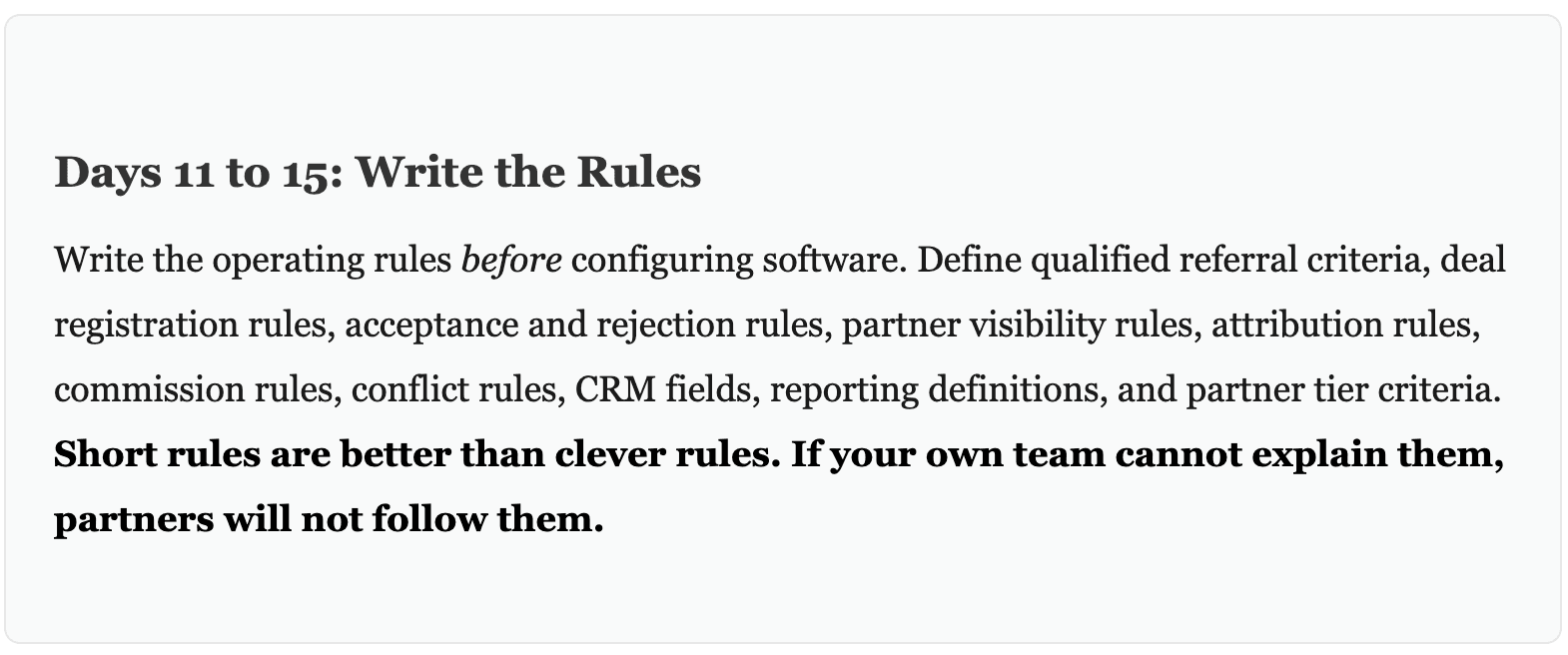
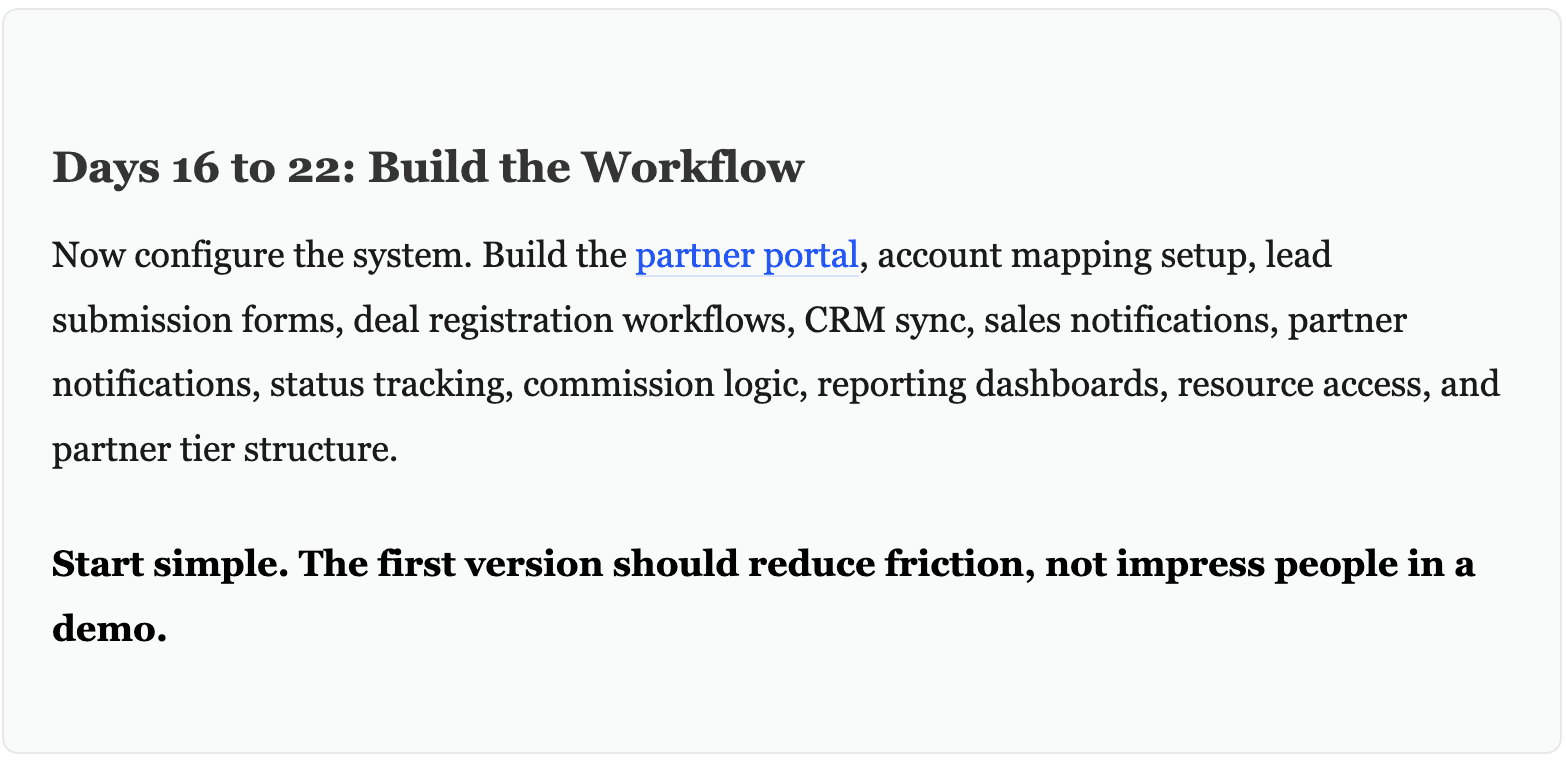
A 30-Day Plan for Moving Beyond Account Mapping

You do not need to boil the ocean. You need to make the partner motion usable.
Want help running this 30-day plan inside a platform built for it?
Try Partner.io Free for 14 Days →
When Crossbeam Makes Sense
Crossbeam makes sense when ecosystem intelligence is the centre of the job. If you have a strong network of partners already sharing data, a mature co-selling motion and a sales team ready to act on partner signals, Crossbeam can help reveal which accounts deserve attention.
It is also useful when the main challenge is prioritisation. For example:
Which target accounts have partner relationships?
Which open opportunities could be accelerated by partners?
Which customers overlap with integration partners?
Which partners can help us enter a new market?
Which partner signals should sales use before outbound?
Those are strong use cases. If that is the job, Crossbeam belongs on the shortlist.
When Partner.io Makes More Sense
Partner.io makes more sense when account mapping needs to connect to the rest of the partner program. That usually means you need more than partner intelligence. You need partner operations.
You need to manage account mapping, partner onboarding, referrals, lead submission, deal registration, co-sell workflows, partner portals, CRM sync, partner visibility, attribution, commission, payouts, and reporting.
This is the reality for most growing partner programs. They do not just need to know where partners overlap with their market. They need to capture the opportunity, route it, work it, reward it and prove it.
That is the Partner.io case. It gives you account mapping, but it does not stop at the map. It gives you the PRM layer that turns partner activity into a repeatable revenue workflow.
Also worth reading: How to build a partner-led growth motion from scratch and Key strategies for Partnership success.
The Bottom Line
A good partner program does not run on enthusiasm.
It runs on clear workflows, clean data, trusted attribution, partner visibility, sales adoption and commercial rules that do not collapse under pressure.
Crossbeam is a strong ecosystem intelligence platform.
Partner.io is the better fit when you want account mapping connected to the practical machinery of partner revenue.
One helps you see where the opportunity is. The other helps you turn that opportunity into a working partner motion.
If your partner program is still living in spreadsheets, inboxes and "I'll chase that" messages, the next step is not another mapping exercise. The next step is to consolidate the partner journey into a single system.
Find the overlap. Route the opportunity. Track the deal. Reward the partner. Prove the revenue.
That is what Partner.io is built for.
Stop running your partner program on spreadsheets and Slack threads.
Try Partner.io Free for 14 Days →