Product
Account Mapping for Mid-Market SaaS That Drives Revenue

Most account maps are dead on arrival.
The software finds 300 overlaps. The team calls them pipeline. Sales opens the spreadsheet once, partners get pestered for introductions, and nothing closes.
The problem is not the map. It is the missing system after the match.
Co-selling with partners fails when the map stops at visibility. For mid-market SaaS, account mapping should be a weekly revenue workflow, not a quarterly data exercise.
Every worthwhile overlap needs four things:
A commercial reason to act now
A credible relationship on the partner side
One owner on each side
A dated action
Without those four, it is not pipeline. It is a row in a database.
The short version. Clean the account data first. Score every overlap on fit, timing, access and mutual value. Route it to the right partner motion. Run the smallest useful play. Record the evidence against the opportunity. Five accounts a week beats 500 in a spreadsheet.

What partner account mapping proves, and what it does not
Partner account mapping compares your customers, prospects and open opportunities with a partner's accounts. It reveals shared companies and possible routes into them.
That is all it proves.
An overlap does not prove that the partner knows the right buyer, can make an introduction, or wants to spend political capital on your deal.
A technology partner may be installed at the account, while its commercial team knows no one there.
An agency may serve the brand but work with a different division.
A reseller may already be pursuing the same buyer under another offer.
The map finds the intersection. Good operations decide whether the intersection is useful.
The demand for the motion is not in question. The competence to run it usually is.
"82% of B2B marketing decision-makers at high-growth companies (those growing revenue 10%+ annually) say their customers prefer to buy through multiple sales channels, including ecosystem partners."
Forrester, Igniting Partner Advocacy: A Strategic Imperative For B2B Marketers, May 2025, citing Forrester's Marketing Survey, 2024
Six overlaps, six different first moves
Partner.io account mapping compares customers, opportunities and prospects across both sides of a partnership. Each part of that matrix points to a different play.
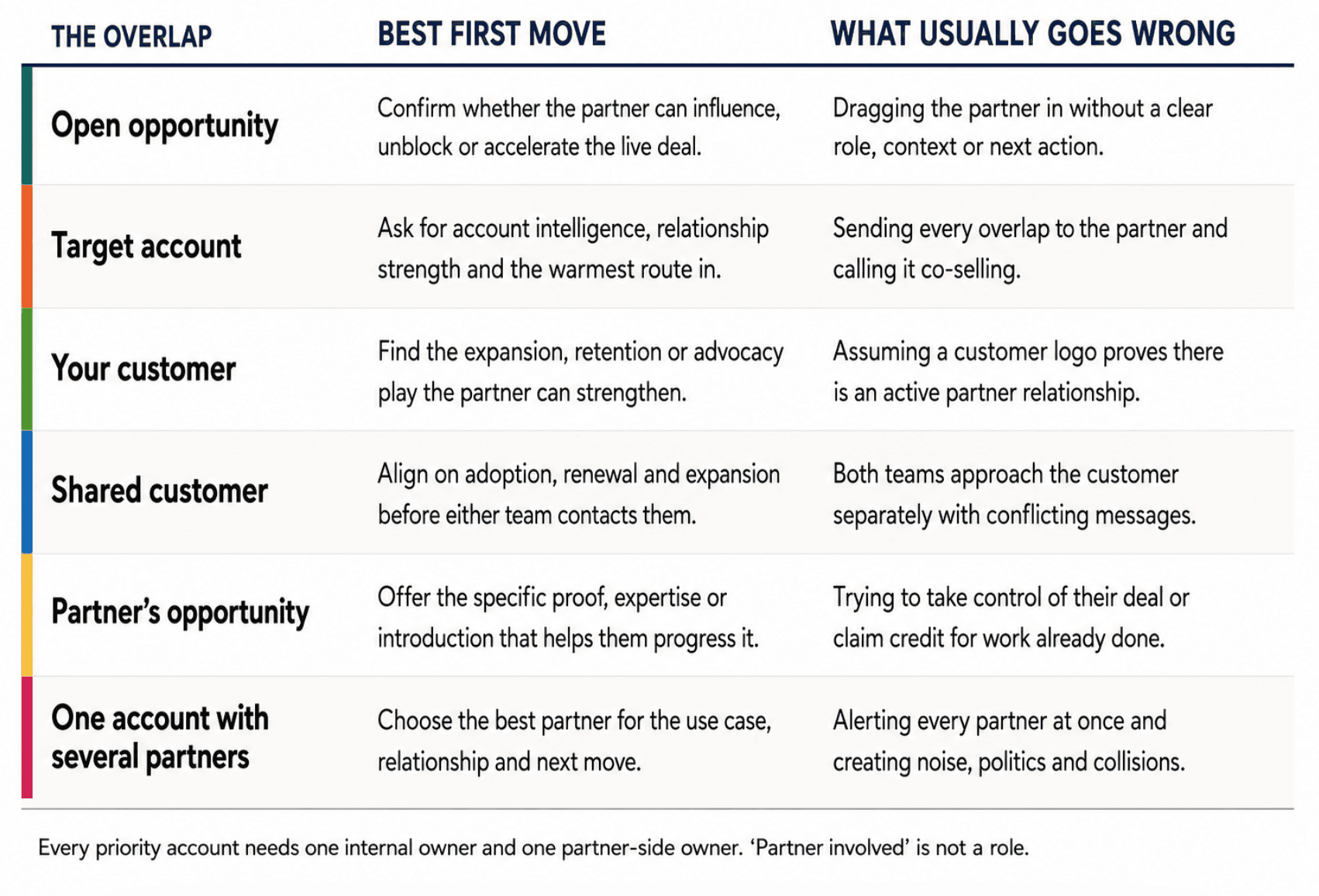
Six overlap types, six different first moves. Treating all six as one list is why sellers stop opening the sheet.
The 5R account mapping system
Run every serious overlap through five decisions: Resolve, Rank, Route, Run and Record.
The sequence matters more than the checklist.
Skip Resolve and the match may be wrong.
Skip Rank and sales gets buried in noise.
Skip Route and ownership becomes political.
Skip Run and the map turns into a report.
Skip Record and the partner's impact disappears at quarter end.
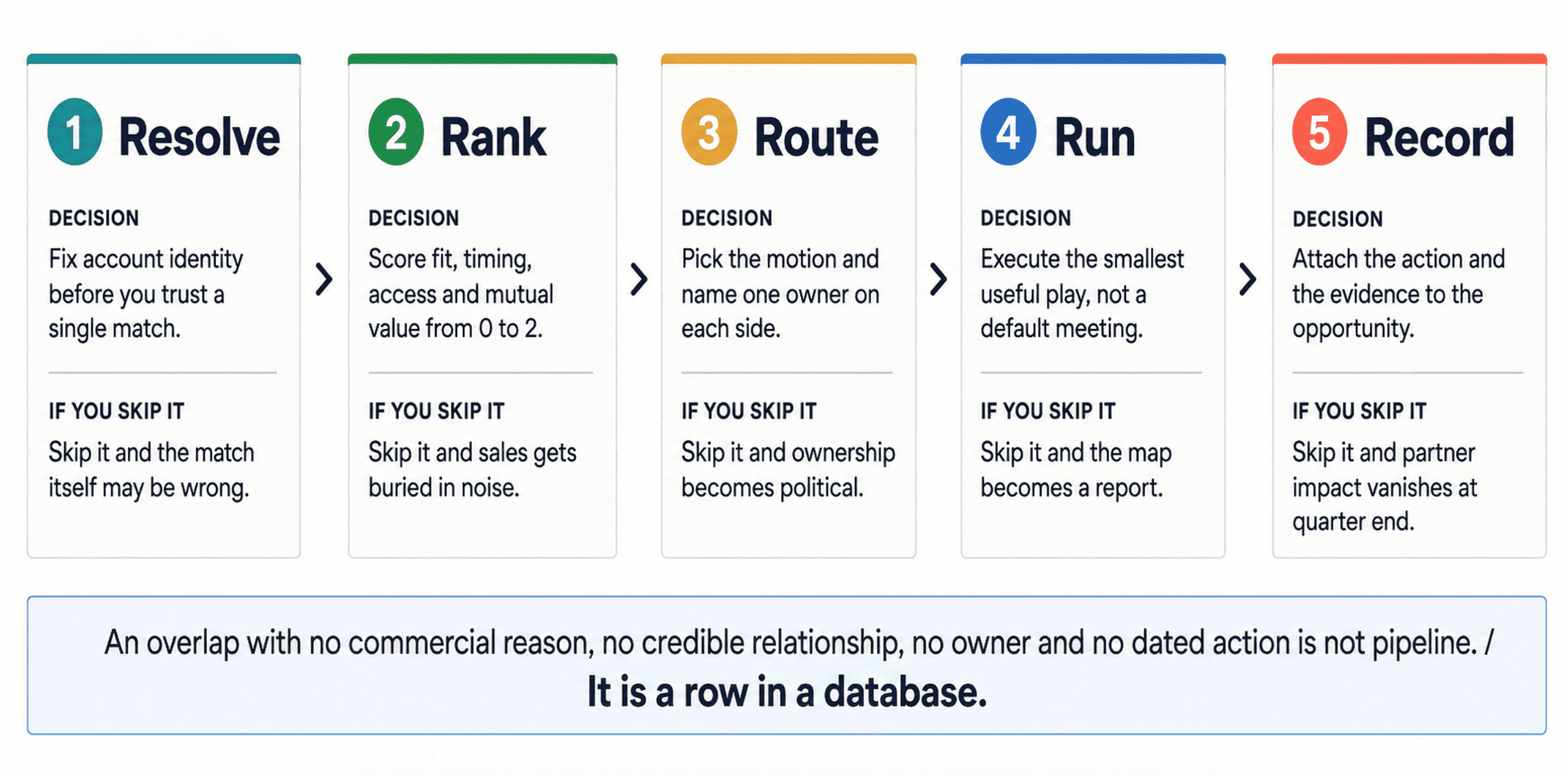
Five decisions, in this order. Every overlap that reaches a seller has passed all five.
1. Resolve the account
Account mapping software cannot rescue bad company data. Matching often relies on domains, and domains become messy fast. Brands rebrand. Subsidiaries have their own websites. One account appears three times under regional names. Closed opportunities remain open because nobody changed the stage.
A credible partner overlap analysis starts with account identity.
Clean the fields that decide whether a match is real:
Primary and former domains
Company name and trading names
Parent and subsidiary relationships
Customer, prospect and opportunity status
Opportunity stage and last meaningful activity
Account owner, territory and region
Ideal customer profile segment
Closed-lost and do-not-contact flags
Do not flatten every subsidiary into its parent for tidy reporting. The contract, the buying committee and the partner relationship may all sit at subsidiary level. Preserve the hierarchy, then choose which level should drive the match.
Before releasing a large overlap list, inspect 20 to 30 records by hand. Look for missed matches, false matches and stale stages. If the sample is poor, stop. Scaling bad data only creates a larger, more persuasive error.
This is not a niche problem. It is the default state of most revenue databases.
"The survey reveals that a majority of organizations, 61%, still handle data cleansing manually." Among the barriers to data quality: "Lack of Time and Resources (72%)", "No Standard Operating Procedures (67%)" and "Outdated Data (50%)".
Demand Gen Report, The Dirty Data Problem, February 2026, citing the 2026 Database Strategies & Contact Acquisition Benchmark Survey
If your account hygiene depends on somebody remembering to do it, your account map inherits that fragility. This is one of the hidden costs of running partnerships in spreadsheets.
Resolve the sharing rules too
Start with the minimum data needed for the agreed motion. Usually that is:
Company and domain
Account status
Region
Relevant opportunity stage
A relationship-strength signal
Personal contact details, pricing and sensitive deal notes should not be shared by default.
If a partner is cautious, begin with counts or a small named-account list. Partner.io lets you define populations such as customers, open opportunities, target accounts and closed-lost, then choose which populations each partner can see. Access should widen as the working relationship earns it.
2. Rank the commercial moment
Do not rank overlaps by logo size. Rank them by the chance of useful action now.
Score each account from 0 to 2 across four signals:
Fit. Does the account match the product, region, segment and commercial model?
Timing. Is there a live deal, project, renewal, integration need or recent trigger?
Access. Does the partner know a relevant stakeholder well enough to help?
Mutual value. Is there a concrete benefit for the partner and the customer?
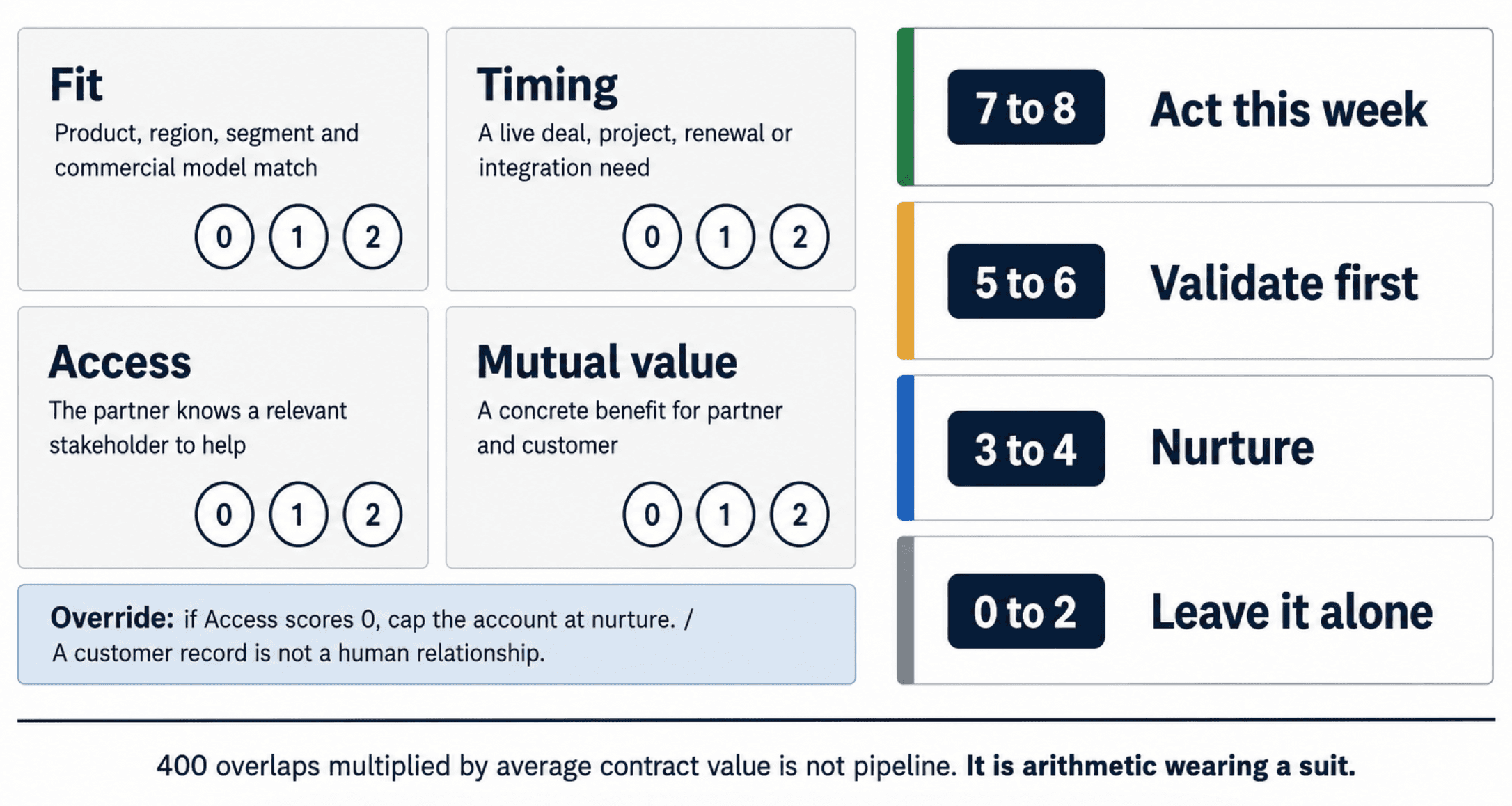
Score every overlap out of 8. The score decides who gets sales time this week and who does not.
Use the total to control the queue:
Score | Decision |
|---|---|
7 to 8 | Act this week |
5 to 6 | Validate with the partner before assigning sales time |
3 to 4 | Nurture, or attach to a later campaign |
0 to 2 | Leave it alone |
One override: if Access scores zero, cap the account at nurture. A customer record is not a human relationship.
This test kills a familiar piece of partnership theatre. Somebody finds 400 overlaps, multiplies them by average contract value, and labels the result "ecosystem potential". That number is not pipeline. It is arithmetic wearing a suit.
Potential revenue becomes forecastable when there is a qualified opportunity, an owner, a dated next step, and evidence of what the partner will do. That is the difference between having partners and running a partner programme.
3. Route the right partner motion
Dumping every overlap into a sheet called "opportunities" destroys context. Referrals, agency influence, integration expansion and reseller deals need different owners, different evidence and different rules.
Referral partners
Use a tight referral trigger. The partner should recognise the problem, know the buyer, and explain why the conversation matters now. A generic deck and "anyone who needs our software" is not enablement. See how referral partners and referral tracking work when the trigger is specific, and why referrals beat cold prospecting for B2B SaaS.
Agencies and consultancies
Qualify the agency's role at the account.
A strategic adviser can influence the buying case.
An implementation firm can reduce delivery risk.
A vendor working with another department may have little leverage.
The best agency play is often joint discovery or implementation scoping, not an introduction.
Technology and integration partners
Prioritise shared customers with low integration adoption, an expansion conversation, renewal risk, or a product gap the combined solution can solve. A shared-customer list without product usage or lifecycle context is trivia. Technology partners earn their place when the joint product does something neither side does alone.
Resellers
Set territory, account ownership, deal registration and protection rules before encouraging outreach. Otherwise the direct seller and the reseller can approach the same buyer with different pricing and wreck the account in a week.
Strategic co-sell partners
Map live opportunities against customer relationships on both sides, then name the contribution:
Introduction
Technical specialist
Commercial endorsement
Implementation capacity
Reference
Access to a missing stakeholder
"Partner involved" is not a role. Neither is "partner aware". Strategic partnerships that produce revenue name the work.
Every priority account needs one internal owner and one partner-side owner. If several partners overlap, choose a lead route. Supporting partners should know their part before anyone contacts the buyer. If your team is still improvising this, the split between sales playbooks and partner playbooks is worth reading first.
Routing also depends on whether your partner managers can actually run these motions, and the evidence on that is not flattering.
"A staggering 62% of sales leaders admit that they do not provide their PAMs with anything beyond basic sales training." By contrast, "51% of high performers, companies that consistently hit their partner sales goals during the same period, provided their PAMs with specialized training."
Forrester, The Partner Sales Divide: Why 51% Of Vendors Succeed And Others Don't, August 2025
4. Run the smallest useful play
Do not default to a meeting. The smallest action that moves the account is usually better.
That could be:
A warm introduction to one named stakeholder
Five minutes of deal intelligence
An answer to a technical objection
A joint discovery or implementation call
A customer reference
A reseller registration
An integration adoption review
A timed introduction before renewal
Make the task concrete.
"Partner to help" cannot be managed.
"Agency lead to confirm by Friday whether its ecommerce director will join a 30-minute implementation call" can.
Build reciprocity into the run stage
Bring accounts where you can help the partner, not only accounts where the partner can help you. Share useful intelligence when an introduction is inappropriate. Offer product expertise, implementation support or customer proof.
Track four numbers in both directions:
Introductions requested
Introductions made
Opportunities supported
Revenue created
The balance will not be equal every week, but it cannot stay one-sided. If every mapping session feels like unpaid prospecting work for you, the partner will stop attending.
Reciprocity is also what separates a partnership from a vendor list. The market has caught up on the intent.
"73% of companies now align their partnership goals with their overall business strategy, signaling a shift toward greater executive buy-in."
Partnership Leaders and Bridge Partners, Ecosystem Compass Report 2025, February 2025
5. Record the action and the evidence
An overlap trapped inside an account mapping tool is still trapped.
Once validated, put it on the company or opportunity record with:
Partner and partner motion
Internal and partner-side owners
Relationship holder
Agreed action and due date
Sourced or influenced status
Evidence of the contribution
Deal value, stage and latest update
This is why account mapping belongs inside a wider partner revenue system. Partner.io links mapping with deal registration and partner workflows, CRM sync, partner visibility, enablement and commission payments.
The HubSpot integration can attach partners to deals and sync stages and fields. The Salesforce integration does the same around opportunities and custom fields. Pipedrive and Slack close the loop on smaller stacks and on the follow-up nobody remembers.
The CRM remains where sales works the deal. Partner.io runs the partner-facing layer and keeps the handoff from falling apart.
Be strict with attribution
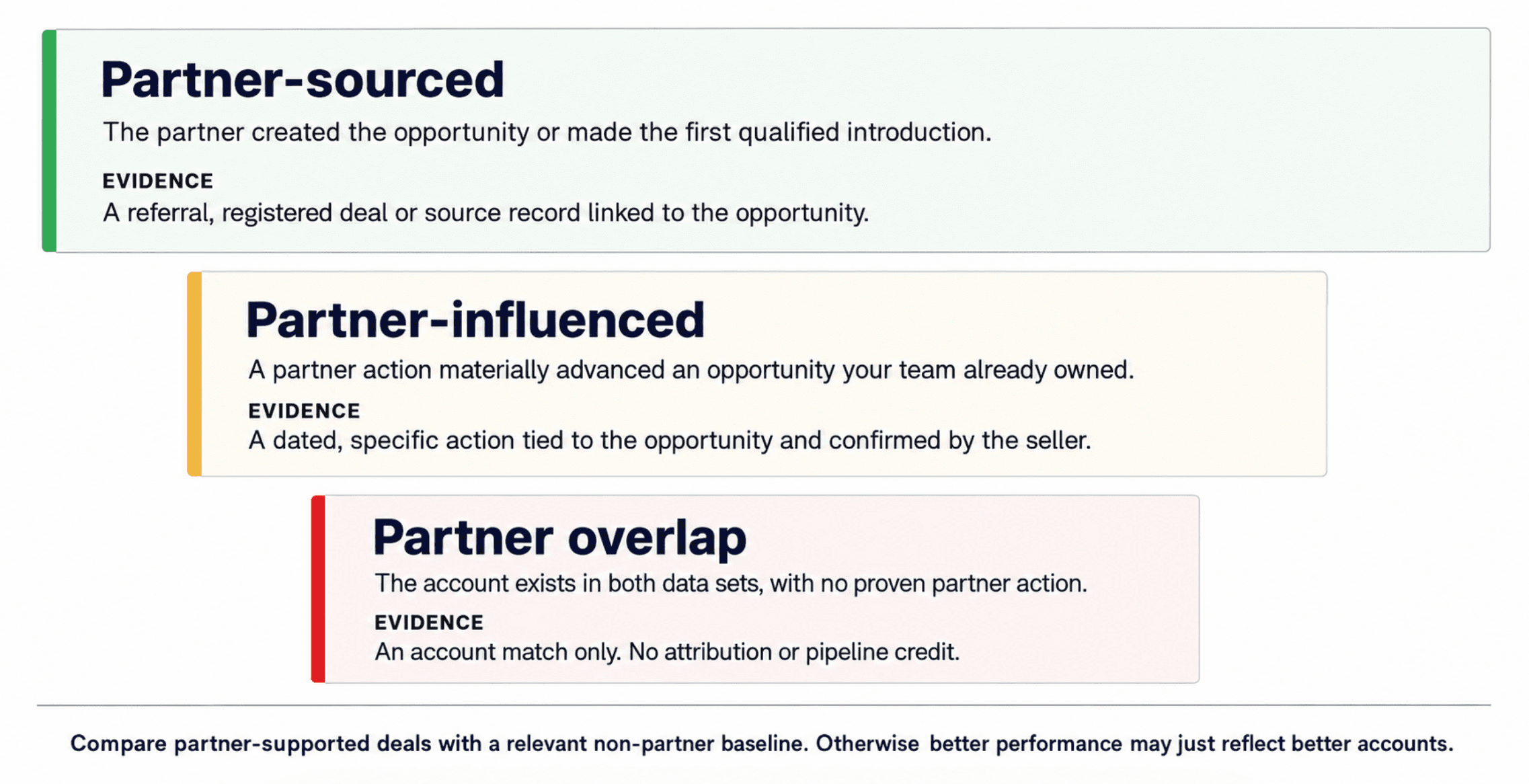
Three tiers, three evidence standards. Overlap is not influence.
Partner-sourced. The partner created the qualified opportunity, or made the introduction that brought it into pipeline.
Partner-influenced. The opportunity already existed, then a documented partner action changed access, confidence, scope or progress.
Partner overlap. The account appears in both data sets, but no contribution has happened.
Do not count overlap as influence. Require evidence: an introduction, stakeholder intelligence, technical validation, a reference, a joint workshop or an implementation plan.
Loose attribution makes the channel look bigger for one quarter and less credible forever. If you want the comparison to survive a CFO, read the £1 on ads versus £1 on partners breakdown before you publish a number.
What this looks like in the real world
A workflow SaaS company opens its weekly map with an agency partner. The dashboard shows 63 overlaps.
They do not export 63 accounts.
They filter for retail opportunities with activity in the past 30 days and a close date this quarter. Four remain.
Account one. The agency has worked with the brand but knows nobody involved in software buying. Access scores zero. It goes to nurture.
Account two. The agency leads the client's ecommerce programme. The SaaS deal has stalled on implementation risk. They book a joint scoping call. No forced executive introduction, just the help the deal needs.
Account three. Already part of a broader transformation project led by the agency. Both sides agree the agency will lead and the vendor will provide product expertise.
Account four. The relationship is strong, but the timing is wrong. They record the renewal date and set a task for six months later.
The session produces one joint call, one support role, one timed follow-up, and one account removed from the queue.
That is more valuable than 63 "potential opportunities".
Run account mapping as a weekly revenue habit
Keep the working session to 25 minutes and five priority accounts per partner.
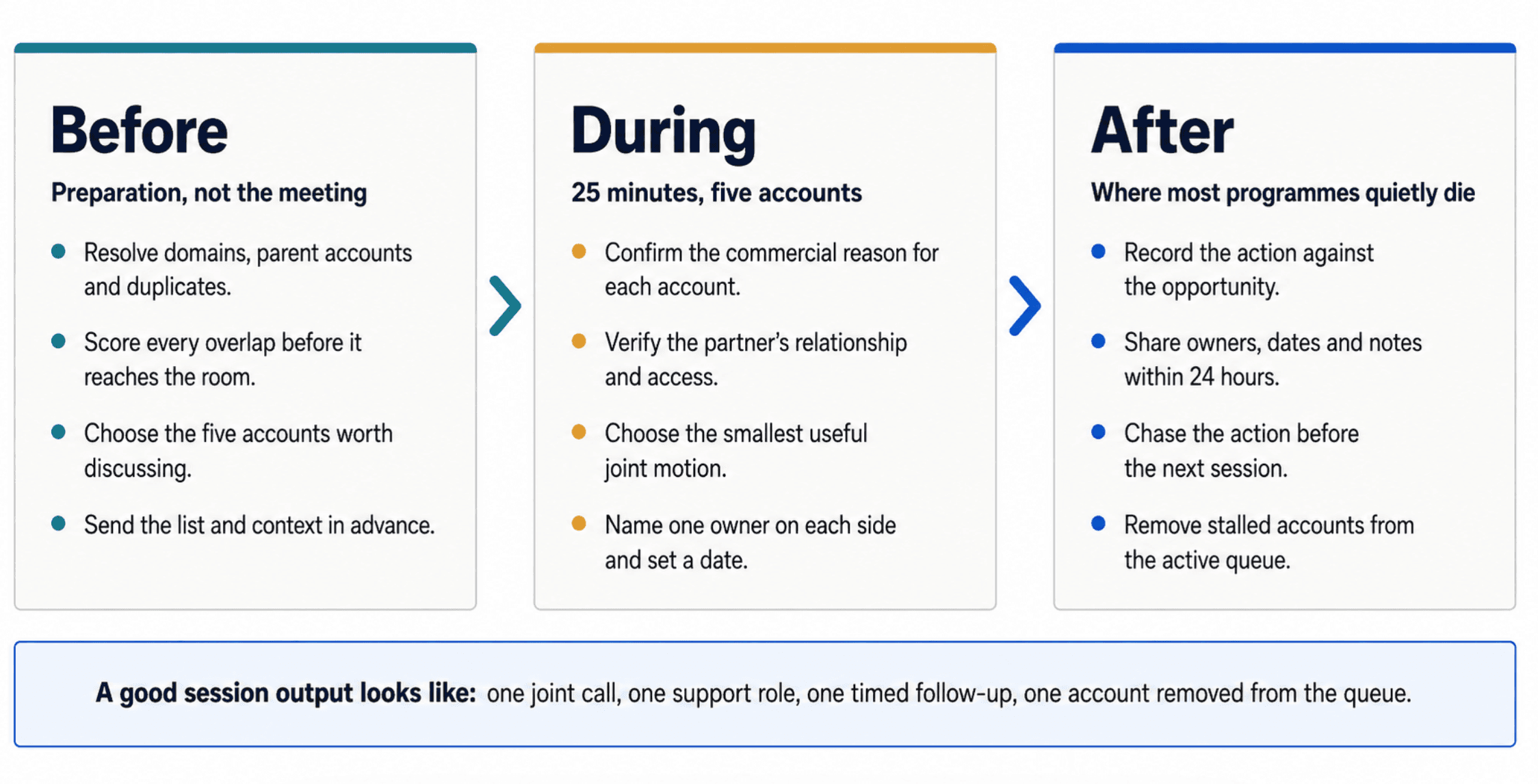
Five accounts, 25 minutes, and a follow-through step that most programmes skip.
Before. Refresh the relevant customers, prospects and opportunities. Remove closed, stale and out-of-territory records. Ask sales for live blockers. Bring at least one account where you can help the partner.
During. Confirm the match, the relationship and the reason to act now. Choose the motion. Assign owners. Agree the next action, due date and sharing boundary.
After. Update the account or opportunity. Create the tasks. Register or attach the partner. Send a short recap. Clear overdue actions before adding new ones.
Cancel the session if neither side brings a decision-ready list. A recurring call is not a substitute for preparation.
Measure movement, not map size
Actionable overlap rate
Percentage of actionable accounts with an owner and a due date
Time from validation to first action
Introduction acceptance rate
Partner-sourced pipeline and partner-influenced pipeline
Win rate, deal size and sales cycle by motion
Value created for each side
Compare partner-supported deals with a relevant non-partner baseline. Otherwise better performance may simply reflect better accounts rather than partner impact.
When account mapping breaks
Failure | What is really wrong | Fix |
|---|---|---|
Sales ignores the list | Too many accounts, weak context, or work happening outside the CRM | Send three to five validated accounts with relationship strength, reason to act, owner and due date |
Partners refuse to share | The request is too broad or too one-sided | Start with counts or named accounts, limit the fields, and state the value for both sides |
Matches are wrong | Duplicate domains, aliases, bad hierarchies or stale stages | Pause automation, review a sample by hand, repair the identity rules |
Every match becomes an intro request | Account presence has been confused with access | Require a named stakeholder and an Access score. Use intelligence or technical help when the intro is weak |
Attribution becomes a fight | Sourced and influenced were defined after the deal | Agree definitions first and attach timestamped evidence to the opportunity |
Sellers and resellers collide | Ownership rules were never set | Enforce registration, territory, protection, pricing and communication rules |
The partnership becomes one-sided | One company treats the other's customers as free pipeline | Put accounts for both sides on the agenda and track value exchanged |
The partner never acts | You mapped with the wrong partner | Stop the cadence and reinvest the time in better partner discovery |
If several of these are true at once, the problem is upstream of mapping. It is the operational mess between the handshake and the revenue.
Spreadsheet or PRM?
A spreadsheet is fine for a pilot. If two people are comparing 20 named accounts with one trusted partner, prove the motion before buying more software.
It stops being fine when:
Account data changes weekly
Several partners touch one opportunity
Attribution affects commission
Partners need deal visibility
Follow-up depends on one person remembering every promise
Standalone account mapping software can find the overlap. It cannot run the partner programme around it.
Partner.io is built around that gap. The map sits beside deal registration, workflows, CRM sync, partner portals, attribution, training and payments. The same account can move from overlap to referral or co-sell, into the CRM, through the deal stages and back to the partner without another export.
For a lean B2B SaaS team, that matters. Buying one tool to find overlaps and another to manage what happens next recreates the handoff problem at a higher price. It is also the reason so many programmes stall before they become partner-led growth.
For the fuller argument on where partner revenue comes from below $25M ARR, see Partner-Led Growth for SaaS CROs.
Try Partner.io free for 7 days. No credit card, no contract, and your first overlap list in a single afternoon.
Start your free trial or book a walkthrough.