Product
Social Media Content Calendar Template That Actually Works
Stop guessing what to post next week
Your content is not failing because of ideas.
It is failing because of coordination.
Good posts exist in drafts. Campaigns slip a week. Metrics get reviewed once, then forgotten. The calendar fills with dates but nothing improves.
A content calendar should compound learning. Most just record activity.
When the structure is wrong, every post starts from zero.
Why calendars decay
The typical setup:
Dates.
Platforms.
A caption field.
Someone presses publish.
That tracks effort, not progress.
Four problems appear quickly:
No link to goals
No ownership
No visible status
No feedback loop
Without those, publishing becomes busywork.
The LOOP model
A working calendar runs a cycle, not a list.
Link
Every post exists to change a measurable outcome.
Organise
Content moves through fixed stages, not ad hoc handoffs.
Observe
Performance sits beside the original idea.
Plan
The next week adapts based on evidence.
If the calendar cannot run this weekly, it will collapse.

The structure that actually works
1. Metadata anchors behaviour
Before planning posts, define:
Owner
Date range
Last updated
Four KPIs max
Typical set:
Reach
Engagement
Clicks
Conversions
More metrics create arguments, not decisions.
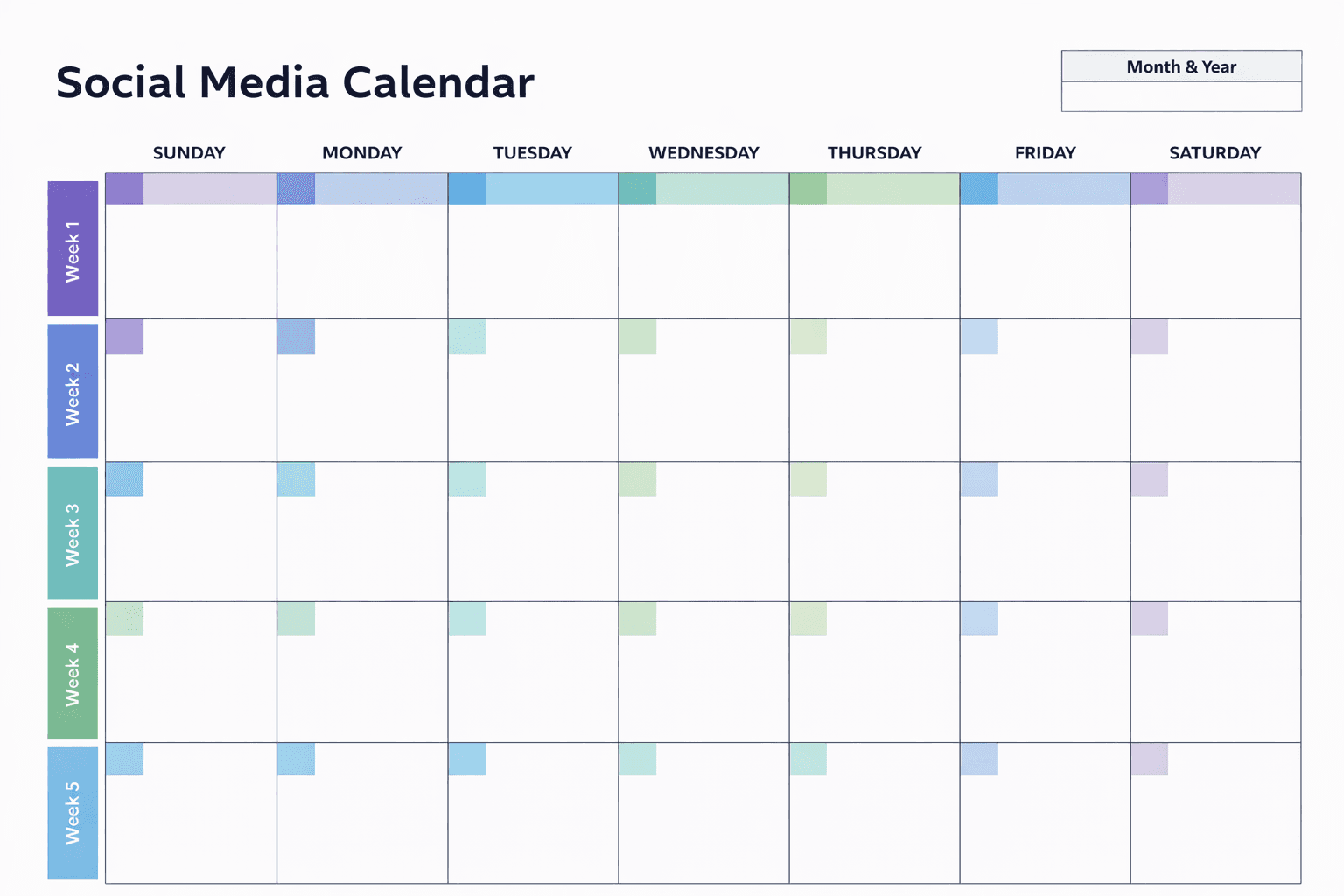
2. The production table
This is not a schedule. It is a pipeline.
Required fields:
Date
Platform
Content type
Caption
Asset
Owner
Status
Statuses must be fixed:
Not started
Draft
Review
Scheduled
Published
Repurpose
When statuses drift, accountability disappears.
3. Campaign layer
Posting without themes creates noise.
Each post attaches to a narrative arc:
Campaign
Timeframe
Objective
Now weeks feel intentional instead of random.
4. Performance in the same place
If analytics live elsewhere, nobody learns.
Track per post:
Impressions
Reactions
Shares
Comments
Clicks
The proximity matters. Seeing results next to the idea changes future ideas automatically.
5. Distribution tracking
Hashtags and mentions are not decoration. They are distribution mechanics.
Over time you learn:
Which topics travel
Who amplifies reach
Which tags bring the wrong audience
This becomes a repeatable promotion playbook.
6. Weekly focus
Every week defines:
Content pillars
Priority posts
One experiment
Without experiments, teams repeat habits.
Without priorities, urgent work wins.
A real scenario
A team publishes three times a week but growth stalls.
They tag every post by theme.
Most are announcements.
They review comments weekly.
Tutorials outperform updates three to one.
They reserve one tutorial slot each week.
Six weeks later tutorials drive most conversions.
No creativity breakthrough happened. The system revealed the pattern.

Operating rules
Separate ideas from publishable work
No caption, asset, and owner means not ready
Every post earns a category
Education, proof, story, promotion, or conversation
Review weekly
Monthly reviews justify decisions. Weekly reviews improve them
Archive aggressively
Old posts become templates, planning accelerates
The trade off
Structure removes spontaneity.
It creates consistency.
You post fewer random ideas.
You publish more effective ones.
Planning time increases.
Rework time collapses.
Where templates matter
Most teams rebuild the same calendar every quarter. Columns change. Statuses drift. Learning resets.
The bottleneck is not strategy. It is repetition.
When the structure becomes reusable, behaviour stabilises. Teams stop managing a sheet and start running a process.
Inside Assemble the calendar becomes infrastructure. Statuses persist. Metrics stay attached to posts. Campaigns follow the same logic every cycle.
The work stops resetting. Improvement compounds.
Build the system once. Then run it.
Turn your posting routine into a repeatable workflow → Explore Assemble