Product
Pricing Strategy Template for Smarter Packaging Decisions

The Pricing Strategy Template That Prevents Expensive Guesswork
Most pricing problems are not pricing problems.
They are alignment problems.
Teams change features. Sales offers discounts. Finance pushes for margin, marketing updates positioning. Suddenly, nobody can explain why a plan costs what it costs.
Revenue slows. Churn creeps up. Discounting becomes the default.
A strong pricing strategy template fixes this, not by picking a number, but by forcing clarity around value, segmentation, packaging, and financial impact.
If pricing touches revenue, growth, retention, positioning, and product roadmap, it deserves a system.
This guide walks through a practical pricing and packaging strategy framework you can actually use. It is built for serious knowledge work, not slideware.
Why Pricing Breaks Down
Before building a template, it helps to understand what usually goes wrong.
From working with scaling SaaS teams and product-led companies, five recurring issues show up:
Pricing is disconnected from customer value.
Tiers are feature dumps, not deliberate value ladders.
Segments are loosely defined or based on intuition.
Financial modeling happens after launch, not before.
Communication to sales and customers is reactive.
A pricing strategy template creates a repeatable structure that prevents these mistakes.
The 5-Part Pricing Architecture Model
Here is a practical mini-framework you can use to structure your pricing decisions.
1. Value Anchor
What outcome are customers actually paying for? Speed, revenue, compliance, visibility, risk reduction?
If your pricing model is not tied to this anchor, it drifts.
2. Segmentation Logic
Who experiences that value differently? Startups, mid-market, enterprise. High-usage vs low-usage. Advanced operators vs casual users.
Clear segments prevent overcomplicated tiers.
3. Packaging Ladder
What increases as customers grow? Seats, usage volume, automation, integrations, governance.
Each tier should map to a maturity stage.
4. Monetization Model
Per seat, per usage, flat rate, hybrid, freemium, value-based. The model should mirror how value scales.
5. Financial Impact
Forecast adoption, ARR, churn risk, and margin. Pricing without modeling is gambling.
Build your template around these five elements and most confusion disappears.
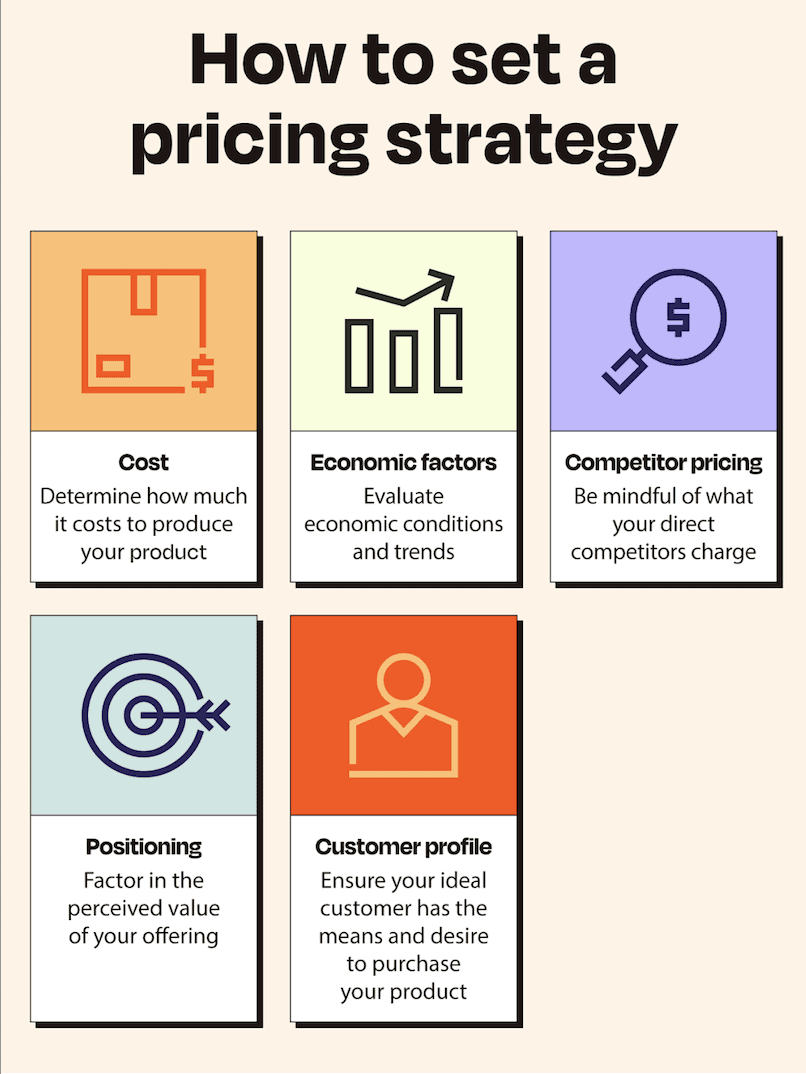
Building a Real Pricing Strategy Template
Below is a structured outline you can adapt into your own pricing strategy template.
1. Document Metadata
Track ownership and versioning. Pricing changes without documentation create internal chaos.
Include:
Product or service
Owner
Version and date
Reviewers and approvers
Treat pricing like a living system, not a one-off decision.
2. Objectives and Success Metrics
Pricing must serve a goal.
Common objectives include:
Target ARR or MRR
Improved conversion rate
Reduced churn
Higher gross margin
Expansion revenue
Decision point: Are you optimizing for growth, margin, or market share right now?
You cannot maximize all three at once.
3. Customer Segmentation
Most pricing mistakes come from vague segmentation.
Instead of “SMB” and “Enterprise”, define:
Buying trigger
Budget range
Core use case
Expansion potential
Current ARR contribution
Example:
Segment A
Early-stage teams buying for speed and simplicity. Sensitive to upfront cost. Low initial ACV but high lifetime expansion potential.
Segment B
Operationally mature teams needing integrations and governance. Higher ACV. Lower churn risk.
When segments are concrete, pricing tiers become obvious.
4. Pricing Model and Tier Structure
This is where structure matters.
For each tier define:
Price
Billing frequency
Features included
Target segment
Upgrade trigger
Avoid arbitrary “Basic, Pro, Premium” naming without meaning.
Each tier should correspond to a stage in the customer journey.
Ask:
What breaks first when a customer outgrows this tier?
What capability becomes essential at the next stage?
A strong pricing tiers structure feels inevitable, not invented.
Competitive Pricing Analysis Without Copying
Competitive benchmarking is useful, but dangerous if done lazily.
Instead of asking “What do they charge?”, ask:
What metric do they monetize?
What value do they anchor pricing to?
Where do they draw the line between tiers?
What objections are they pre-solving?
Your goal is positioning clarity, not imitation.
If a competitor charges per seat but your value scales with usage, copying them will distort your model.
Financial Modeling for Pricing Decisions
This is where most teams rush.
Build a simple financial modeling table per tier:
Target customers
Forecasted adoption rate
Average contract value
Churn assumptions
Expansion assumptions
Resulting ARR
Model at least three scenarios:
Conservative
Expected
Aggressive
Then pressure-test it.
What happens if conversion drops by 20 percent?
What if churn increases in your lowest tier?
What if discounting becomes standard practice?
Pricing is strategy. Strategy requires modeling.
What This Looks Like in the Real World
A growing SaaS product introduced a “Premium” tier because customers asked for more features.
They bundled advanced analytics, integrations, and priority support into one expensive plan.
Adoption stalled.
After revisiting their pricing strategy template, they discovered:
Analytics drove value for mid-tier customers.
Integrations were enterprise-only needs.
Priority support mattered only to high-revenue accounts.
They split the plan into two tiers aligned with actual usage maturity.
Within one quarter:
Conversion increased.
Discounting decreased.
Expansion revenue improved because upgrade triggers were clearer.
The difference was not the price. It was the structure.
Risks and Trade-Offs to Document
Every pricing and packaging strategy carries risk.
Document explicitly:
Price sensitivity by segment
Churn risk by tier
Likely competitive response
Sales objections and discount pressure
If your lowest tier is too generous, you kill upgrades.
If your highest tier is too abstract, you stall enterprise deals.
Write these trade-offs down. Future you will thank you.
Rollout and Internal Alignment
Even perfect pricing fails without communication.
Your template should include:
Internal enablement sessions
Updated sales scripts
FAQ for objections
Website messaging updates
Review cadence
Pricing is not a launch. It is a system that needs monitoring.
Set a quarterly review rhythm. Track performance against your original assumptions.
Why Templates Matter in Pricing Strategy
Most teams build pricing in scattered slides, Slack threads, and spreadsheets.
That fragmentation creates misalignment.
A structured pricing strategy template:
Forces clarity on assumptions
Speeds up decision-making
Improves cross-team alignment
Makes updates repeatable
Reduces internal debate
This is exactly where Assemble fits.
Instead of rebuilding your pricing and packaging strategy from scratch every time, you can create a structured, reusable template that captures segmentation logic, tier rationale, financial modeling, and rollout steps in one place.
Assemble makes that framework living and adaptable, not trapped in a one-off document.
The Next Step
If pricing decisions feel reactive, unclear, or political, it is time to formalize the system.
Start by documenting:
Your value anchor
Your segments
Your tier ladder
Your monetization model
Your financial assumptions
Turn pricing from debate into design.
Build your own pricing strategy template inside Assemble and make every future update faster, clearer, and smarter.
Stop guessing on pricing. Start documenting it properly with Assemble.