Product
Sales Forecasting Template for ARR and Pipeline Planning

Sales forecasts don’t fail loudly. They fail late.
The number gets approved. Heads nod. Plans get locked.
Then the quarter closes and everyone is surprised.
Not because the team missed something small, but because the forecast was built on loose definitions, recycled assumptions, and optimism pretending to be math. By the time the truth shows up, it is already too late to act.
A forecast is not a prediction. It is an early warning system. Most teams never build it that way.
Where forecasts actually break
The problem is rarely effort. It is structure.
Pipeline stages mean different things to different people. “Commit” turns into a feeling, not a fact.
Coverage ratios get quoted without checking whether win rates support them.
ARR and MRR are rolled up without separating new, expansion, or churn. Timing risk disappears.
Risks live in people’s heads, not on the page, so they vanish after the call.
Every quarter starts fresh, which guarantees inconsistency.
You end up with a forecast that looks solid but cannot be challenged. It is visible, not usable.

The Forecast Integrity Loop
Strong forecasts follow a repeatable loop. Miss one step and the whole thing bends.
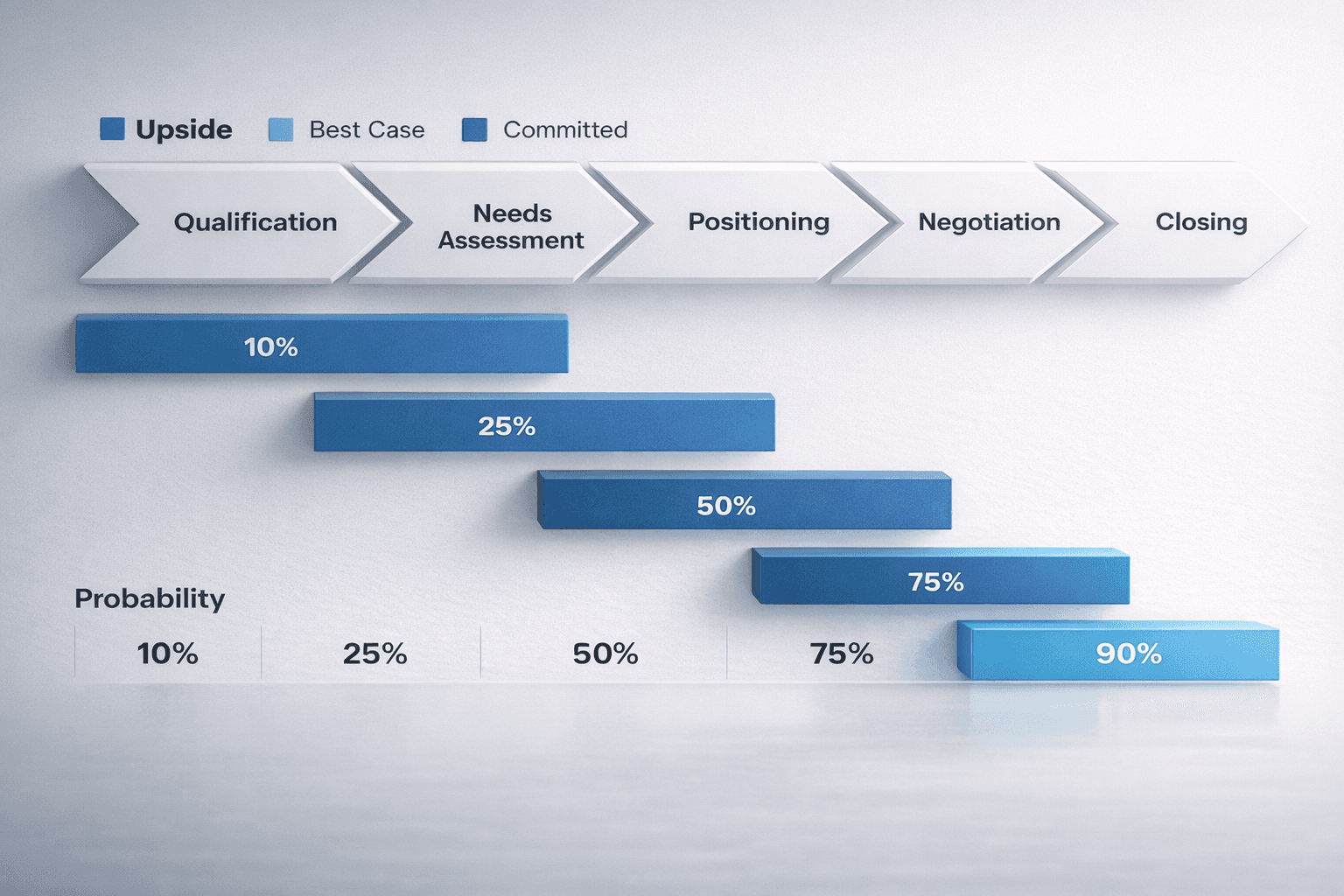
1. Define the stages
Each stage has a clear entry rule. If the rule is not met, the deal does not sit there. No exceptions.
2. Check coverage first
Pipeline coverage versus quota comes before confidence. Always adjusted by historical win rate, not hope.
3. Force timing into view
ARR is broken down month by month. New. Expansion. Churn. Totals hide risk; timing exposes it.
4. Write down the risk
Every meaningful deal carries a stated risk or upside, owned by a person. If it is not written, it is not real.
5. Attach action
A forecast without decisions is just reporting. Every cycle ends with clear intervention points.
This loop does not chase precision. It creates early truth.
What strong forecasts always show
You can spot a serious forecast by what it refuses to hide.
Pipeline coverage vs quota
By rep or region, not just a global ratio. This shows where pressure will land before it lands.
Stage weighted numbers
Conversion rates by stage force honesty. Inflated probabilities show up fast.
ARR and MRR movement
New, expansion, churn, and separation. Growth without churn context is fiction.
Win and loss patterns
Top reasons won and lost, tracked quarter to quarter. Forecasting becomes a learning system.
Named risks and upsides
Specific deals. Specific issues. Aggregates are not allowed to do the talking.
What this looks like in the real world
A SaaS team enters the quarter with 3.8x pipeline coverage. On paper, that should clear quota.
Once the forecast is structured properly, two things surface immediately. One region owns most late stage deals. Another has volume, but weak historical conversion. Expansion ARR is overstated because churn assumptions were copied from a strong outlier quarter.
Nothing dramatic happens. That is the point.
They pull execs into three at risk deals early. Marketing spend shifts toward the region that actually converts. Hiring plans pause. The quarter lands slightly under target, but with no surprises. The next one lands clean.
That is what a forecast is supposed to do.
The trade-offs most teams avoid
Better forecasting removes comfort.
Deals you want to believe in get downgraded.
Stage definitions expose weak discipline.
Leadership loses the safety of a single top line number.
What you gain is control. Forecasts stop being theatre and start steering decisions while there is still time to act.
Where templates earn their place
Most teams know what a good forecast should include. They just do not capture it the same way twice.
A well-designed sales forecasting template removes that friction. It standardises definitions, forces risk into the open, and makes every forecast comparable to the last. Not rigid. Repeatable.
This is how Assemble fits naturally into the workflow. You define the structure once, then reuse it without flattening nuance. Forecasts get faster to produce and easier to interrogate. The thinking stays consistent, even as the numbers change.

The point of forecasting
If your forecast cannot explain why you will miss or beat the number, it is not a forecast. It is a guess with formatting.
Structure comes first. Accuracy follows.
Templates are how that structure survives the quarter.
Stop rebuilding forecasts from scratch.
Use Assemble, the number one template builder for serious work, to surface risk early, force clarity, and act before the quarter ends.