Startups
Partnerstack Alternatives for 2026 (tried & tested)

Are you seeking PartnerStack alternatives that offer better margins, faster support, and a more intuitive partner experience?
There are plenty of Partner Relationship Management (PRM) tools for SaaS companies and agencies, each varying in their features, fee structures, and focus. In this article, I’ve gathered the 5 best PartnerStack alternatives to help you streamline your partnership ecosystem without eating into your profits.
PartnerStack’s pricing model can be a deal-breaker for growing businesses. The platform generally charges a hefty monthly platform fee, but the real kicker is the percentage-based fee on partner revenue (often referred to as the "marketplace tax"). If you are scaling successfully, you are penalized with higher fees. As a result, many partnership managers consider PartnerStack alternatives that allow them to scale revenue without scaling costs.
Here’s what a G2 reviewer had to say about PartnerStack:
What do you dislike about PartnerStack?
"The implementation took much longer than expected. We felt like a small fish in a big pond. Also, the fees on top of the payouts really eat into our margins. We wanted a tool to manage partners, not a tax on our growth."
There is also a steep learning curve due to the platform’s complexity. Simple tasks, like adjusting a commission structure for a specific tier of partners, can feel buried in menus.
5 Best Alternatives to PartnerStack
Let’s go over some PartnerStack competitors & alternatives you should consider to reclaim your margins.
1. Partner.io: Best PartnerStack alternative for ROI and ease of use
Partner.io Tracking | Partner.io Payouts | Partner.io vs PartnerStack Pricing | Final Takeaway
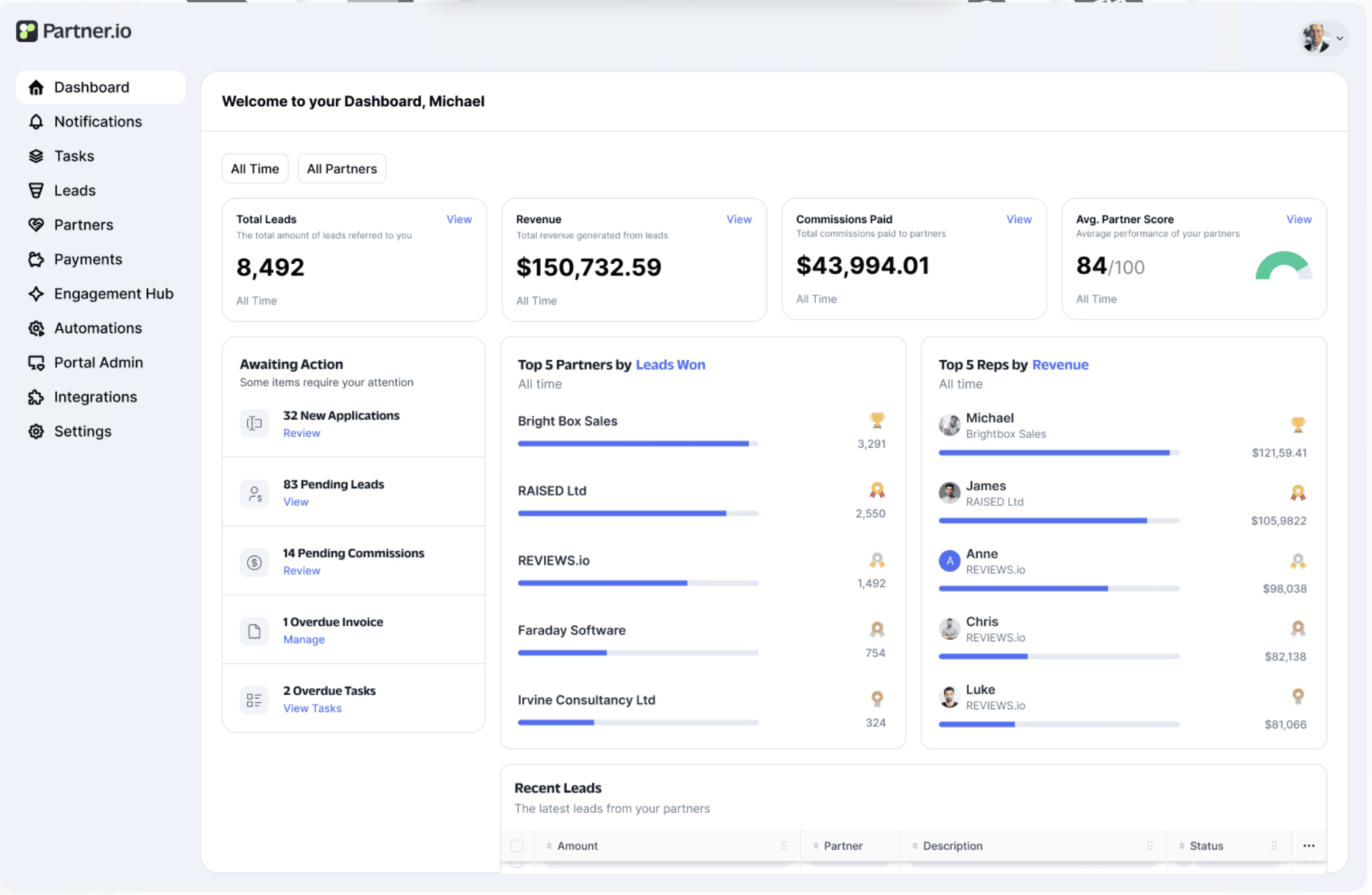
Efficiency and profitability are what define Partner.io. The tool offers robust partnership management features, including automated onboarding, precise tracking, and flexible commission structures, without the bloat or the "tax" on your revenue.
With Partner.io, partnership managers tackle all sorts of channels: from affiliates and ambassadors to deep reseller relationships. It’s a comprehensive tool that helps you stay on top of your ecosystem game.
"Partner.io has helped make our entire partner onboarding process so simple. Before using Partner.io, I had tried PartnerStack and manual spreadsheets. PartnerStack was too expensive for the stage we were at, and spreadsheets were a nightmare. Partner.io simplified our payouts and tracking instantly."
— Head of Partnerships, SaaS Company
Supported segments
Affiliate, Reseller, Referral, Ambassador, and Influencer.
Downsides
Partner.io is laser-focused on SaaS and Service businesses, so it may not be the perfect fit for physical e-commerce goods compared to B2C-specific tools.
Partner.io vs. PartnerStack
Tracking & Attribution
Partner.io’s tracking engine brings more precision to the table. You can easily segment partners by tiers and customize cookie durations and attribution windows without needing a developer.
Most notably, Partner.io allows for a cleaner interface for the partners themselves. Partners can log in and immediately see their clicks, conversions, and due payouts without navigating a complex marketplace UI.
Payouts
Like PartnerStack, Partner.io handles global payouts. However, Partner.io focuses on ensuring you keep more of your money. There are no hidden fees based on the volume of revenue your partners generate. You pay for the software, not a percentage of your success.
Verdict
Feature | Partner.io | PartnerStack |
Pricing Model | Flat SaaS fee (Predictable) | Platform fee + % of Revenue (Unpredictable) |
Onboarding | Fast, intuitive, self-serve options | Lengthy, often requires implementation team |
User Interface | Modern, clean, "Apple-like" | Enterprise-heavy, complex menus |
Support | Dedicated, fast response | Can be slow for non-enterprise tiers |
Partner.io vs. PartnerStack final takeaway
Although PartnerStack has a massive marketplace, Partner.io offers a superior experience for the day-to-day management of partners. It eliminates the revenue share tax, meaning as you grow, your costs stay flat.
Overall, Partner.io is the best PartnerStack alternative for teams that want to scale their program profitably. It’s more flexible and tailored to fit the needs of modern SaaS companies.
2. Crossbeam: The "Ecosystem" Alternative
Crossbeam is less of a traditional PRM (Partner Relationship Management) and more of an ELM (Ecosystem-Led Growth) tool. While PartnerStack focuses on affiliate links and payouts, Crossbeam focuses on data mapping. It helps you see which of your customers are also customers of your partners.
Crossbeam’s key features are:
Account Mapping: Securely compare your CRM data with your partners' data to find overlaps.
Co-selling: Identify opportunities where a partner can help close a deal.
Integrations: Deep syncing with Salesforce and HubSpot.
Supported segments:
Tech Partners, Strategic Alliances.
Downsides
Crossbeam is not a tool for paying affiliates. You cannot generate referral links, track clicks, or send money to partners through it. It is purely for data overlap.
Crossbeam vs. PartnerStack
PartnerStack is for transacting (payouts/links). Crossbeam is for identifying (data overlap).
Many companies use both, but if you strictly need account mapping and not affiliate management, Crossbeam is the specialist.
Takeaway
If your primary goal is co-selling with other SaaS companies rather than running an affiliate army, Crossbeam is the superior choice. However, it lacks the payout infrastructure of PartnerStack.
3. Impartner: The Enterprise Legacy Alternative
Impartner is the heavyweight champion of the old-school PRM world. It is designed for massive global enterprises with complex channel sales, such as hardware manufacturers or massive distributors.
With Impartner, you can:
Manage complex tiered reseller programs.
Distribute marketing assets and co-branded collateral.
Manage deal registration with complex approval workflows.
Track partner certification and training LMS.
Supported segments
VARs (Value Added Resellers), MSPs, Distributors.
Downsides
Impartner is expensive and heavy. The implementation can take months, and the UI feels dated compared to modern tools like Partner.io. It is often overkill for a digital-first SaaS company.
Impartner vs. PartnerStack
Impartner offers deeper "Asset Management" and "Through-Channel Marketing Automation" (TCMA) than PartnerStack.
PartnerStack is better suited for high-volume, lower-touch affiliate relationships.
Impartner’s pricing is gated and generally aimed at the Fortune 1000.
Takeaway
Impartner is a valid alternative only if you are a massive enterprise with a complex reseller network requiring heavy compliance and asset management. For agile SaaS teams, it feels clunky.
4. Kiflo: The SMB Alternative
Kiflo is a PRM designed specifically for small to mid-sized businesses (SMBs). It covers the basics of partner management without the complexity of PartnerStack or Impartner.
With Kiflo you can:
Manage Affiliate, Referral, and Reseller partners in one hub.
Sync with HubSpot and Pipedrive.
Create a simple partner portal.
Downsides
Kiflo can feel a bit limited as you scale. The reporting is basic, and it lacks the advanced commission customization that tools like Partner.io or PartnerStack offer.
Kiflo vs. PartnerStack
Pricing: Kiflo is significantly cheaper and more transparent than PartnerStack.
Features: PartnerStack has a marketplace; Kiflo does not.
Usability: Kiflo has a very low learning curve, similar to Partner.io.
Takeaway
Kiflo is a great "starter" PRM. If you are a small team with a limited budget, it’s a great way to leave spreadsheets behind. However, high-growth teams may outgrow its feature set.
5. Allbound: The Content-Centric Alternative
Allbound positions itself as a "Partner Success" platform. Its main differentiator is its focus on content and training. It believes that an educated partner sells more, so the platform is built around distributing content to partners.
Allbound’s key features are:
Content Library: A visually appealing way to share sales decks and one-pagers.
Partner Journey: Gamification of partner training.
Pipeline Management: Registering and tracking deals.
Downsides
Like Impartner, Allbound can be on the expensive side. It is also less focused on the "Affiliate" motion (high volume, link tracking) and more on the "Reseller" motion (enabling sales teams).
Allbound vs. PartnerStack
PartnerStack is transactional (clicks and cash). Allbound is educational (content and training).
Allbound lacks the marketplace network effect that PartnerStack offers.
Takeaway
If your struggle is that your partners don't know how to sell your product, Allbound is a great alternative. If your struggle is tracking links and paying people efficiently, Partner.io or PartnerStack are better fits.
PartnerStack Alternatives FAQs
What is better than PartnerStack?
Partner.io is the best PartnerStack alternative regarding ROI and usability. It provides the powerful tracking and payout features you need without the "marketplace tax" that eats into your revenue.
Is there a cheaper alternative to PartnerStack?
Yes. Partner.io and Kiflo are both more affordable. PartnerStack’s pricing model scales with your revenue, making it very expensive for successful programs. Partner.io uses predictable SaaS pricing.
Which tool is best for B2B SaaS?
For B2B SaaS, Partner.io strikes the best balance. It handles the complexity of B2B sales cycles (unlike simple affiliate tools) but remains agile and easy to use (unlike heavy legacy PRMs like Impartner).