Product
PRM Software for SaaS: Why Partner Revenue Breaks Without a System

The six handoff points where partner revenue leaks without a PRM system in place.
Your partner program is not failing because partners do not care. It is failing because nobody can see what is happening. PRM software for SaaS exists to fix that, turning partner activity into a revenue system every team can trust.
A referral sits in someone's inbox. A deal is mentioned in Slack. Sales forgets the partner was involved. Finance questions the commission. The partner chases for an update. Leadership asks what revenue came from the channel, and everyone starts digging through spreadsheets like archaeologists.
That is the point where partnerships stop feeling strategic and start feeling expensive.
A proper partner relationship management platform gives every partner motion a process, every deal a source of truth, and every team enough visibility to stop arguing about what happened.
Why Most SaaS Partner Programs Break at Scale
The first few partners are easy to manage. You know them by name. They message you directly. A spreadsheet is annoying, but survivable.
Then the program grows. A consultant sends a referral. An agency influences a deal. A reseller wants a protected margin. An integration partner wants co-marketing support. Sales owns the opportunity but does not own the partner relationship. Finance wants clean payout data. RevOps wants field discipline.
Suddenly, the spreadsheet is not lean anymore. It is a liability.
Most partner programs break down in the handoffs between teams and systems:
Partner to sales: referrals get lost or ignored
Sales to CRM: partner source is not tagged or disappears
CRM to finance: commission data is incomplete or contradictory
Finance to payout: disputes emerge because the rules were never written down
Partner activity to reporting: leadership cannot measure the channel
Enablement to partner action: training content exists but partners do not use it
That is where partner relationship management software earns its keep. The job is not to make partnerships look organised. The job is to stop good partner activity leaking out of the revenue process.

What PRM Software for SaaS Actually Needs to Do
SaaS partnerships are messy because they involve people outside your company helping create revenue inside your company. A PRM needs to handle that cleanly across every motion your team is running.
Capture referrals without inbox chaos
Register and protect partner-sourced deals
Track partner influence as well as partner source
Show partners what happened after they submitted a lead
Give sales partner context inside the CRM: not in a separate tool they will ignore
Train partners on what to sell, who to target, and when to bring sales in
Segment partners by motion, not just by tier
Connect to the tools already used by sales, marketing, finance, and operations
The distinction that matters: Bad PRM software stores information. Good PRM software moves revenue forward. Build your evaluation criteria around the second definition.
See how Partner.io handles all five partner motions in one platform.
Try Partner.io Free for 14 Days
The Partner Revenue Loop: Five Stages Every Program Needs
Before choosing PRM software, map your operating model. The strongest partner-led teams run a loop. It is simple, but unforgiving. Miss one stage and the program drags.
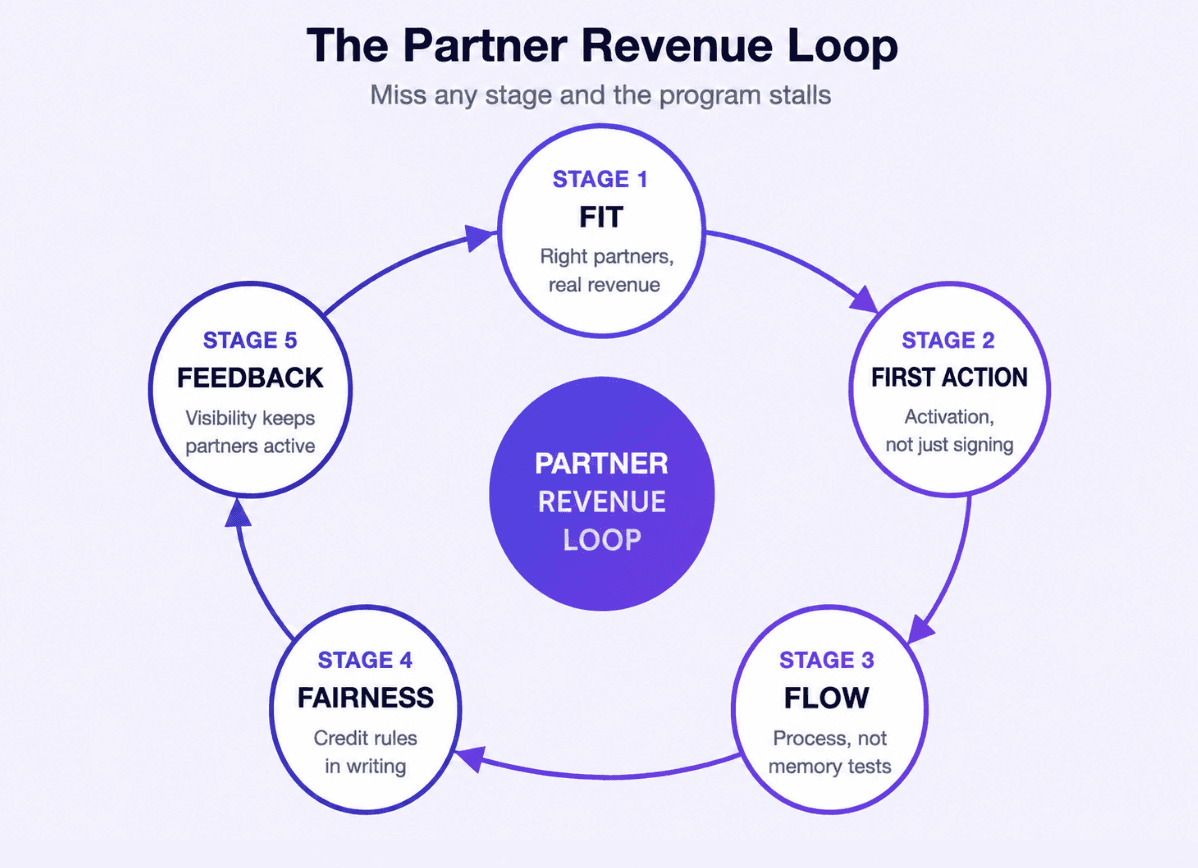
The five-stage loop that every productive partner program runs. Miss any one and the whole cycle slows.
1. Fit: Start With the Partners Who Can Create Real Revenue Now
Not theoretical reach. Not a nice logo. Not someone who "might be strategic." Ask:
Who already has trust with your buyer?
Who sees the problem before you do?
Who can create a qualified pipeline, not just introductions?
Who can influence deals already in motion?
Who can expand you into a segment or market faster than direct sales?
A referral partner, agency, integration partner, and reseller do not need the same program. Treating them the same is how partner portals become graveyards.
2. First Action: Activation Is Not Joining, It Is Doing
A partner has not activated because they joined. They have activated when they do something useful. That first action should be obvious and frictionless.
For a referral partner: submit one qualified lead
For an agency: complete certification and add your product to a client recommendation deck
For an integration partner: identify shared accounts
For a reseller: register the first opportunity
If a partner logs in and sees twelve tabs, four PDFs, and no clear next step, you have already lost momentum. Structured partner onboarding is what separates programs that activate from programs that accumulate.
3. Flow: Where Most Partner Programs Fall Apart
A partner submits a lead. Then what? Does it create a CRM record? Who owns it? Can sales accept or reject it? What if the account already exists? Spreadsheets can record activity. They cannot run the process. A PRM has to turn partner activity into workflow: clear lead routing, CRM sync, notifications, approval flows, and status changes. Without that, every deal becomes a memory test. See how deal registration and HubSpot integration (amongst others) handle this inside Partner.io.
4. Fairness: Credit Disputes Kill Partner Programs Faster Than Bad Leads
Sales worries partners are claiming deals they did not create. Partners worry sales will close deals and forget them. Finance worries that commission numbers are being made up after the fact. Everyone has a point. Fairness needs rules in the system, not in someone's memory: deal registration, duplicate lead handling, referral expiry, partner influence vs source, split credit, commission eligibility, refunds, and renewal commission. If those rules are not written down, they will be fought over in calls.
5. Feedback: Silence Kills Partner Engagement
A partner sends a lead. Nothing comes back. The deal might be progressing, dead, or ignored. The partner has no idea, so they stop sending good opportunities. Partner programs do not die suddenly. They die from silence, one ignored referral at a time. A strong PRM gives partners deal status, commission status, training progress, and performance by period, enough visibility to keep them engaged and sending quality leads.
The Five Partner Motions Your PRM Has to Support
A SaaS partner program is rarely one clean channel. It is usually five different motions wearing the same badge. Your PRM needs to handle each one without forcing them all into the same workflow.
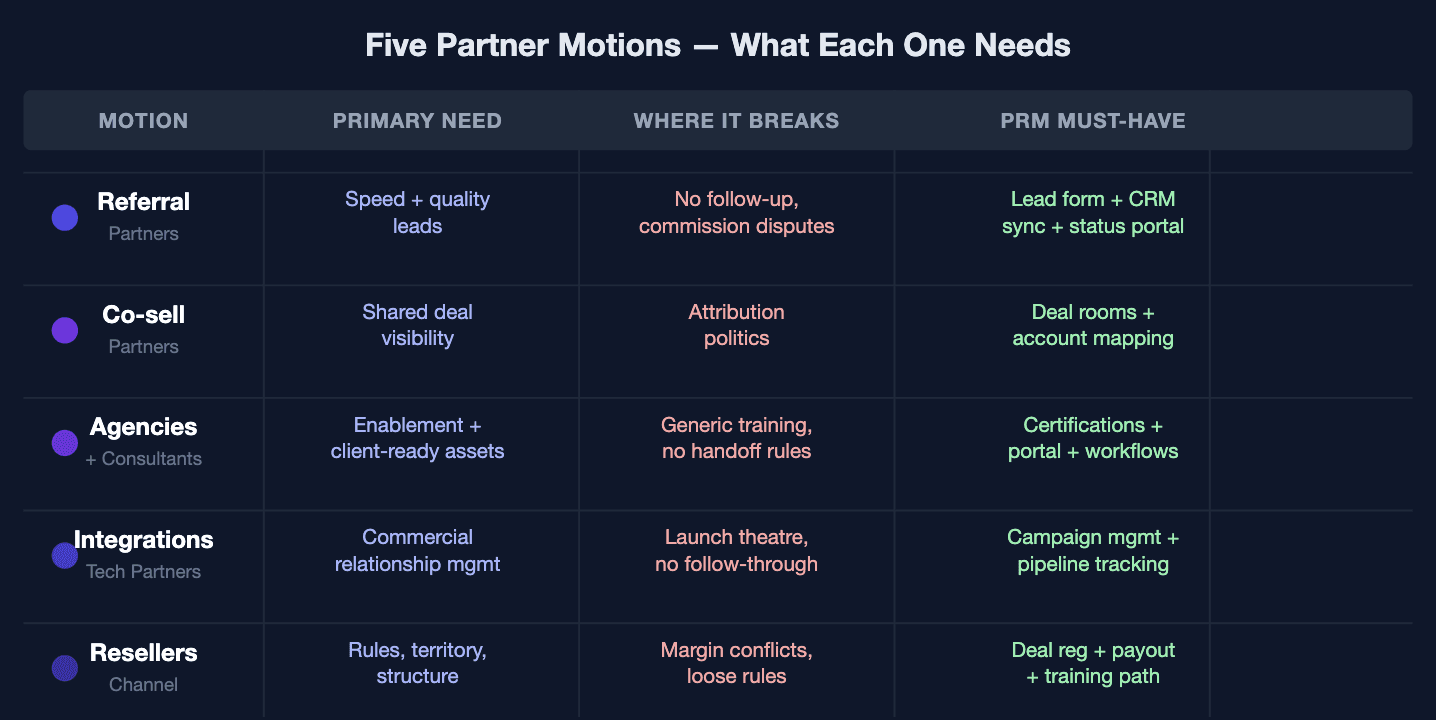
Each partner motion has different needs, different failure points, and different PRM requirements. One generic process will not serve all five.
Referral Partners: Simple in Theory, Messy in Practice
Referral partners are the easiest place to start. They know someone who has a problem. They make the introduction. Your team sells. They get rewarded. Common failures are predictable: low-quality leads, duplicate accounts, slow follow-up, no status updates, and commission disputes because eligibility was never defined.
What works: a clear referral form with required qualification fields, CRM sync on submission, accept/reject workflow for sales, partner-visible status updates, and commission rules tied to real revenue. One partner who submits three clean opportunities is worth more than twenty who spray bad-fit leads into the funnel. Lead management with qualification gates makes that difference obvious in the data.
Co-Sell Partners: Where Attribution Gets Political
The partner has the relationship. Your sales team has the product. The buyer trusts the partner, but your company owns the commercial process. Co-sell only works with shared visibility. A co-sell partner may not source the opportunity, but they may open the door, validate the business case, support procurement, or help unblock legal. If your system only tracks source, you will undercount partner impact and annoy the partners who help close the deals sales care about most. Learn how account mapping handles co-sell attribution inside Partner.io.
Agencies and Consultants: Earn the Recommendation Before You Ask for It
Agencies are powerful because they see demand early. They know when a client is changing CRM, rebuilding onboarding, or entering a new market. But agencies will not recommend you just because the commission looks decent. They care about client outcomes. They care about delivery risk. They care whether your company makes them look sharp or stupid. What they actually need: which client problem triggers a recommendation, what a bad-fit client looks like, what services they can wrap around the product, and when to bring your sales team in. A structured training and certification path turns an agency relationship from inconsistent to repeatable.
Integration Partners: An Integration Is Not a Partnership
An integration is a product connection. The partnership starts when that connection creates distribution, retention, expansion, or sales leverage. Plenty of SaaS companies build integrations, launch them once, add a logo to the website, and then move on. That is integration theatre. What actually works: prioritise integrations by customer overlap, build a joint launch plan, give sales a proper talk track, and downgrade integrations that produce nothing.
Resellers: Strong Channel, Fast Chaos Without Rules
Do not launch resellers because you need more distribution. Launch resellers when they can win a market, segment, or use case better than your direct team. They need defined margin, territory, deal registration, renewal ownership, support responsibility, training requirements, and payment terms, all in writing, not assumed.
Partner.io covers all five motions: referral, co-sell, agency, integration, and reseller — in one platform.
Try Partner.io Free for 14 Days
Build It in the CRM, or Use a PRM? The Honest Answer
Someone will always say: "Can't we just do this in HubSpot or Salesforce?" Sometimes, yes. If you have three referral partners, one commission rule, and no need for a partner portal, use the CRM. Keep it simple.
But the CRM starts to bend when the partner program needs external users, partner-facing updates, deal registration, onboarding, certifications, commission rules, partner analytics, and payout workflows. The question is not "Can the CRM store this?" It probably can. The better question is: Can the CRM run this without turning RevOps into a support desk?
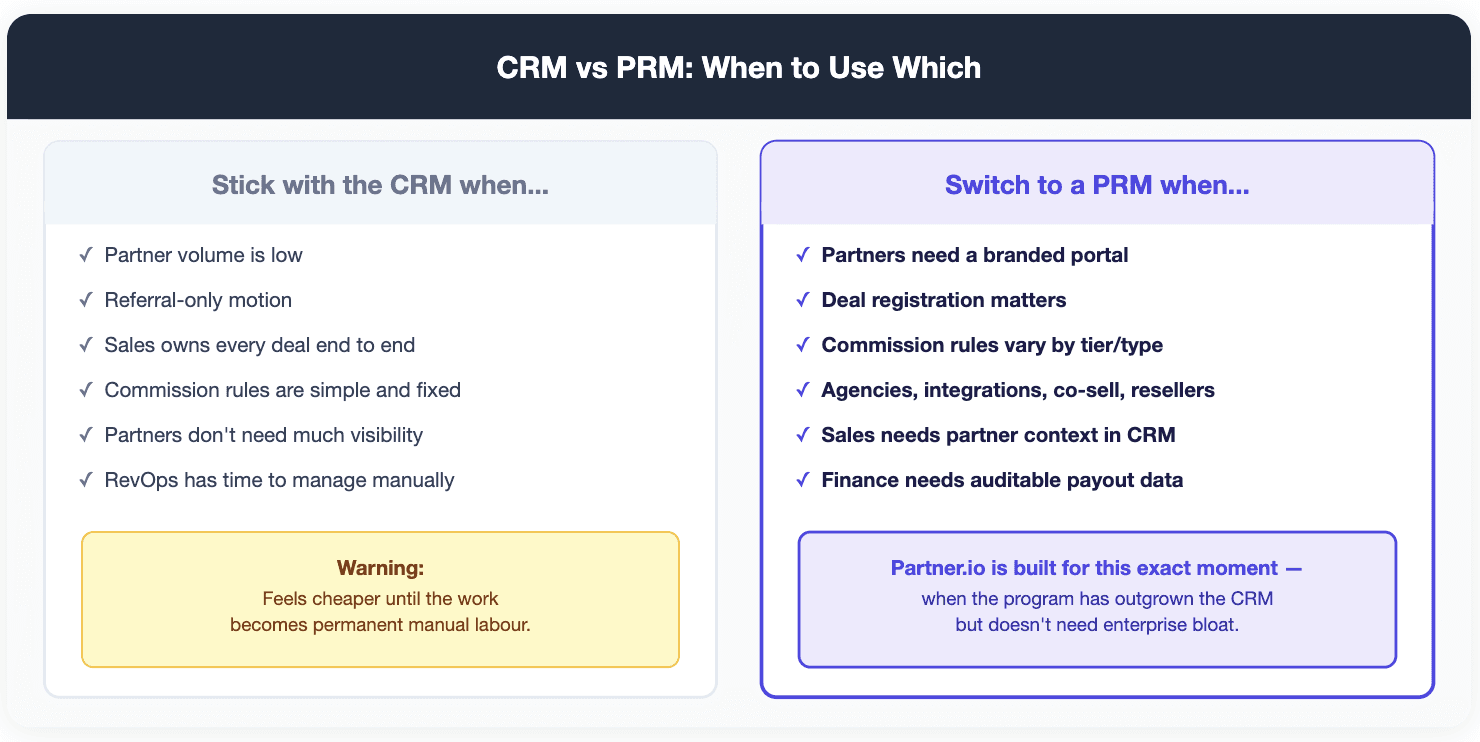
The decision is not about what the CRM can store. It is about what it can run without turning RevOps into a support desk.
How to Know When You Actually Need PRM Software
You do not need PRM software because partnerships sound important. You need it when the work starts leaking. Use this diagnostic.
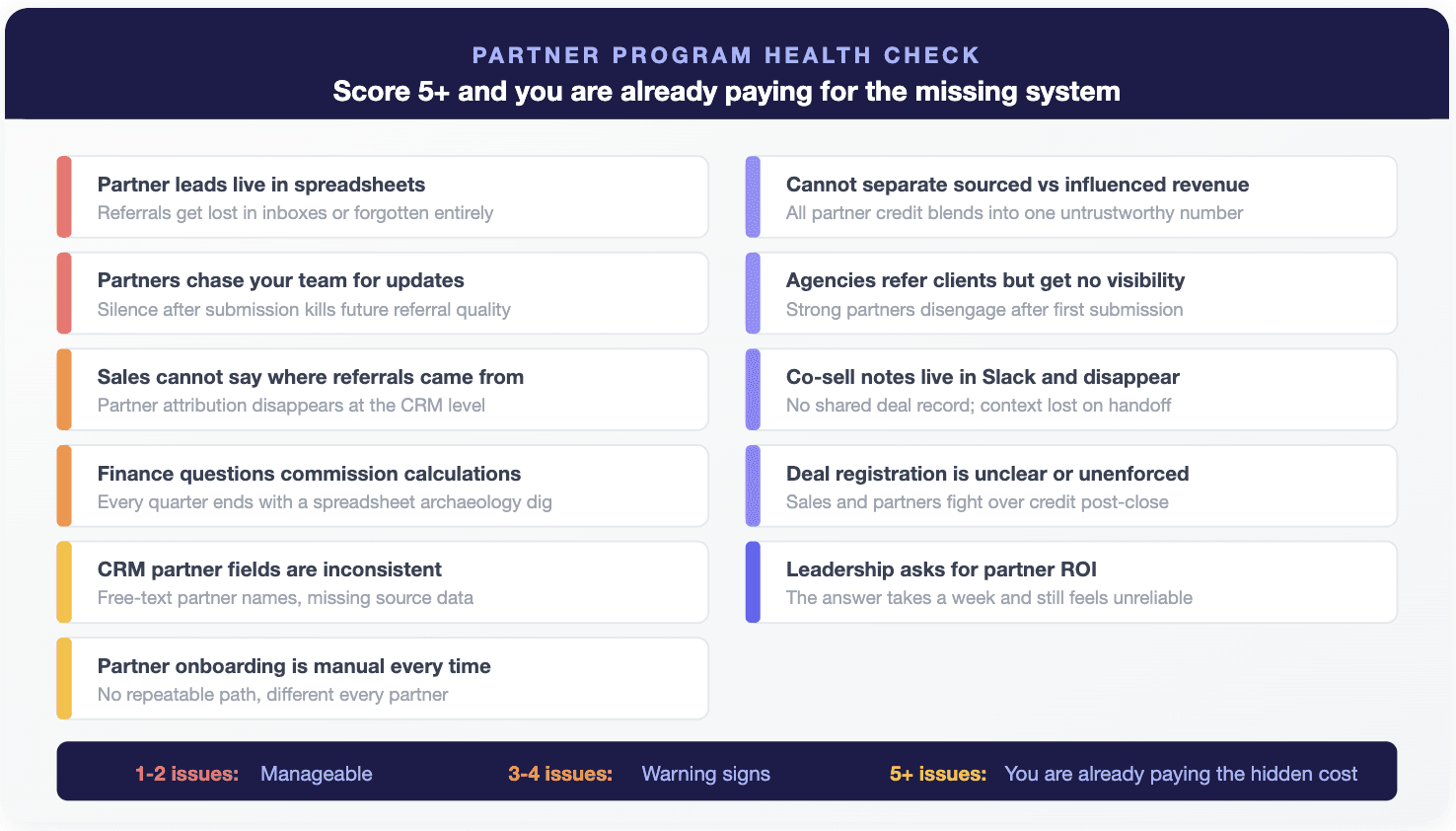
Run this diagnostic honestly. Five or more signals means the cost of not having a PRM is already embedded in your team's calendar and commission disputes
One or two of these are manageable. Five means you are already paying for the missing system through admin, confusion, slow follow-up, partner frustration, and weak reporting. The cost is real. It is just hidden across different teams' calendars.
What to Fix When Your Partner Program Breaks
Every partner program breaks somewhere. The difference between weak and strong teams is the speed of diagnosis. Here are the six most common failure modes and how to fix each one.
Partners Sign Up But Do Nothing
This is an activation problem, not a motivation problem. Fix it by giving every partner one clear first action, building a 7-day activation workflow, adding short certification, and giving partners a bad-fit guide. Stop celebrating partner count. A large inactive partner list is not a channel. It is a mailing list with ambition.
Sales Ignores Partner Leads
This is usually a trust or process problem, and sometimes sales is right. Bad referrals do not deserve special treatment. Fix it by adding partner source and owner fields in the CRM, setting an SLA for referral response, routing accepted leads automatically with context attached, and tracking response time by partner source in pipeline reviews.
Partners Complain About Lack of Updates
This is a feedback problem. Fix it by showing deal status in the partner portal, triggering updates at key stages, and running pipeline reviews for high-value partner relationships. Silence makes partners assume the worst — and assumption leads to churn.
Commission Disputes Keep Happening
This is a rules problem with money attached. A commission dispute is not admin. It is a trust problem. Fix it by defining eligibility, setting referral expiry windows, deciding what happens with duplicates and renewals, and linking payout to revenue received. Automated commission tracking removes the spreadsheet formulas where errors hide.
CRM Data Is a Mess
This is what happens when partnerships are bolted onto direct sales after the fact. Fix it by standardising partner fields, separating partner source from influence, using required fields for partner-submitted leads, and mapping PRM data into the CRM cleanly. Do not let partner reporting rely on quarter-end heroics.
The Partner Portal Is Dead
A portal dies when it is built around content instead of action. Fix it by putting the next best action on the homepage, showing lead and commission status above the fold, and removing stale assets. Partners do not log in because you sent them a password. They log in because the portal helps them win.
The Spreadsheet Is Not Cheaper
A spreadsheet feels cheap because the invoice is hidden. The cost shows up somewhere else, spread across ten different line items that nobody ever adds together.
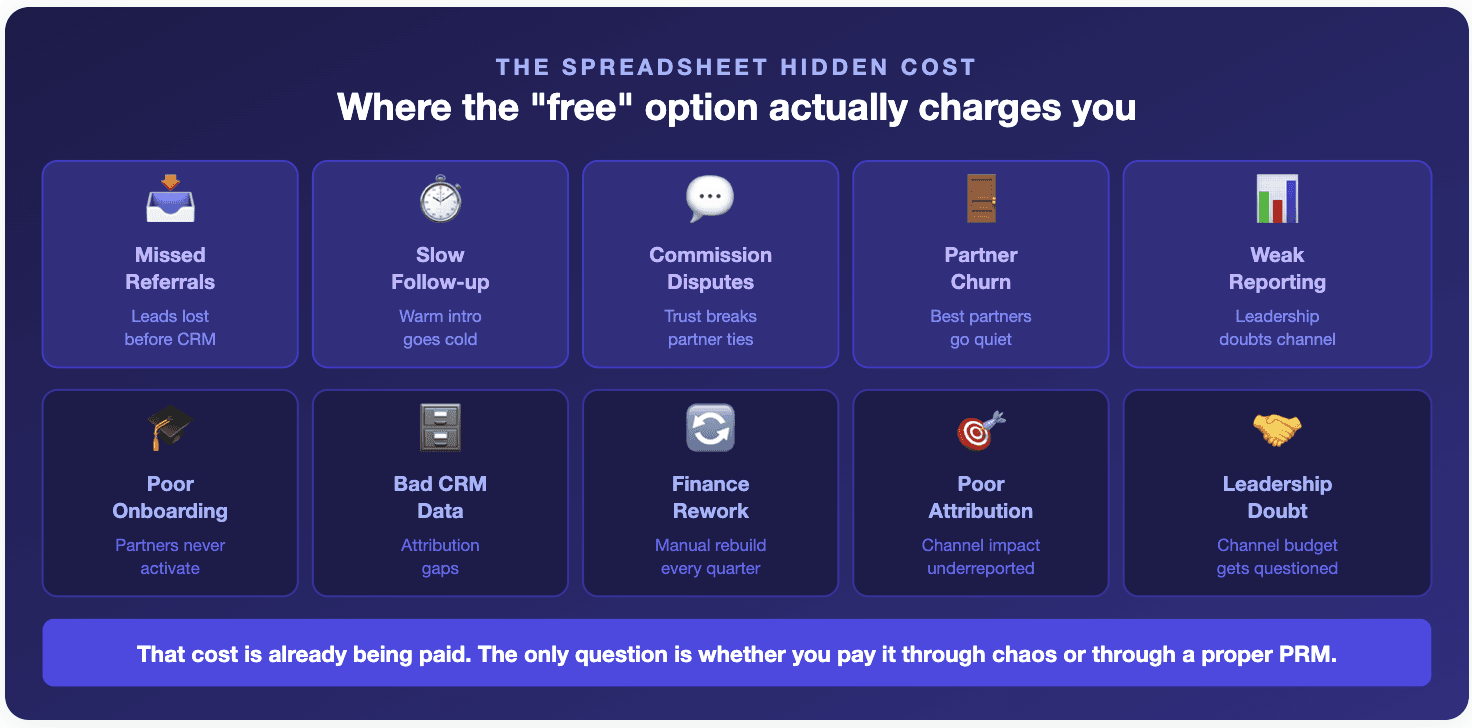
The spreadsheet invoices you invisibly across ten different line items. Add them up and the PRM pays for itself quickly.
That cost is already being paid. The only question is whether the program keeps paying it through chaos, or moves the work into a proper PRM.
The companies that win with partners are not the ones with the longest partner list. They are the ones partners trust, sales accept, finance can pay, and leadership can measure. Build that, and partner revenue stops being a side bet. It becomes a channel.
For further reading on building partner programs that produce consistent revenue, the Partner Leaders community is worth the time.
A Sharper PRM Setup Checklist Before You Go Live
Do not automate confusion. Before launching PRM software, make the operating model explicit.
Partner Types
Decide which motions are active now and which ones you can actually support. A half-built reseller program causes more damage than no reseller program at all. Pick the motions you can resource properly.
Deal Rules
Define what counts as a qualified referral, whether partners can register existing accounts, who accepts or rejects a lead, how long a referral is protected, and what happens when two partners submit the same company. If these answers are vague, the program will become political.
CRM Fields
Set up clean, boring fields: partner source, partner influence, partner name, partner owner, partner type, referral status, commission status, deal registration date, and partner notes. Boring fields produce useful reporting. Free-text fields produce arguments.
Commission Logic
Decide percentage vs fixed reward, one-time vs recurring, payment trigger, payout delay, refund policy, clawback policy, tier-based rewards, and currency handling. Never leave commission logic as "we'll sort it later." Later arrives angry.
Partner Onboarding
Build the minimum useful version: welcome sequence, ICP guide, bad-fit guide, pitch notes, objection handling, demo recording, certification, first referral prompt, and sales handoff process. Get the partner to the first valuable action.
Reporting Metrics That Actually Change Behaviour
Active and activated partners — these are different numbers
Leads submitted and leads accepted
Partner-sourced pipeline and partner-influenced pipeline
Closed-won partner revenue and average deal size by partner type
Conversion rate by partner type
Sales response time to partner referrals
Commission owed vs commission paid
Dormant partner count
Partner count is not a serious metric on its own. See how Partner.io's analytics dashboard surfaces the numbers that actually drive decisions and separates them from the vanity metrics that waste everyone's time.
The PRM Buying Questions That Actually Matter
Ignore bloated feature grids. Ask the questions that expose whether the system will work in practice.
Will Partners Use It?
If the partner experience is clunky, adoption dies. Partners need fast access, clear actions, lead visibility, useful training, and payout status. If they have to ask where everything is, the portal has already failed.
Will Sales Trust It?
Sales will not live in a PRM all day. The PRM has to feed the CRM cleanly and reduce rep admin. Salesforce and HubSpot integrations are not nice-to-haves — they are the adoption mechanism.
Will Finance Trust It?
If commission reporting looks hand-waved, finance will rebuild it in a spreadsheet. Once that happens, the PRM has lost authority. Automated, auditable payout data is not a feature. It is the credibility of the entire system.
Can It Handle More Than Referrals?
A referral-only tool can work early. It becomes limiting once agencies, integrations, co-sell partners, and resellers enter the program. Buy for the motion you are building next, not only the motion you have today.
Can It Launch Fast Enough to Matter?
Partnerships move through relationships, not implementation committees. You need enough structure to scale without trapping the team in a systems project that takes longer than your sales cycle. Partner.io is designed for that middle ground: serious partner operations without enterprise bloat.
The Blunt Truth About Partner-Led Growth
Partner-led growth is not "getting other people to sell for us." That is how weak programs think. Real partner-led growth is borrowed trust, turned into a repeatable revenue motion.
A buyer listens because the recommendation comes from someone already close to their problem — an agency, consultant, integration partner, reseller, customer, or trusted vendor. That trust is valuable. It is also fragile.
If the referral disappears into a black hole, trust drops. If sales mishandles the handoff, trust drops. If commission is unclear, trust drops. If the program feels like a side project, trust drops.
PRM software protects trust by making the work visible, repeatable, and fair. Partner.io gives SaaS teams the system to do that across referrals, agencies, co-sell, integrations, and resellers.
Ready to Turn Partner Activity Into Partner Revenue?
Partner.io gives SaaS teams the portal, deal registration, commission tracking, CRM integrations, and partner analytics to run a program partners trust and leadership can measure.
Try Partner.io Free for 14 Days