Product
Business Case Template: Build Clear, ROI-Driven Proposals | Assemble

The Business Case Template That Gets Decisions Made
Every organisation says it makes rational decisions. In reality, most decisions are shaped by whoever tells the clearest story.
Projects stall not because the idea is weak, but because the thinking behind it is scattered. Notes live in slide decks. Numbers sit in spreadsheets. Risks are mentioned verbally and forgotten. By the time leadership is asked to approve funding, they are reacting to fragments, not a complete picture.
A strong business case fixes that. Not by adding more content, but by giving your thinking a structure that decision makers can actually trust.
This is where a well designed business case template earns its keep.
Why business cases fail in practice
Most business cases fail in one of three ways.
They focus too heavily on the solution and not enough on the problem. They drown readers in detail without anchoring to strategy. Or they skip the hard parts, like trade offs, risks, and real costs, in the hope that enthusiasm will carry the decision.
None of those approaches scale. As organisations grow, intuition stops being enough. Leaders need to see alignment, impact, and consequences in one place, laid out clearly.
A good template forces that discipline. It does not let you skip steps. It makes gaps obvious. It turns fuzzy thinking into something inspectable.
A template that mirrors how decisions are actually made
The most effective business cases follow a natural flow. They answer the questions leaders are already asking, in the order they tend to ask them.
What is this, and why should I care?
How does it connect to where we are trying to go?
What happens if we do nothing?
What are we proposing instead?
What do we gain, and what does it cost?
What could go wrong?
What decision are you asking me to make?
A strong business case template maps directly to that mental checklist.
Below is a practical structure that does exactly that, and works whether you are pitching a new initiative, requesting budget, or just trying to bring clarity to a complex decision.
1. Project overview
This section is not a formality. It sets the tone.
A clear initiative name, ownership, and date give the document context. The summary statement does the real work. In a few sentences, it should explain what the initiative is, why it matters now, and the core problem it solves.
If someone only reads this section, they should still understand the essence of the proposal.
Templates help here by limiting space. When you only have a small area to write, vague language has nowhere to hide.
2. Strategic alignment
This is where many proposals quietly fall apart.
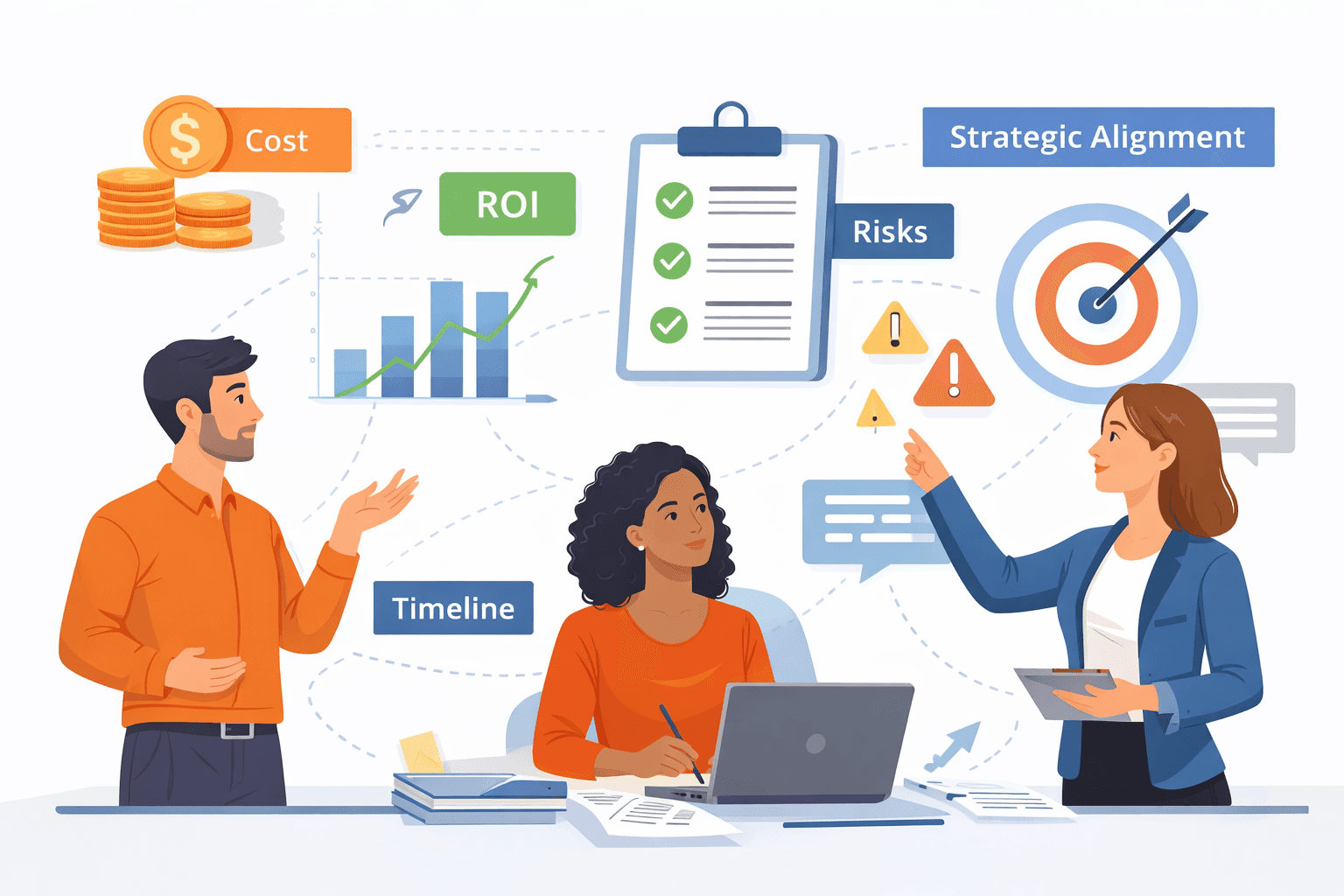
Linking an initiative to company objectives and OKRs is not about box-ticking. It is about showing that this work moves the organisation forward, not sideways.
A good template asks uncomfortable but necessary questions. Which objectives does this support? What outcomes does it move? Why now, not later?
Writing this down often reveals misalignment early, before time and credibility are spent chasing approval.
3. Problem statement
Great business cases are grounded in reality.
This section describes the current pain point in plain language. What is broken, slow, risky, or holding progress back? What happens if nothing changes?
Be specific. Name the impact on revenue, costs, customers, or teams. Identify who feels the pain most.
A template keeps this grounded by separating the problem from the solution. That separation matters more than it seems. When teams jump straight to solutions, they often solve the wrong thing very well.

4. Proposed solution
Only now does the solution earn its place.
This section outlines the high-level approach, what is in scope, what is out, and what alternatives were considered. Including alternatives is a subtle signal of maturity. It shows the decision was not pre-baked.
A strong template encourages clarity without over-engineering. You are not writing an implementation plan here. You are describing the shape of the answer, not every step.
5. Benefits and ROI
This is where credibility is won or lost.
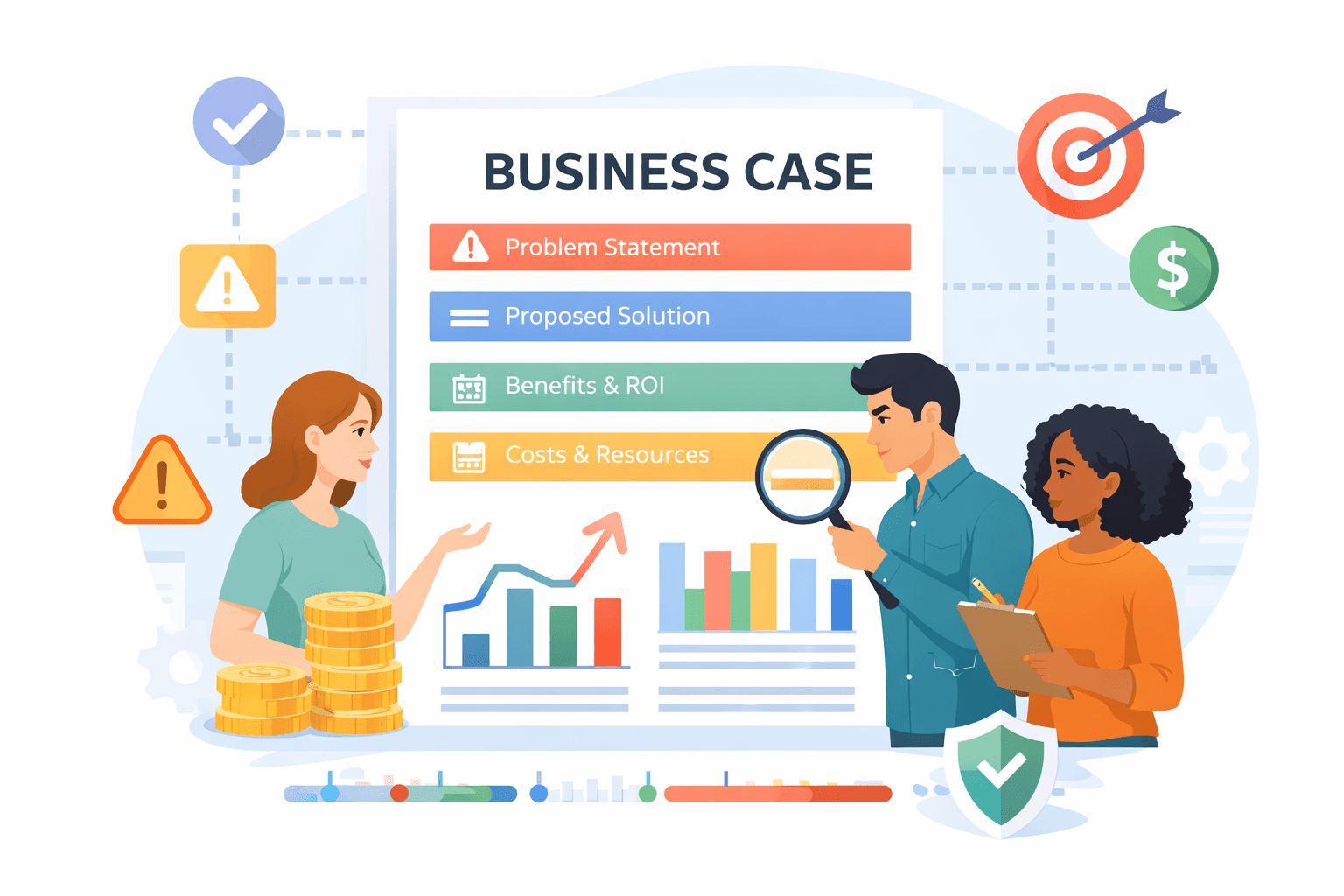
Breaking benefits into clear areas, such as revenue growth, cost savings, efficiency gains, risk mitigation, and customer value, makes trade-offs visible. Estimating impact, even roughly, is better than avoiding numbers entirely.
Templates that include simple tables for benefits and ROI force realism. If an initiative cannot articulate its upside, it should not expect investment.
6. Costs and resources required
Hidden costs kill trust.
This section surfaces headcount, tools, vendors, go to market spend, and anything else required to make the initiative real. Notes matter here. Context matters.
A template helps teams think beyond the obvious line items. It reminds them that delivery has a shape, and that shape has a price.
7. Timeline and milestones
Decision makers are not just buying an idea. They are buying a plan.
Laying out key phases, target dates, ownership, and review points makes progress tangible. It also creates natural moments for reassessment.
Good templates keep timelines high level. They show momentum without pretending that everything is known upfront.
8. Risks and mitigations
Avoiding risk does not reduce it. Naming it does.
This section builds confidence by showing that downsides have been considered. Listing likelihood, impact, and mitigation strategies signals seriousness and experience.
Teams that skip this often do so out of fear. Templates remove that fear by normalising the conversation.
9. Recommendation and ask
End with clarity.
State the funding required, resources needed, and the exact decision being requested. Ambiguity here undermines everything that came before.
A strong template makes the ask explicit. It respects the reader’s time and authority.
Why this works better in Assemble
What turns this from a useful outline into a repeatable system is how it is built and shared.
In Assemble, a business case is not a static document. It is a living template. Teams can reuse it, adapt it, and improve it over time. Context stays attached. Decisions stay visible. Assumptions can be revisited months later, not lost in email threads.
Templates stop being paperwork and start becoming infrastructure.
If you want fewer opinion-driven debates and more confident decisions, start with the structure your thinking lives in.
Explore the Business Case template in Assemble and see how much easier good decisions become when the work behind them is clear.